

Vince's proposed map combines the disputed Walam Olum, published by Rafinesque in 1836, with three stones attributed to Burroughs Cave. The video argues that the stones depict Great Lakes copper mines and that a circle-and-cross matches a Copper Harbor petroglyph. The cave identification and the document's authenticity remain disputed. 🗺️
Video argues disputed Burroughs Cave stones trace Great Lakes copper routes
 ScotlandArtifact
Key facts
- The video identifies the Walam Olum, also spelled Wallam Olum, as a purported Lenape migration record first recorded under Constantine Rafinesque around 1820. Rafinesque published it in 1836, and its authenticity has been disputed since publication.
- On Vince's map, routes attributed to the Walam Olum run through the Great Lakes, down the Mississippi via Indiana to Ohio, and toward the Delaware and Hudson rivers and the Iroquois Confederacy. The video also cites Brinton's St. Lawrence route and Morgan's continental-mark model.
- The video proposes a timeline of undated traditions, 350 BC–400 AD ceremonial earthworks, 1400–1650 stockades and copper plates at European contact, 1630–1800 documented westward migration and 1800–1900 removals in the printed record.
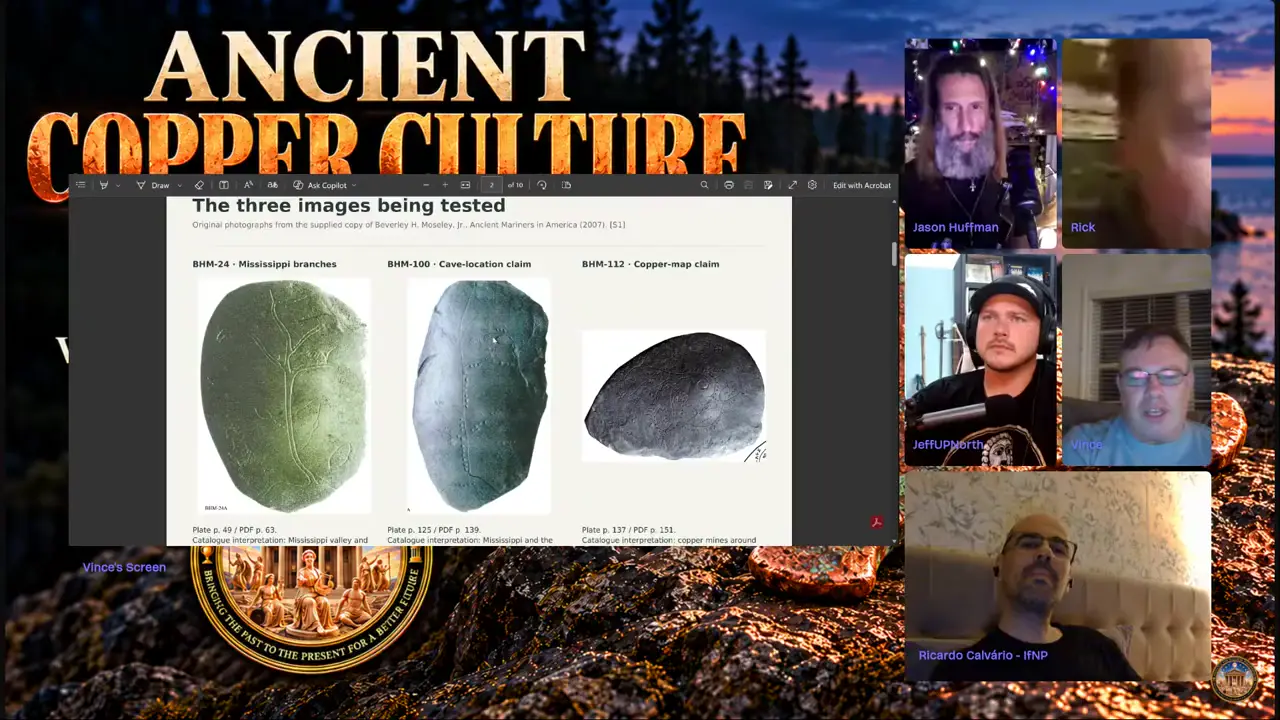
- According to the video, Beverly Mosley tested three stones attributed to Burroughs Cave and discussed them in Ancient Mysteries of America in 2007. Vince interprets them as showing the Great Lakes, copper mines, the Keweenaw Peninsula and several major rivers.
- The video interprets the dots on the stones as days of travel along the rivers.
- Rick says roughly 15–18 such stones are known and that most bear a northern snake-clan symbol and a southern 'mystic' symbol, which he interprets as a division between two trading groups.
- The video notes that the reported Escanaba River cave site is in an area with no natural caves and that the cave identification and stones' attribution are disputed.
- The video compares a circle-and-cross petroglyph at Copper Harbor with symbols on the stones; it says a second purported example is eroded and lichen-covered.
Sources
Walam Olumen.wikipedia.org
The document has provoked controversy as to its authenticity since its publication in the 1830s by botanist and antiquarian Constantine Samuel Rafinesque.
THE WALAM OLUMjournals.psu.edu
Rafinesque, in his American Nations (Phila., 1836), published his translations of the now famous Delaware (Lenape) Indian. Walam Olum, believed by some students ...
Walam olum; or, Red score, the migration legend of ...archive.org
Introduction.--Walam olum: Pictographs and Lenape text, after C. Rafinesque. Translation, by C.F. Voegelin. Interpretation of the ...
Walam Olumgenesisapologetics.com
He gave his doctor the 183-glyph Walam Olum. His doctor, in turn, gave the wooden tablets to a friend, Constantine Samuel Rafinesque, a professor at ...
Hoaxes, Fakes, and Strange Sites - Walam Olum Hokumarchive.archaeology.org
Scholars saw the Walam Olum as evidence corroborating an Asian origin for Native Americans, as Rafinesque maintained. There were some doubts about the Walum ...
Was this story useful?
Keep exploring
Every site on this page sits on the globe, and the people who research them are on the Discord.
3D Globe · Sites by country · Story Archive · Research Library · Weekly Journal · Search
AI-generated text · images from the original sources · always verify with the sources.