

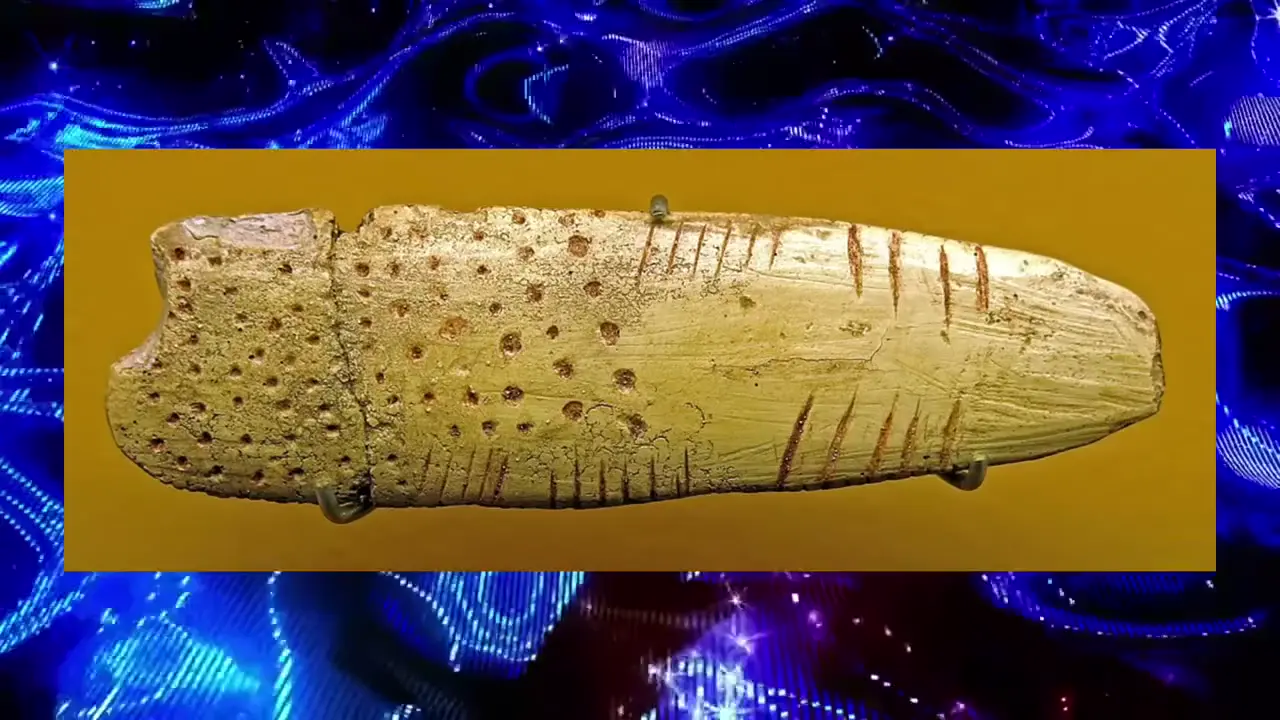
This engraved bone fragment from Abri Blanchard in France, near Abri Lartet, dates to roughly 35,000–40,000 years ago. In NASA-supported work in 1972, Alexander Marshack interpreted its geometric patterns and notched edges as a lunar-cycle notation, with some phases absent and the layout functioning as a coordinate system. The video argues that this was evidence of early lunar observation. The object is an early example of geometric notation in the European Paleolithic, but its identification as a lunar calendar remains an interpretation.
Video Argues Abri Blanchard Bone Shows Lunar Phases
Site mentioned
📍 Abri Blanchard🌍 Show on the globe
Key facts
- The object is an engraved bone fragment, not an antler plaque.
- It was recovered at the Abri Blanchard rock shelter in France, near Abri Lartet, and dates to roughly 35,000–40,000 years ago.
- Alexander Marshack studied it in NASA-supported work in 1972.
- The video presents Marshack's interpretation of the marks as lunar phases, with some phases absent, and as a coordinate system; the lunar-calendar reading is not established fact.
- The artifact is an early Upper Paleolithic example of geometric notation in Europe.
Sources
Marking Time | Daniel Rosenberg - Cabinet Magazinecabinetmagazine.org
Rock art theories IX - Bradshaw Foundationbradshawfoundation.com
Ancient humans used the moon as a calendar in the skysciencenews.org
Abri Blanchard Calendar: The Mooncavescript.org
File:Lunar calendar Blanchard MAN ArtsEtPrehistoire.jpgcommons.wikimedia.org
Was this story useful?
Keep exploring
Every site on this page sits on the globe, and the people who research them are on the Discord.
3D Globe · Sites by country · Story Archive · Research Library · Weekly Journal · Search
AI-generated text · images from the original sources · always verify with the sources.