

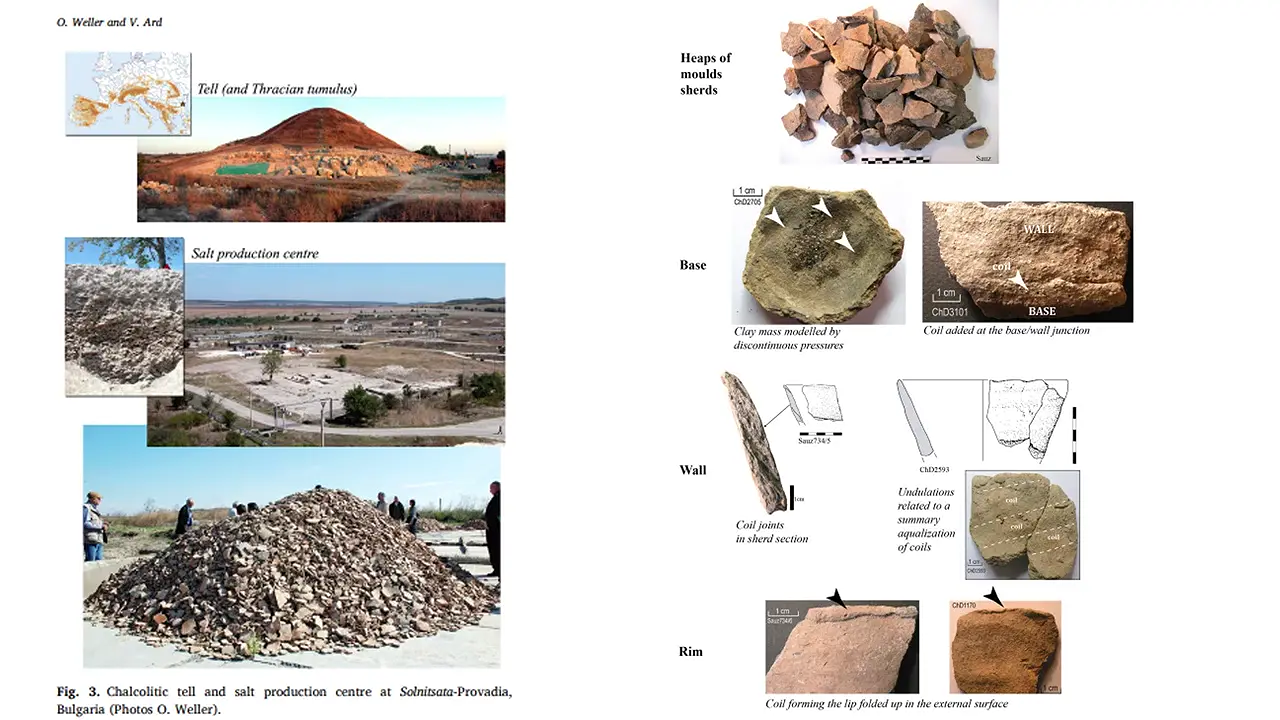
Oliver Weller and Vincent Ard's study of Solnitsata salt ceramics found crushed pottery mixed into the clay, specially made vessel bases for very large containers, and elevated chlorine levels compared with ordinary domestic wares. One pit held debris from roughly 600–1,100 vessels. Bases even preserve impressions of woven plant-fiber mats, letting Mila Andonova and Nikolov reconstruct a layered manufacturing process. Ceramics as evidence. 🔬🏺
Solnitsata salt vessels: crushed pottery temper, elevated chlorine, mat impressions
Site mentioned
📍 Solnitsata
Key facts
- A study by Oliver Weller and Vincent Ard found crushed pottery mixed into the clay of salt-production ceramics, plus carefully constructed vessel bases made by a different manufacturing technique suited to very large containers
- One production pit contained debris from around 600 to 1,100 vessels
- Chemical analysis showed elevated chlorine concentrations in salt-production ceramics relative to ordinary domestic wares, indicating vessels made specifically for the large evaporation pits
- Vessel bases preserve impressions of woven plant-fiber mats whose original fibers dissolved but whose pattern hardened in the fired clay
- Mila Andonova and Nikolov used these mat impressions to reconstruct the manufacturing process, suggesting the vessels were wrapped in fiber mats, with many different materials involved in producing a single pot
Sources
The prehistoric salt-production and urban center of Provadia-Solnitsata, ...journals.openedition.org
Prehistoric salt production: Technological approach in ceramic ...sciencedirect.com
Provadia-Solnitsataprovadia-solnitsata.com
Solnitsataen.wikipedia.org
Was this story useful?
Keep exploring
Every site on this page sits on the globe, and the people who research them are on the Discord.
3D Globe · Sites by country · Story Archive · Research Library · Weekly Journal · Search
AI-generated text · images from the original sources · always verify with the sources.