

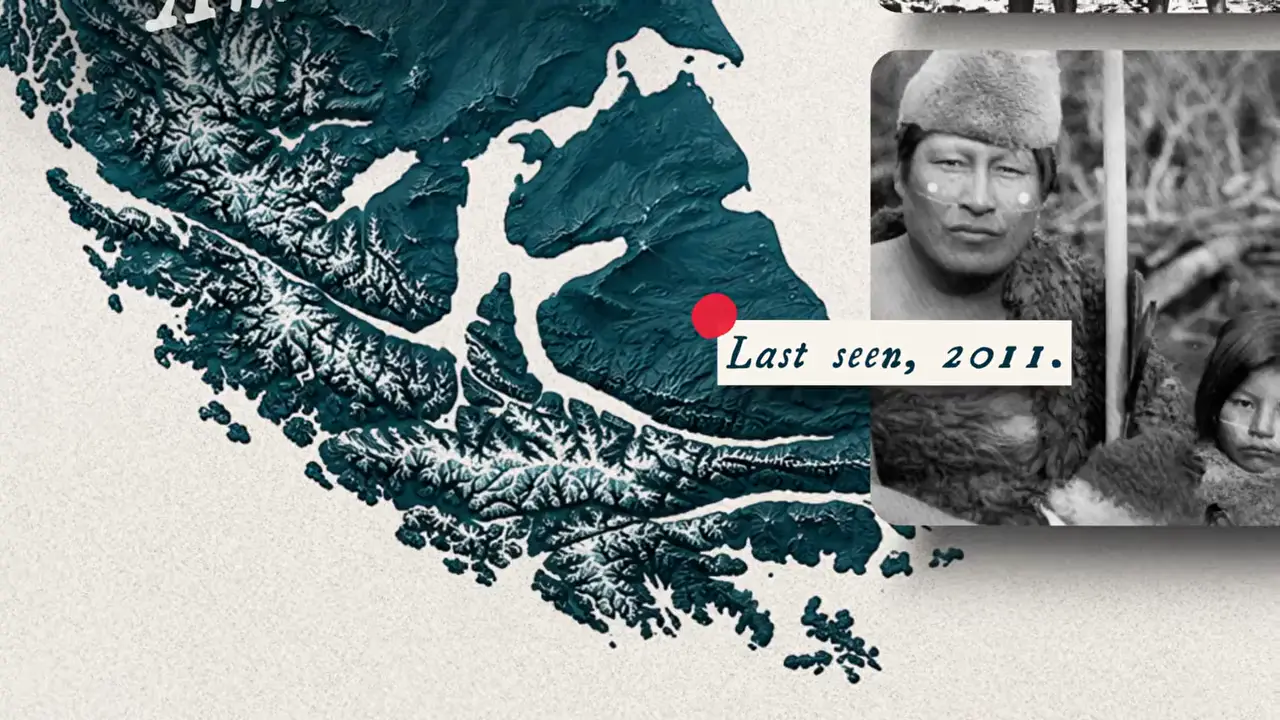
Between roughly 3,000 and 4,000 Selk'nam, possibly up to 10,000, once hunted the guanaco across Tierra del Fuego's northern grasslands before 1800. After gold prospectors arrived in the 1880s, ranch owners paid bounty hunters per killing and demanded ears, hands or feet as proof; poisoned whale carcasses on beaches killed whole families. A German-born priest and ethnographer visited four times between 1918 and 1924 and was allowed to witness and photograph the Hain initiation — around 1923, the last traditional performance ever recorded. Men painted head to toe in red, white and black stripes and wore cone-shaped bark masks. 🌿🪶
Selk'nam Hain initiation photographed around 1923, last traditional performance
Key facts
- Tierra del Fuego was named in 1520 when Ferdinand Magellan sailed through the strait and his crew saw the smoke and glow of fires along the shore, made by the Selk'nam.
- The Selk'nam were nomadic hunters of the northern grasslands whose world revolved around the guanaco, a wild relative of the llama, which supplied food, clothing and shelter.
- They wore little clothing, mainly cloaks of thick guanaco fur, and rubbed their bodies with grease and clay against the wind; European sailors described them as very tall, and Magellan claimed to have met giants.
- Before the 1800s an estimated 3,000-4,000, possibly up to 10,000 Selk'nam lived in the area, far from the Bering land bridge their ancestors crossed 13,000-plus years ago.
- In the 1880s prospectors poured into the island after gold was found in its rivers; a Romanian engineer led an armed expedition, and one period photograph shows his men posing with rifles over a dead Selk'nam man.
- Chilean and Argentine governments granted huge tracts to a handful of investors who built large sheep ranches on Selk'nam hunting land; the natives called sheep "white guanacos" and hunted them.
- Some ranch owners paid bounty hunters per killing and demanded body parts as proof, such as ears, hands, fingers, toes, feet or heads; accounts describe poisoned whale carcasses left on beaches that killed whole families.
- Catholic missions, including one on Dawson Island in Chile, brought people forcibly to live in crowded conditions in unfamiliar clothing and diet, with deaths from tuberculosis, measles and other disease.
- In 1889 a group of Selk'nam was kidnapped and shipped to Europe, exhibited in a cage at the Paris World's Fair and advertised as "cannibals"; several died on the tour.
- Within about 30 years the population fell from several thousand to a few hundred.
- A German-born priest and ethnographer visited Tierra del Fuego four times between 1918 and 1924, lived among the survivors, and was allowed to witness and photograph the Hain, the long initiation rite in which young men were taught the secrets of adulthood.
- During the Hain men painted their bodies head to toe in red, white and black stripes, dots and bands and wore cone-shaped bark and hide masks, each spirit mask having its own design.
- The Hain photographs were taken around 1923 and represent the last traditional performance ever recorded; in the 1960s and 70s an American-French anthropologist recorded the songs and memories of the last elders, who spoke the language and knew the rites.
Sources
Tierra del Fuego - Studentskids.britannica.com
Introducing Tierra del Fuego, aka 'The End of the World'saexpeditions.com
Tierra del Fuegonewworldencyclopedia.org
Tierra del Fuegoen.wikipedia.org
Was this story useful?
Keep exploring
Every site on this page sits on the globe, and the people who research them are on the Discord.
3D Globe · Sites by country · Story Archive · Research Library · Weekly Journal · Search
AI-generated text · images from the original sources · always verify with the sources.