

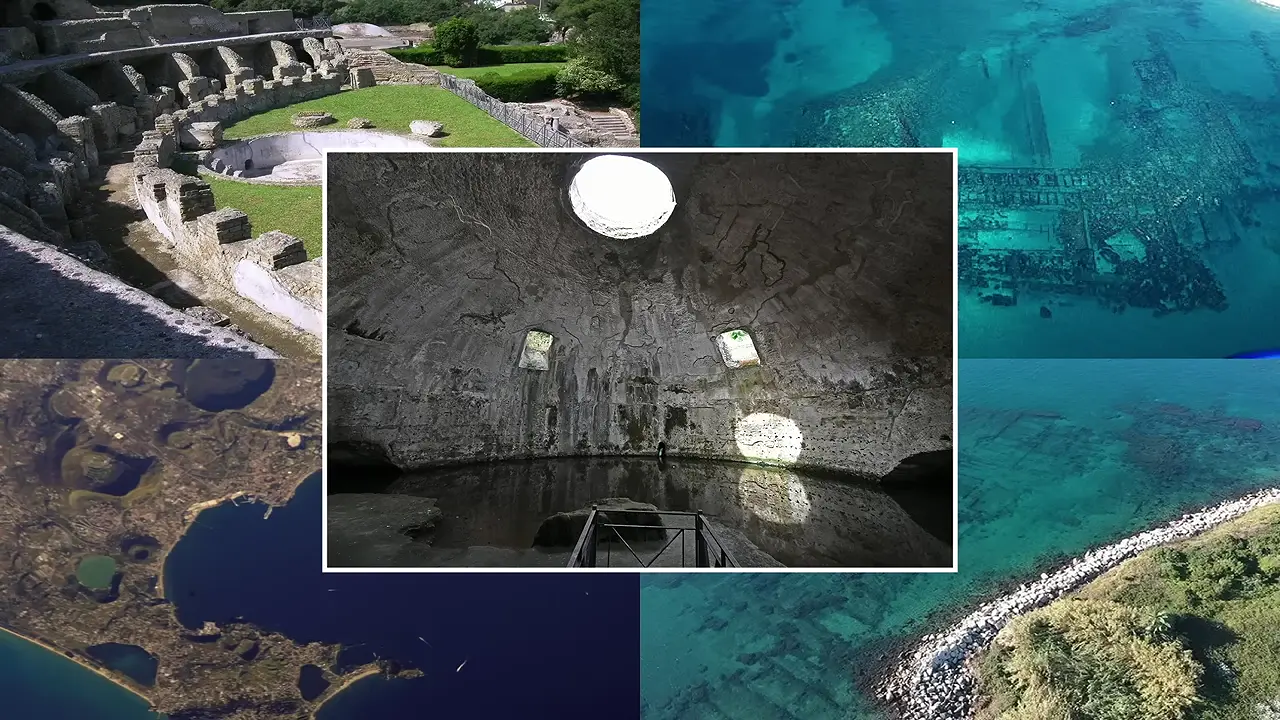
Roman concrete mixed water, lime, volcanic pozzolana sand, and aggregate. Architect Vitruvius documented how it even hardened underwater. Romans developed it around 200-250 BC, and Baiae holds one of the oldest surviving concrete domes. The Pantheon itself reduced dome weight by using progressively lighter aggregate—pumice near the top—with coffered panels decorating the interior surface.
Roman concrete composition and earliest surviving structures
Key facts
- Roman concrete was composed of water, lime, pozzolana (a volcanic sand), and aggregate (gravel, stone fragments, or rubble).
- Pozzolana deposits were concentrated in the volcanic landscape of Italy, especially around the Bay of Naples region.
- The architect Vitruvius documented pozzolana's properties, noting that the substance hardened underwater when mixed with lime and rubble.
- Vitruvius's writings survived into the medieval period through monks copying them by hand.
- Volcanic sands other than Italian pozzolana were also used, including those around the island of Santorini.
- Romans developed concrete around 200–250 BC, and by about 150 BC they were using it in construction.
- The Mediterranean town of Baiae features the oldest surviving concrete dome, built approximately 200 years before the Pantheon.
- The harbor complex known as the Portus was constructed first by Claudius and later expanded by Trajan.
- The Pantheon dome was constructed with lighter weight by embedding empty vessels into the concrete as coffering to reduce density.
- Roman concrete was placed by hand and tamped down rather than poured or pumped.
Sources
Roman concrete - Wikipediaen.wikipedia.org
... cement. The high silica composition of Roman pozzolana cements is very close to that of modern cement to which blast furnace slag, fly ash, or silica fume ...
What Is Roman Concrete? The Secrets Behind Its Durabilitybarrowmixconcrete.com
Roman concrete, made from lime, volcanic ash, and seawater, is famous for its strength and durability in ancient buildings. Its unique mix ...
Roman Concrete - Ancient Engineering Technologiesancientengrtech.wisc.edu
The Ancient Roman's concrete consisted of a mix of volcanic ash or also known as Pozzolana, lime, and water to make a mortar [13]. The mortar was then mixed ...
Pozzolana | Definition, Description, History, Composition, & Factsbritannica.com
Roman engineers used two parts by weight of pozzolan mixed with one part of lime to give strength to mortar and concrete in bridges and other masonry and ...
Roman Concrete: An analysis of Its Strength and Composition - ADSui.adsabs.harvard.edu
Though Vitruvius specifies that concrete intended for land-based structures (such as buildings or roads) was made from a 3:1 ratio of pozzolana ash and lime, he ...
Was this story useful?
Keep exploring
Every site on this page sits on the globe, and the people who research them are on the Discord.
3D Globe · Sites by country · Story Archive · Research Library · Weekly Journal · Search
AI-generated text · images from the original sources · always verify with the sources.