

Coulson's 2011 paper dropped the 70,000-year claim. The cave shows Middle Stone Age occupation with rock outcrop modification—conservative conclusions this time. Tsodilo Hills is the only outcrop for over 100 km, with freshwater springs. Spearheads appear purposefully burnt and damaged, possibly ritual destruction. Specific dating remains uncertain. ⛏️
Revised Interpretation: Middle Stone Age Occupation Without Definitive Dating
 BotswanaGeneral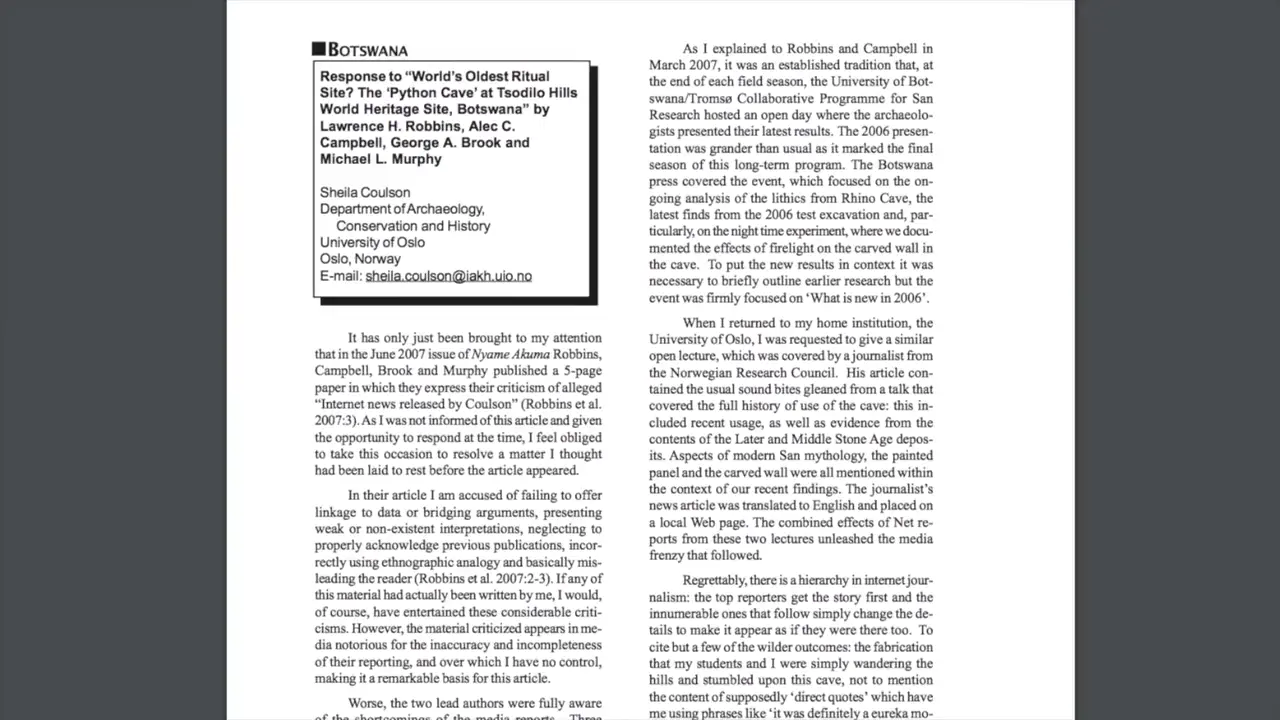
Site mentioned
Key facts
- Coulson clarified that 2006 media stories were misleading journalism, not from her papers
- In 2011, Coulson published a thorough paper with conservative conclusions
- The 70,000-year-old ritual site claim was dropped in the revised publication
- The cave was occupied during the Middle Stone Age with evidence of rock outcrop modification
- Tsodilo Hills is the only outcrop for over 100 km in any direction, containing freshwater springs
- Middle Stone Age spearheads of many colors are found in abundance and appear purposefully burnt and damaged
- Quartzite fragments from the snake rock were found among Middle Stone Age artifacts
- Specific dating of the artifacts remains uncertain - they could be 70,000 years old or far younger
- The cave was occupied sometime before 25,000 years ago and continued as a focal point for many centuries
Sources
The Emergence of Habitual Ochre Use in Africa and its Significance ...researchgate.net
An engraved bone fragment from c. 70,000-year-old Middle Stone ... Middle Stone Age at Blombos Cave, South Africa: Implications for the origins of.
(PDF) Examining the distribution of Middle Paleolithic Nubian cores ...researchgate.net
We tested this prediction by collecting 124 chert samples from 22 outcrops and then quantitatively assessed two geochemical variables that are ...
Words.lab - Johns Hopkins Computer Sciencecs.jhu.edu
... occupation 381 attorney 382 age 383 71 384 74 385 birth 386 Opelika 387 Ala 388 lived 389 together 390 man 391 more 392 than 393 year 394 home 395 637 396 E ...
[PDF] Field Manual for African Archaeologyafricamuseum.be
... Stone Age sites. R. Vogelsang. 104. Village sites. H.-P. Wotzka. 109. The pit: archaeological excavation and analysis. A. Assoko Ndong. 116. Excavating in urban ...
[PDF] Ritualized Behavior in the Middle Stone Age: Evidence from Rhino ...paleoanthro.org
Rhino Cave, located at the World Heritage site of Tsodilo Hills, is one of the three main Middle Stone Age (MSA) sites in Botswana. Initial investigations ...
Was this story useful?
Keep exploring
Every site on this page sits on the globe, and the people who research them are on the Discord.
3D Globe · Sites by country · Story Archive · Research Library · Weekly Journal · Search
AI-generated text · images from the original sources · always verify with the sources.