

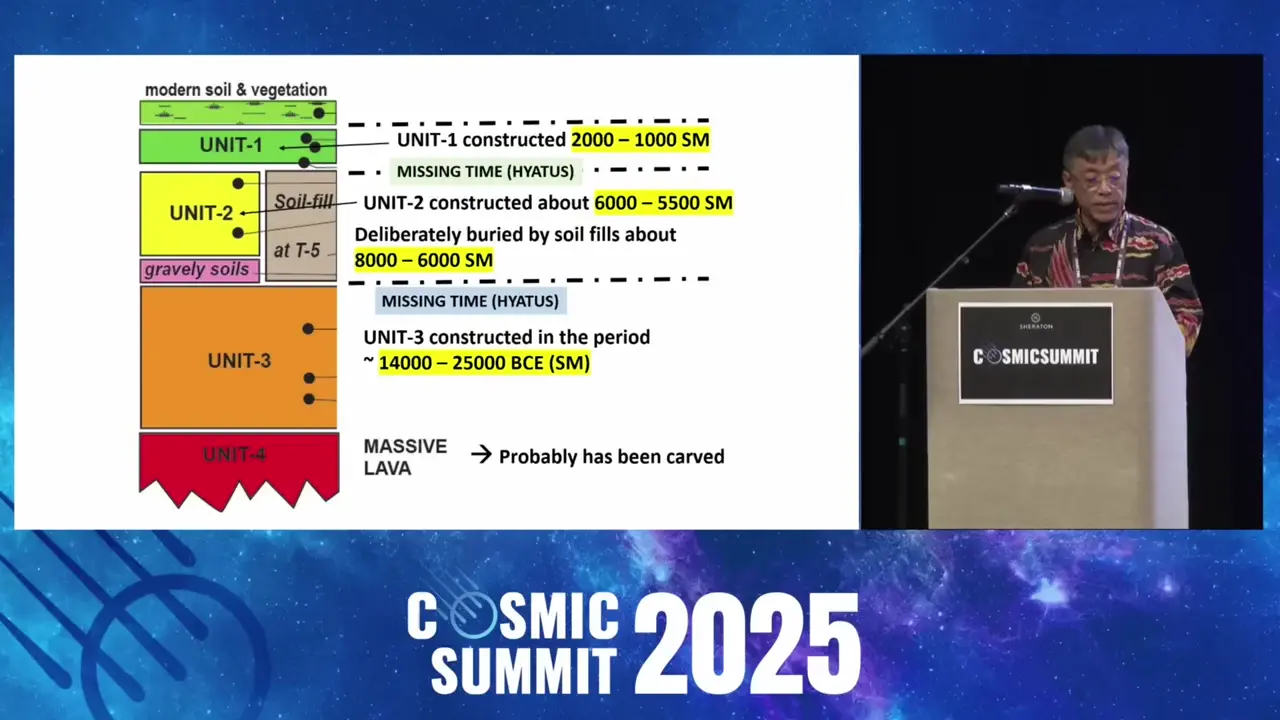
A now-retracted 2024 Archaeological Prospection paper used ground-penetrating radar, electrical-resistivity tomography, seismic tomography and seven cores drilled 15–35 metres deep to map four units at Gunung Padang in West Java, Indonesia. From radiocarbon-dated organic sediments associated with the layers, the authors inferred ages of 16,000–27,000 years for Unit 3, 7,500–8,500 years for Unit 2 and 3,500–4,000 years for Unit 1. They interpreted Unit 2 as the pyramid's bulk, Unit 1 as a retaining wall and Unit 4, at roughly 20–30 metres, as natural basaltic-andesite bedrock. Earlier excavations also found aligned stones and inter-stone fill that the authors interpreted as mortar. The journal retracted the paper in 2024 over concerns about its dating data and stratigraphic context. The 16,000–27,000-year construction claim and the pyramid interpretation therefore remain disputed, not established.
Retracted study claimed 16,000–27,000-year-old phase at Gunung Padang
 IndonesiaTheory
Key facts
- The 2024 Archaeological Prospection paper inferred an age of 16,000–27,000 calibrated years ago for Unit 3, 7,500–8,500 years for Unit 2 and 3,500–4,000 years for Unit 1; these were disputed study estimates, not established construction dates.
- The chronology was inferred from radiocarbon dates of organic material in sediments associated with the layers, rather than from direct dating of the stone construction.
- The authors interpreted Unit 2 as the bulk of the pyramid-shaped structure and Unit 1 as a near-surface retaining wall.
- The paper identified Unit 4, encountered at roughly 20–30 metres, as natural basaltic-andesite bedrock.
- The reported methods were ground-penetrating radar, electrical-resistivity tomography, seismic tomography and seven drill cores between 15 and 35 metres deep.
- Earlier excavation reports described aligned stones and mineral-filled gaps that the authors identified by XRD as hydrothermally altered volcanic material and interpreted as mortar.
- The journal retracted the paper in 2024 following concerns about the reliability and stratigraphic context of its dating evidence, leaving both the construction chronology and pyramid interpretation disputed.
Sources
(PDF) Geo‐archaeological prospecting of Gunung Padang buried ...researchgate.net
Notably, a high‐resistive anomaly in electric resistivity tomography aligns with a low‐velocity anomaly detected in seismic tomography, indicating the existence ...
RETRACTED: Geo‑archaeological prospecting of Gunung Padang ...ui.adsabs.harvard.edu
Notably, a high‑resistive anomaly in electric resistivity tomography aligns with a low‑velocity anomaly detected in seismic tomography, indicating the ...
A Controversial Paper on an Alleged 'Prehistoric Pyramid' in ...news.artnet.com
The paper claiming the Gunung Padang megalithic site in Indonesia was built as a pyramid has been retracted by Archaological Prospection.
Gunung Padang: Re-reading an Ancient Site Between Science and ...chem.ui.ac.id
For more than a decade, Gunung Padang has become the longest-running scientific debate in the history of Indonesian archaeology—whether it is ...
'Really, really weak': experts attack claim that Indonesia site is ...theguardian.com
Sensational report that Indonesia's Gunung Padang site is 25,000 years old is dismissed by archaeologists around the world.
Gunung Padangen.wikipedia.org
Gunung Padang is an archaeological site located in Karyamukti, West Java, Indonesia, 50 kilometres (31 mi) southwest of Cianjur. Located at 885 metres ...
Gunung Padang Could be the Oldest Pyramid in the Worlddiscovermagazine.com
Latest research says the deepest layers of Gunung Padang are 16,000 years to 27,000 years old. That would make Gunung Padang the oldest pyramid ...
Features - Java's Megalithic Mountainarchaeology.org
Excavations carried out by the National Archaeology Research Institute in the 1980s exposed the monument's basic layout.
Was this story useful?
Keep exploring
Every site on this page sits on the globe, and the people who research them are on the Discord.
3D Globe · Sites by country · Story Archive · Research Library · Weekly Journal · Search
AI-generated text · images from the original sources · always verify with the sources.