

A new study led by Palmira Saladié and Antonio Rodríguez-Hidalgo, with original excavator Miguel C. Botella, has revisited three Granada caves once considered textbook examples of Neolithic cannibalism. Their combined radiocarbon dating and taphonomic analysis reveals varied scenarios across Malalmuerzo, Carigüela, and Majolicas, from collective violence to ceremonial handling of remains! 🦴
Restudy of three Spanish caves shows varied Neolithic cannibalism episodes
Key facts
- Three caves in the Granada region of southern Spain (Carigüela, Malalmuerzo, and Majolicas) were excavated in the 1970s and have been textbook examples of Neolithic cannibalism for 50 years
- Original excavations yielded close to 1,000 human bones with cut marks, fractures, burns, and human bite marks
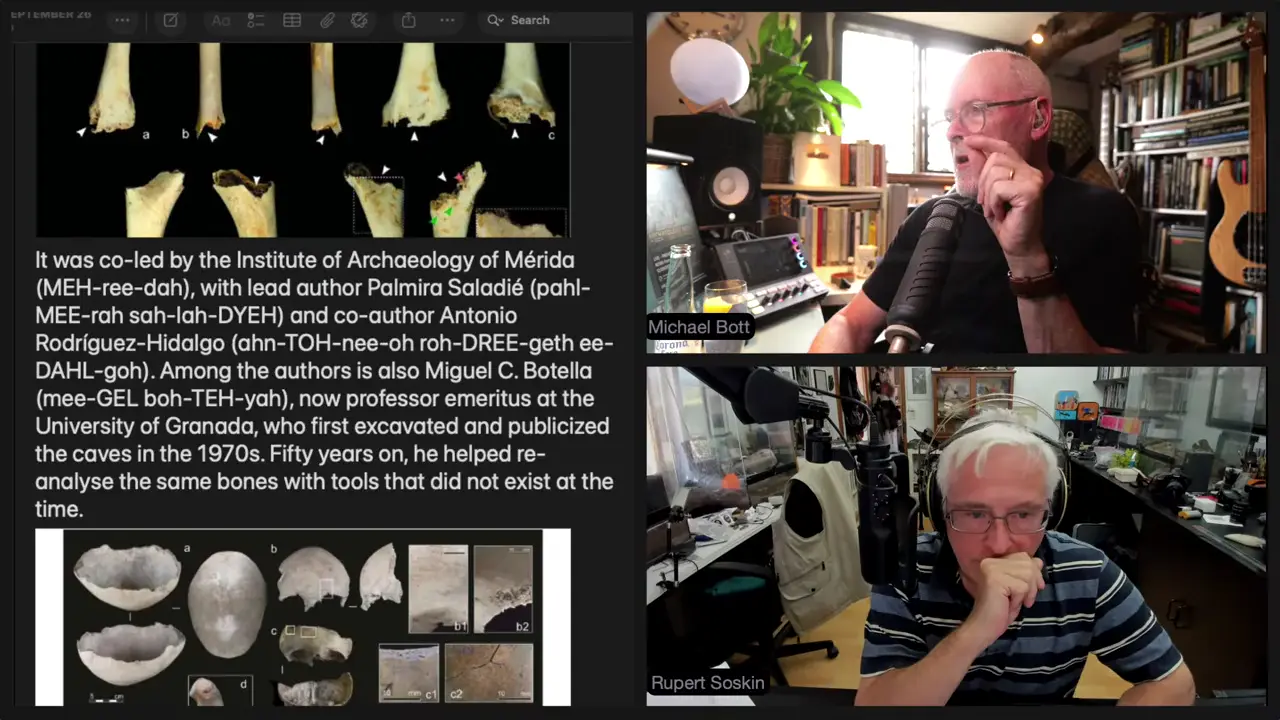
- New study published in the Journal of Archaeological Science combined direct radiocarbon dating with detailed taphonomic analysis to separate deliberate human action from scavenger damage and natural decay
- Co-led by Palmira Saladié (Institute of Archaeology of Mérida) and Antonio Rodríguez-Hidalgo, with Miguel C. Botella (professor emeritus at University of Granada), who first excavated the caves in the 1970s
- At Malalmuerzo around 5,000 BC: 714 bone fragments representing a minimum of 36 people of all ages; fractures consistent with trauma at or near time of death; interpretation is collective violence, a single brutal event
- At Carigüela: multiple separate episodes spread across different Neolithic phases, including two human skulls deliberately shaped into cups (skull cups), possibly linked to trophy-taking with parallels at Gough's Cave in England
- At Majolicas around 3,800 BCE: most recent episode, with some bones stained red with cinnabar (a mercury sulfide mineral sourced and traded over long distances); evidence points toward ceremony around handling of remains, not violence or hunger
- Findings cluster with three wider windows documented elsewhere in Neolithic and early Bronze Age Europe: late 6th millennium BCE, mid-5th millennium BCE, and late 3rd millennium BCE
Site mentioned
📍 Granada caves (Carigüela, Malalmuerzo, Majolicas)
Sources
thedebrief.org
Linked in video description
Canibalismo en la Cueva de Malamuerzofulcrum.org
by A Solari Giachino · 2012 · Cited by 3 — This study entailed the re-examination of the human bones recovered at Malalmuerzo cave where traces of cannibalism were noticed on Neolithic samples.
Aggressive or funerary cannibalism? Skull‐cup and human ...researchgate.net
... Neolithic in these. caves, including directly dated human remains in Malalmuerzo, indi- ... Evidence of neolithic cannibalism among farming ...
Multiphase human cannibalism in Neolithic southern Iberiasciencedirect.com
Malalmuerzo, Carigüela and Majolicas Caves have long been cited as examples of cannibalism. evidence of human cannibalism has been reported at all three sites. ...
Ancient bones reveal that cannibalism took different forms ...phys.org
The most recent cannibalism occurred at Majolicas Cave between 3950–3760 B.C. during the Late Neolithic. Bones were stained with a red pigment ...
Cannibalism returned to the menu multiple times in ...popsci.com
At Malalmuerzo, it appears that a single, brutal act of collective violence involving victims across many age groups took place about 5000 BCE.
Was this story useful?
Keep exploring
Every site on this page sits on the globe, and the people who research them are on the Discord.
3D Globe · Sites by country · Story Archive · Research Library · Weekly Journal · Search
AI-generated text · images from the original sources · always verify with the sources.