

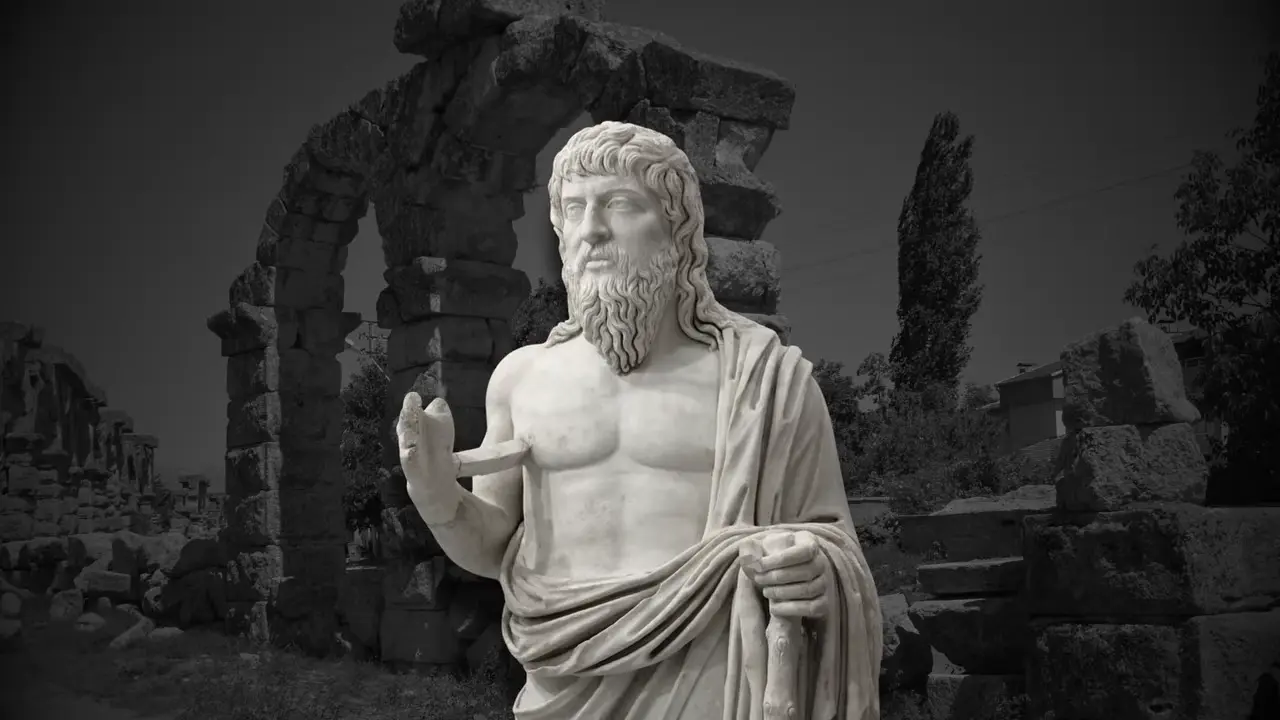
Apollonius of Tyana: ascetic healer who wore only linen and bark, ate no meat, and wandered Asia Minor for five years in silence. Philostratus's biography, written a century later, is largely thought to be fiction — even its supposed source, a disciple's memoir, is doubtful. 📜
Philostratus's life of Apollonius of Tyana judged largely fictional
Key facts
- Philostratus wrote a lengthy biography of Apollonius of Tyana about a century after the sage's death, purportedly based on the memoirs of one of his disciples, who may or may not have existed; the biography is assumed to be largely fictional (02:43-03:52)
- Few, if any, of the philosophical treatises transmitted under Apollonius's name are considered genuine (03:52-04:00)
- Apollonius was born on the eastern edge of the Roman Empire and his mother tongue was probably Aramaic (04:03-04:12)
- As a young adult he adopted an ascetic lifestyle associated with Pythagorean philosophy: he became a vegetarian, swore off wine and women, wore only linen and bark, and never cut his beard (04:12-04:29)
- He established himself in a temple of Asclepius, where he gained a reputation as a healer (04:29-04:36)
- According to Philostratus, he spent five years wandering around Asia Minor in absolute silence (04:36-04:42)
- Later travels took him to Persia, India, Ethiopia and Egypt, where he learned the local philosophies (04:42-04:52)
- The claims that he spoke all languages, including those of birds and animals, and that he remembered his past lives and foresaw the death of Emperor Domitian from hundreds of miles away come from Philostratus and are presented as legend rather than established fact (04:52-05:08)
- Philostratus presents Apollonius as confidant and critic of emperors from Nero to Nerva, although the video states this is unlikely to have any historical basis (05:19-05:33)
- Julia Domna, wife of Septimius Severus, commissioned Philostratus's biography; her son Caracalla was devoted to Apollonius's works, and Alexander Severus reportedly kept a statue of Apollonius in his personal shrine (06:30-06:56)
- At the end of the 3rd century, pagan polemicists presented Apollonius as a sage who worked greater miracles than Jesus, while Christian authors retorted that he was at best a conjurer of demons; the debate continued into late antiquity and Apollonius entered Arab folklore (06:56-07:20)
Sources
The Life of Apollonius of Tyana (Loeb Classical Library vols. 16, 17)bmcr.brynmawr.edu
Introduction. Philostratus' Life of Apollonius of Tyana ( Τὰ ἐς τὸν Τυανέα Ἀπολλώνιον) is a heavily fictionalized biography of a first-century Pythagorean ...
Philostratus, Life of Apollonius of Tyana (Philostr.VA)topostext.org
Philostratus the elder, Life of Apollonius of Tyana, translated by Frederick Cornwallis Conybeare (1856-1924), edition of 1912
Introductionlivius.org
In the Life of Apollonius, the Athenian author Philostratus, a sophist who lived from c.170 to c.247, tells the story of Apollonius of Tyana ...
Philostratus, Apollonius of Tyana, Volume I: Books 1–4loebclassics.com
The Life of Apollonius is formally a biography (by far the longest that survives from antiquity), but in reality a combination of travel narrative, rhetorical ...
Life of Apollonius of Tyanaen.wikipedia.org
is a text in eight books written in Ancient Greece by Philostratus. It tells the story of Apollonius of Tyana (c. AD 15 – c. AD 100), a Pythagorean philosopher ...
Was this story useful?
Keep exploring
Every site on this page sits on the globe, and the people who research them are on the Discord.
3D Globe · Sites by country · Story Archive · Research Library · Weekly Journal · Search
AI-generated text · images from the original sources · always verify with the sources.