

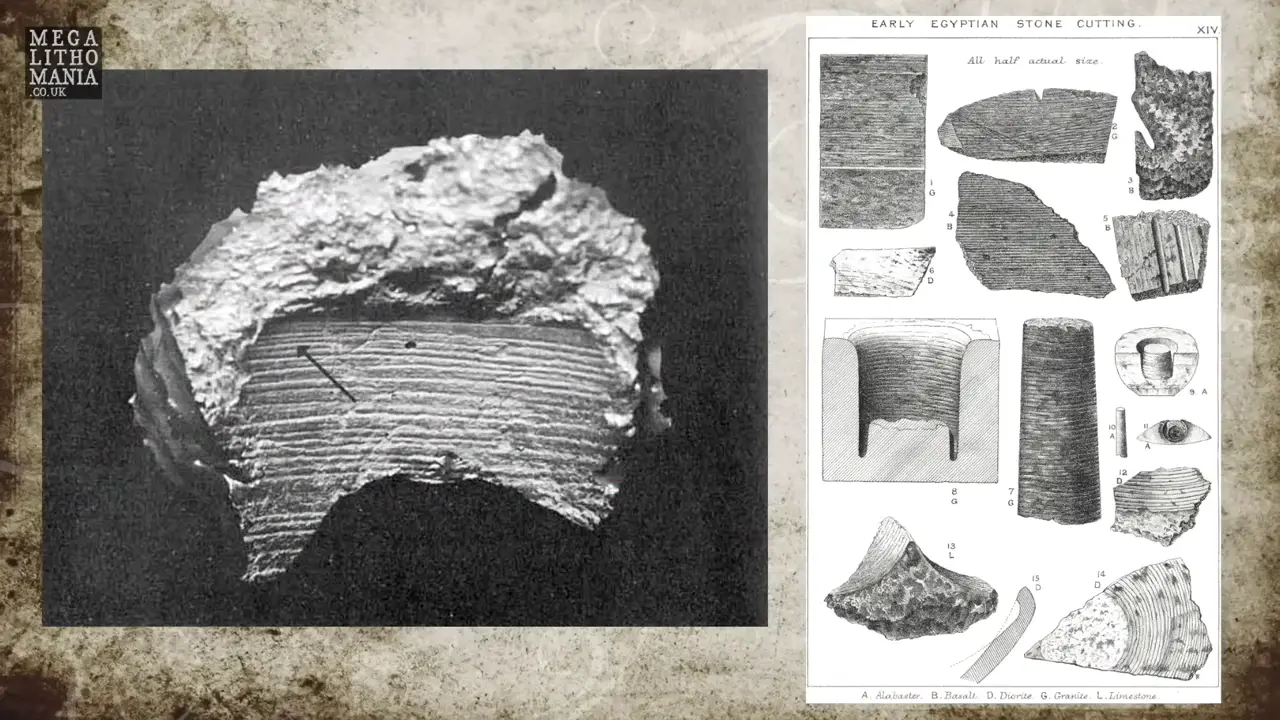
Flinders Petrie found a granite core at Giza in 1881–82 and published it in 1883. Its tubular bore and striations show that ancient Egyptians used tubular drills. The surviving core measured 24 cm long and 5.3 cm in diameter. The video argues that industrial-era drilling technology gave observers the context to recognise the technique, that Petrie saw apparent lathe marks on pre-lathe-period objects, and that ancient boring rates exceeded modern rates. The cited evidence supports tubular drilling, not those broader claims.
Petrie documented ancient Egyptian tubular drilling in 1883
Key facts
- Flinders Petrie found the granite core at Giza in 1881–82 and published it in 1883.
- The surviving granite core measured 24 cm long and 5.3 cm in diameter.
- Its tubular bore and striations show that ancient Egyptians used tubular drills.
- The video argues that industrial-era drilling technology was needed to recognise the technique, that Petrie saw apparent lathe marks on objects dated before the conventional invention of the lathe, and that the marks imply boring rates exceeding modern rates.
- The cited archaeological evidence supports tubular drilling, not pre-lathe machining or rates above modern drilling.
Sources
Sir William Flinders Petrie: Archaeologist Extraordinairenewcreation.blog
Sir William Matthew Flinders Petrie was as eccentric as he was brilliant. Petrie was among the first to treat archaeology as a science.
Expedition Magazine | Ancient Egyptian Stone-Drilling - Penn Museumpenn.museum
The granite core published by Petrie was made by the ancient Egyptians using a tubular drill. Note the similarity of the concentric lines (arrow) found on the ...
William F. Petrie's Lost Technology of Ancient Egyptian Core#7gizapower.com
They do not address the remarkable geometry and exactness of the ancient Egyptians statues, and they have ignored evidence presented by Flinders Petrie in 1883 ...
Ancient Egyptian Copper Coring Drills - Hall of Maathallofmaat.com
No tubular copper barrels or the wooden drill-shaft used for coring of rock have been found in the archaeological record from ancient Egypt, or from Mesopotamia ...
Privacy & Cookie Settingscollections.ucl.ac.uk
Granite core from tubular drill hole, found by Flinders Petrie at Giza in 1881-82 and numbered by him as 'core 7'. The circumference of one end is greater ...
Flinders Petrieen.wikipedia.org
Flinders Petrie, was an English Egyptologist and a pioneer of systematic methodology in archaeology and the preservation of artefacts.
drill-corebritishmuseum.org
Petrie noted that 'many thousands of alabaster drill cores from tubular drilling' as well as unfinished vessels in alabaster were found in the temenos of ...
How did the ancient Egyptians drill holes into hard granite?gigazine.net
Lucas suggested that they had been polished with quartz sand, while Petrie suggested that they had been polished with emery .
Was this story useful?
Keep exploring
Every site on this page sits on the globe, and the people who research them are on the Discord.
3D Globe · Sites by country · Story Archive · Research Library · Weekly Journal · Search
AI-generated text · images from the original sources · always verify with the sources.