

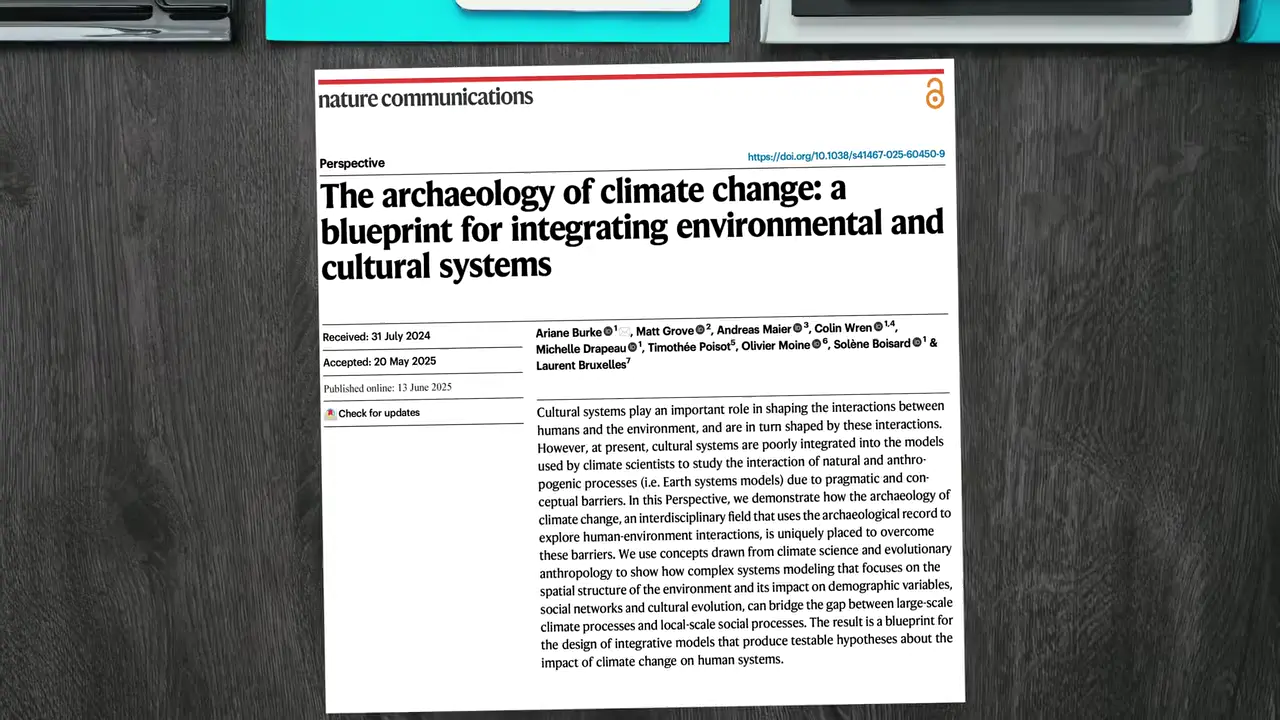
A 2025 Nature Communications Perspective article proposed a framework for integrating environmental and cultural systems to produce testable hypotheses about climate change impacts on human societies. The authors argued for combining multiple lines of evidence while accounting for uncertainties in both climate and archaeological records. The framework enables researchers to develop and test predictions about whether climate change preceded, coincided with, or followed social transformations, and requires evidence for collapse claims to be evaluated against explicit hypotheses.
New framework integrates climate proxies with archaeological timelines
Key facts
- A 2025 Nature Communications study created a formal framework integrating multiple climate proxies
- The framework explicitly accounts for uncertainties and combines them into a coherent climate signal
- Climate signals are aligned probabilistically with archaeological timelines using Bayesian spatiotemporal models
- Researchers can now test whether climate change came before, after, or alongside social change
- Claims about drought, cooling, or floods causing collapse must now pass statistical tests
- The framework allows testing specific hypotheses about settlement density, mobility, and population change
Was this story useful?
Keep exploring
Every site on this page sits on the globe, and the people who research them are on the Discord.
3D Globe · Sites by country · Story Archive · Research Library · Weekly Journal · Search
AI-generated text · images from the original sources · always verify with the sources.