

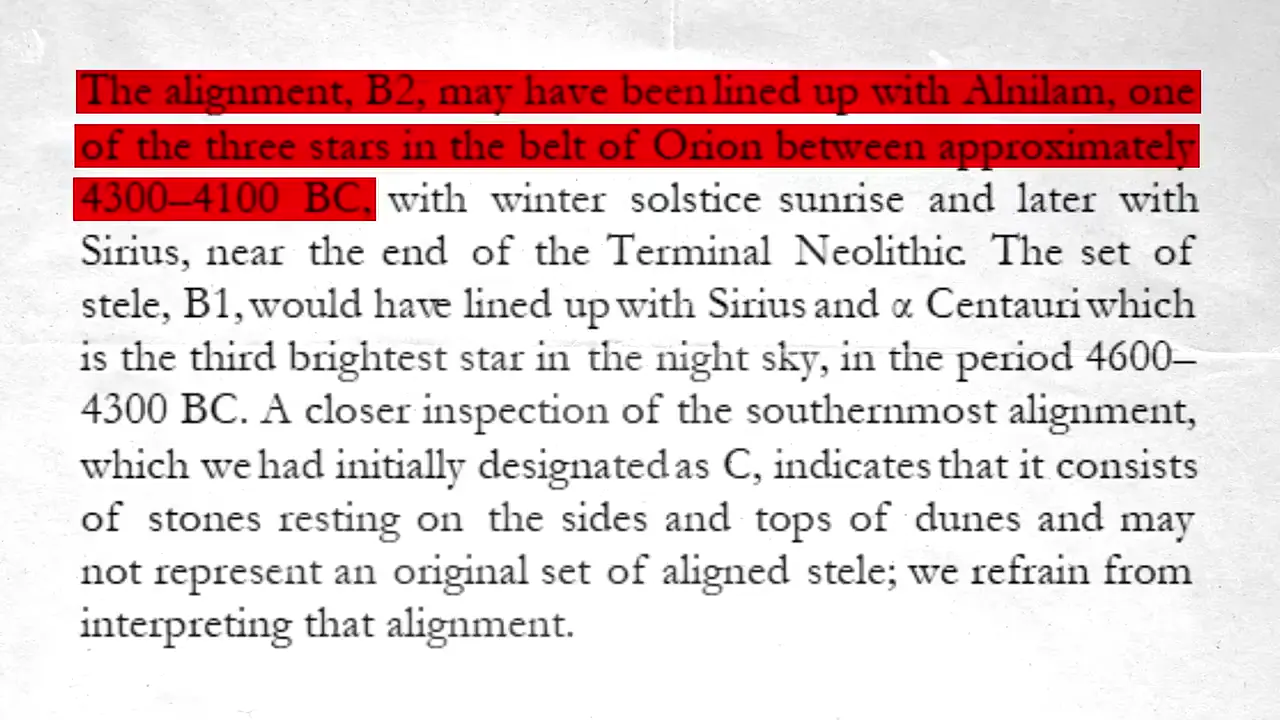
The Nabta Playa stone circle dates to ~5,000 BC — roughly 1,000 years before Stonehenge! In the late 1990s, astronomer Thomas Brophy proposed that six inner uprights align with summer solstice sunrise/sunset, while outlying megaliths may have mirrored constellations like Orion's Belt around 4,800 BC (his theory, still debated).
Nabta Playa, Egypt stone circle dated to ~5,000 BC may align with solstice and stars
Site mentioned
📍 Nabta Playa, Egypt🌍 Show on the globe
Key facts
- The stone circle dates to approximately 5,000 BC, roughly 1,000 years before Stonehenge and 2,000 years before the Egyptian Old Kingdom
- In the late 1990s, astronomer Thomas Brophy analyzed the stone circle's layout
- The circle's six inner upright stones form two lines pointing toward sunrise and sunset at summer solstice
- Brophy argued certain outlying megaliths aligned with prominent stars as they appeared around 4,800 BC, including Orion's Belt
- Stone circles include paired upright slabs called 'gates' or 'windows' oriented to frame specific sightlines
Sources
nature.com
Linked in video description
Was this story useful?
Keep exploring
Every site on this page sits on the globe, and the people who research them are on the Discord.
3D Globe · Sites by country · Story Archive · Research Library · Weekly Journal · Search
AI-generated text · images from the original sources · always verify with the sources.