

Who built Derinkuyu? Earliest artifacts are ~3,000 years old, but stone can't be radiocarbon dated. Scholars suggest Phrygians in 8th cent. BC. Enormous evidence shows this site was reused by Byzantines, Arab war refugees, Mongols, and Christians fleeing Ottomans over millennia. Origin entirely undocumented—may qualify as prehistoric.
Mysterious origin: Unknown builders, possible 11,600-year-old connection
 TürkiyeExcavation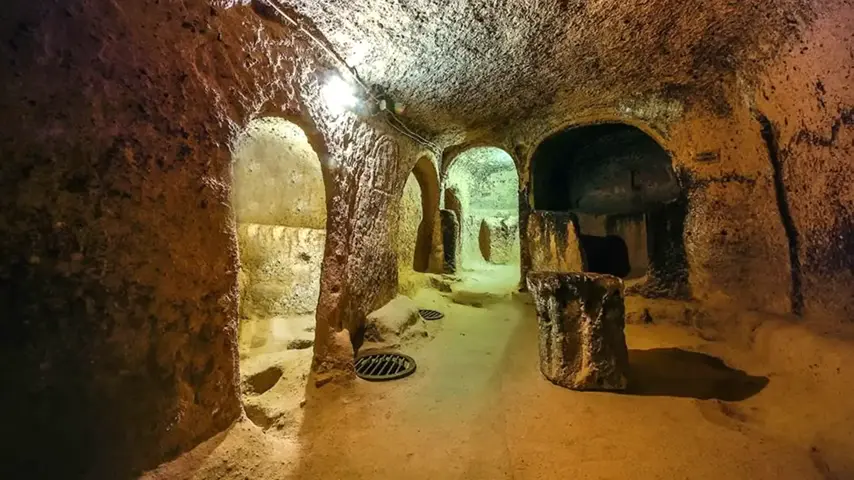
Key facts
- Earliest artifacts date back approximately 3,000 years ago
- Academics suggest initial construction by Phrygians in 8th century BC (~2,900 years ago)
- Stone cannot be radiocarbon dated, making exact age unknown
- Artifacts found from Middle Byzantine period (~1,600 years ago)
- Artifacts from Arab Byzantine wars (~1,200 years ago)
- Evidence of use during Mongolian incursions (~700 years ago)
- Used by Christians as refuge from Ottoman conquest
- The site was reused many times by different peoples over millennia
- Possible connection to Gobekli Tepe and Younger Dryas climate catastrophe 11,600 years ago
- Potential dumping ground along river contains Paleolithic tools ending 11,600 years ago
- Lower 10 levels (90% of site) are sealed off to public and tourists
Site mentioned
Sources
Derinkuyu: The Ancient Underground City of Cappadocia in Turkey ...vocal.media
The Phrygians, an Indo-European people who occupied central Anatolia during this period, are considered the probable originators of the earliest sections of ...
Derinkuyu: Strange underground city found in man's basementbigthink.com
Some archaeologists speculate that the oldest part of the complex could have been dug about 2000 BC by the Hittites, the people who dominated ...
Derinkuyu: A Subterranean Marvel of Ancient Engineering with 18 ...arkeonews.net
The Phrygians, an Indo-European people who established a significant kingdom in Anatolia, were known for their rock-cut architecture, and ...
Who Built the Underground City of Derinkuyu?transcend.org
It's possible that the Phrygian people could have constructed the underground city around 800 BC, as they occupied that area at the time.
Derinkuyu - The Underground City - HeritageDailyheritagedaily.com
According to the Turkish Department of Culture, the soft volcanic rock was first excavated by the Phrygians (an Indo-European culture from the ...
Was this story useful?
Keep exploring
Every site on this page sits on the globe, and the people who research them are on the Discord.
3D Globe · Sites by country · Story Archive · Research Library · Weekly Journal · Search
AI-generated text · images from the original sources · always verify with the sources.