

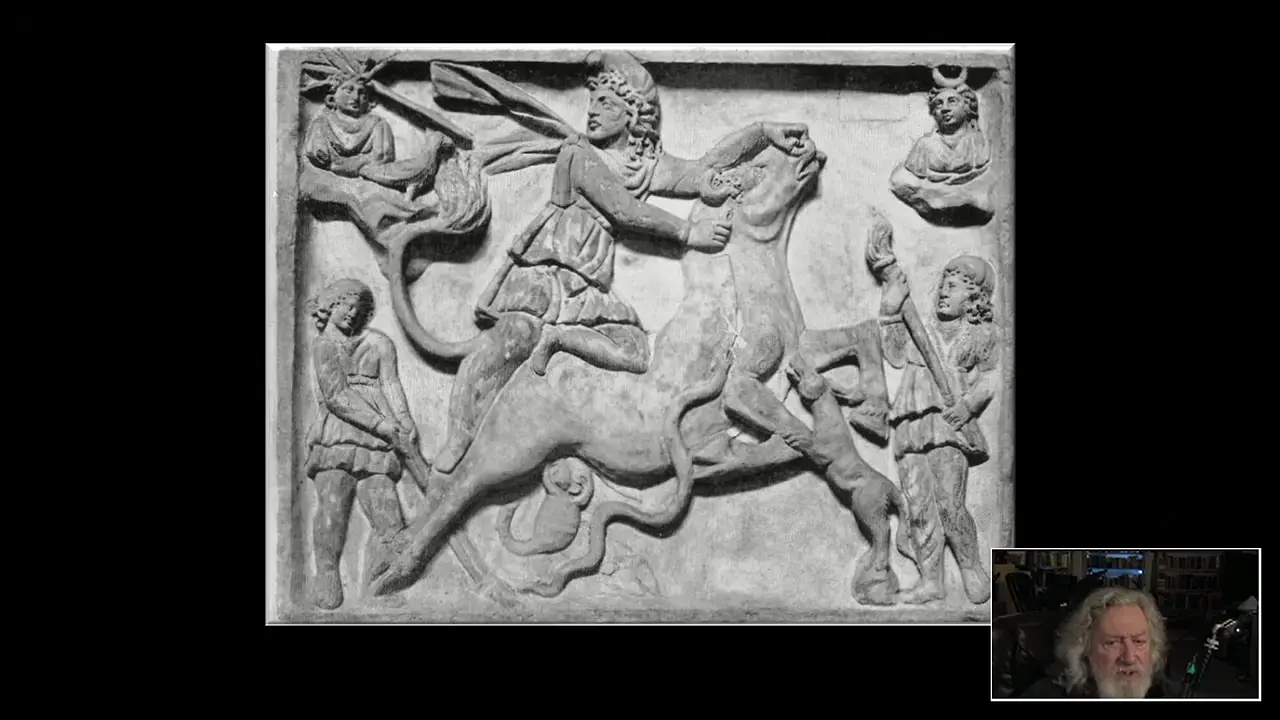
Roman Mithraic reliefs show Mithras flanked by two torch-bearing attendants, one torch raised toward the sky, one lowered toward the earth. In the tauroctony he grips the bull by the nose, turns toward the raven, and plunges his sword into the bull's shoulder — the region of the Pleiades. The tail becomes a stalk of wheat. 🗡️
Mithraic tauroctony: sword in the bull's shoulder, the region of the Pleiades
Key facts
- Roman Mithraic reliefs, including examples on two Roman-era pillars, show Mithras flanked by two torch-bearing attendants, one torch pointing upward toward the sky and one downward toward the earth.
- In the tauroctony, Mithras grasps the bull by the nose to pull its head back, turns toward the raven (identified as a divine messenger), and plunges his sword into the bull's shoulder, the region occupied by the Pleiades.
- The bull's tail in these reliefs becomes a stalk of wheat, and the attendants wear Phrygian caps.
- The video notes that Mithraism, traced from the Persian god Mitra and Indian traditions, was for several centuries the principal competitor to Christianity, and that the up/down torch motif parallels imagery in the Dresden Codex and Mesoamerican codices.
- The video also notes that the Egyptian deities Set and Typhon, of Chaldean and earlier Sumerian origin, were fused into the Christian concept of Satan in the first centuries CE, and that these are not interchangeable with the serpent or with Lucifer.
Sources
Cautes and Cautopatesen.wikipedia.org
CAUTES AND CAUTOPATESiranicaonline.org
Figure of Cautopateszenodo.org
Tauroctony relief from Aïtodormithraeum.eu
Was this story useful?
Keep exploring
Every site on this page sits on the globe, and the people who research them are on the Discord.
3D Globe · Sites by country · Story Archive · Research Library · Weekly Journal · Search
AI-generated text · images from the original sources · always verify with the sources.