

Mastaba G7510 in Giza's Eastern Cemetery is massive — roughly 100x51 meters, nearly matching Mastaba G2000 in the Western Cemetery. Its chapel bears the name of Prince Ankhaf, possible half-brother of Pharaoh Khufu, who served as vizier and head of royal building works. Ankhaf even appears in the Diary of Merer, which records Tura limestone transport to Giza. George Reisner dated the burial chamber to early in Khufu's reign, with some experts considering G7510 one of the oldest mastabas on the plateau.
Mastaba G7510 at Giza: Largest in Eastern Cemetery, attributed to Prince Ankhaf
Site mentioned
📍 Mastaba G7510
Key facts
- Mastaba G7510 measures approximately 100x51 meters, nearly identical in size to Mastaba G2000 in the Western Cemetery
- The mastaba has an exterior wall of large masonry blocks retaining debris fill, cased in fine white Tura limestone
- A single burial shaft is located in the southwestern quadrant, mirroring the shaft position in Mastaba G2000
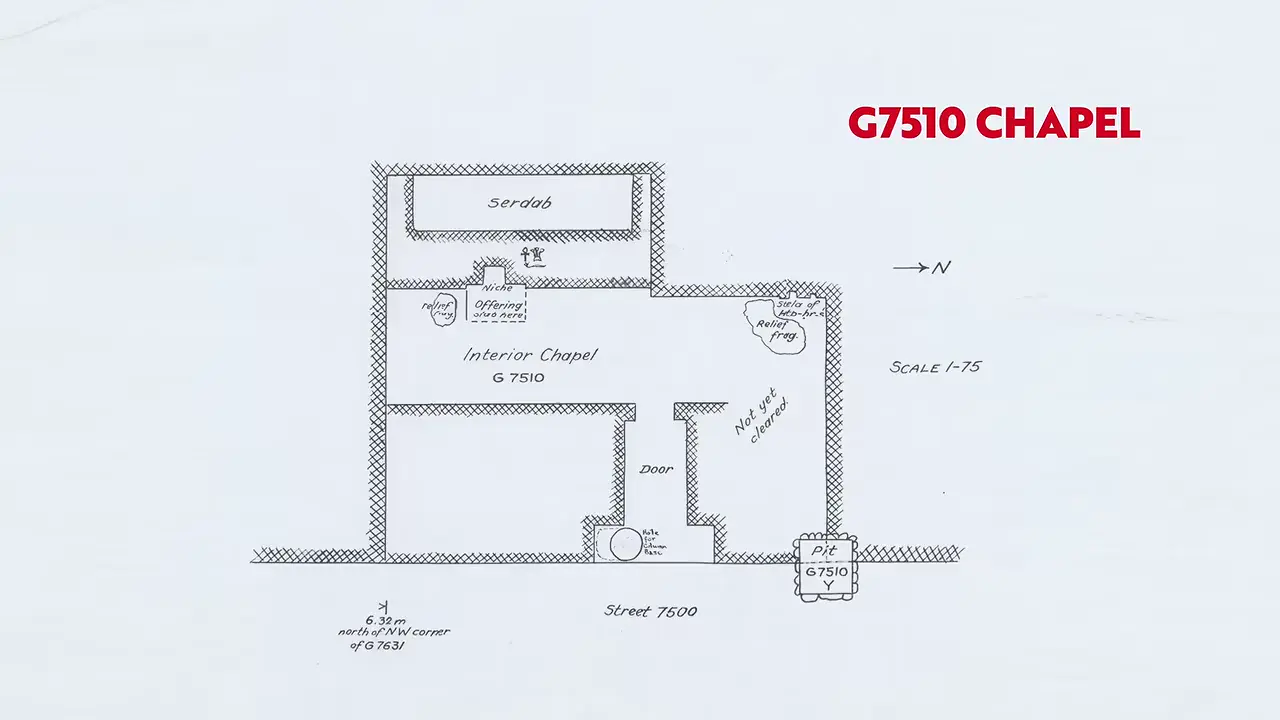
- The chapel contains the name of Prince Ankhaf, identified as a possible half-brother of Pharaoh Khufu
- Ankhaf served as vizier and head of royal building works during Khufu's reign
- Ankhaf is mentioned in the Diary of Merer, a document from the latter years of Khufu's reign recording the transport of Tura limestone to Giza
- George Reisner dated the burial chamber to early in Khufu's reign, while another expert considers G7510 potentially one of the oldest mastabas on the plateau
Sources
Painted limestone Bust of Prince Ankh-Haf dating to the ...ancient-egypt.co.uk
Ankh-Haf's mastaba was the largest in the great Eastern Cemetery at Giza. His bust was installed in a mud-brick chapel attached to the east ...
The Cemeteries of Giza in Egypttouregypt.net
The necropolis at Giza consists of the Great Western cemetery, the Eastern Cemetery and a third, less extensive field south of the pyramid of Khufu.
Giza East Fielden.wikipedia.org
The rest of the eastern field was built around this group of eight twin mastabas. Of these, the great mastaba G 7510 of the prince and vizier Ankhhaf stands out ...
G 7560 - Digital Giza - Harvard Universitygiza.fas.harvard.edu
"The Mastaba of Meresankh III (G 7530/7540) in the Eastern Cemetery at Giza: An Archaeological and Art Historical Analysis." Bulletin of the Egyptian Museum ...
The Mastabas of Ankh-haf (G7510) and Akhethetep and ...gizamedia.rc.fas.harvard.edu
These two mastabas are located next to one another on the periphery of the eight twin- mastabas, which form the original section of the Eastern Cemetery. George ...
Was this story useful?
Keep exploring
Every site on this page sits on the globe, and the people who research them are on the Discord.
3D Globe · Sites by country · Story Archive · Research Library · Weekly Journal · Search
AI-generated text · images from the original sources · always verify with the sources.