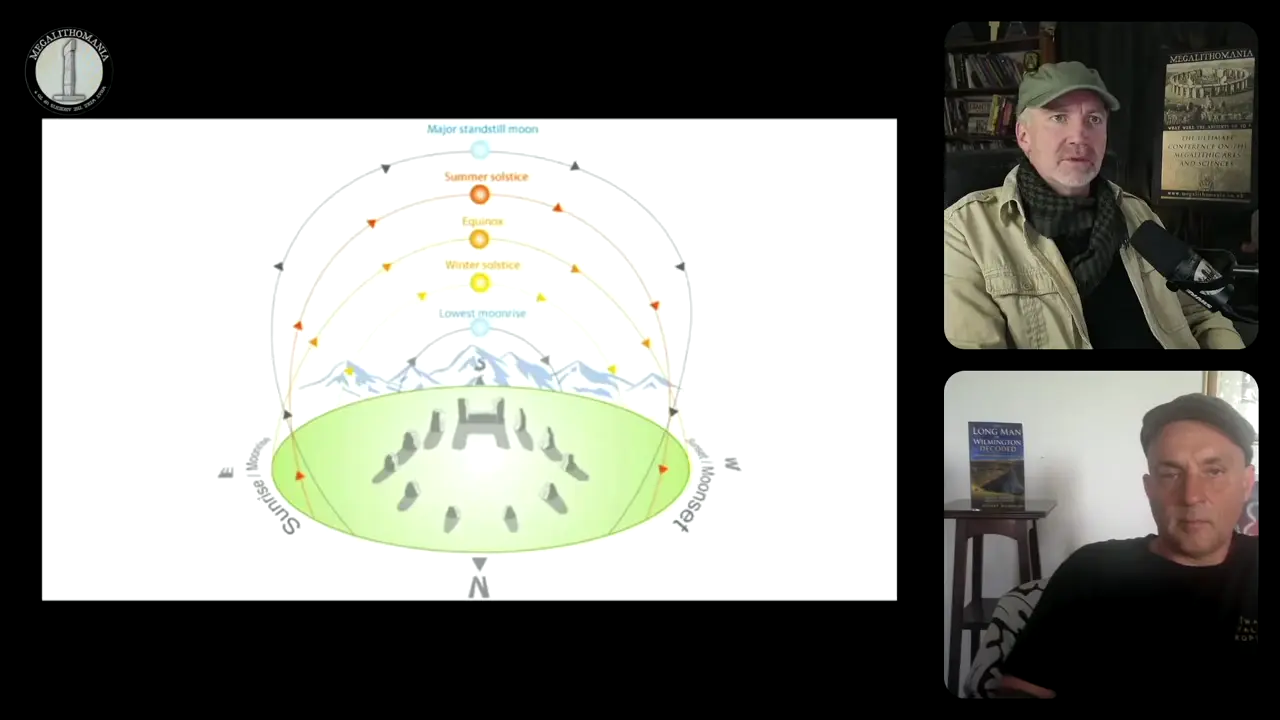
Every 18.6 years, the Moon passes through a major lunar standstill, reaching its most northerly and southerly monthly rising and setting positions. At the southern extreme, its rise can be lower than the winter-solstice Sun. A perigee full Moon near an equinox can produce especially high tides and increase flood risk, though flooding is not guaranteed.
The video argues that Callanish and Chimney Rock were deliberately arranged to observe these extremes. Callanish's alignments match major lunar standstills, and Scottish astronomer Alexander Thom witnessed minor-standstill extremes in the Outer Hebrides. No evidence shows that Callanish's builders observed the Moon continuously for 18 years.
Sources
Extreme Moon: The Major Lunar Standstills of 2024 - 2025griffithobservatory.lacity.govThe major lunar standstill results from the rotation of the Moon's inclined orbit over an 18.6-year cycle. Because the greatest monthly excursion of the Moon ...
Lunar standstill - Wikipediaen.wikipedia.orgThe degree of lunar standstills changes over the course of 18.6 years ... In a year of a major lunar standstill, solar eclipses occur in March or April at ...
Stonehenge Major Lunar Standstill - English Heritageenglish-heritage.org.ukThe limits of moonrise and moonset change over a period of about 18.6 years. The major lunar standstill is when the northernmost and southernmost moonrise and ...
2024-2025 MAJOR LUNAR STANDSTILL - Cloudy Nightscloudynights.comThe 18.6-year cycle is caused by the precession of the plane of the lunar orbit, while this orbit maintains a 5 degree tilt relative to the ...
The 1st 'major lunar standstill' in more than 18 years is ... - Spacespace.comA major lunar standstill is about to occur. The phenomenon happens every 18.6 years when the moon rises and sets at its most extreme points on the horizon.
Moon Base Phasesnasa.govNASA will establish a Moon Base in the lunar South Pole region through a phased, iterative approach that builds capability over time.
Moon Phasesscience.nasa.govThe 8 lunar phases are new moon, waxing crescent, first quarter, waxing gibbous, full moon, waning gibbous, third quarter, waning crescent.
Major Lunar Standstill - ExploreGlobe.net/ArchAstroexploreglobe.netMajor Lunar Standstill occurs every 18.6 years when the moon reaches a maximum monthly range of moonrise/set to the north and south.
AI-generated text · images from the original sources · always verify with the sources.