

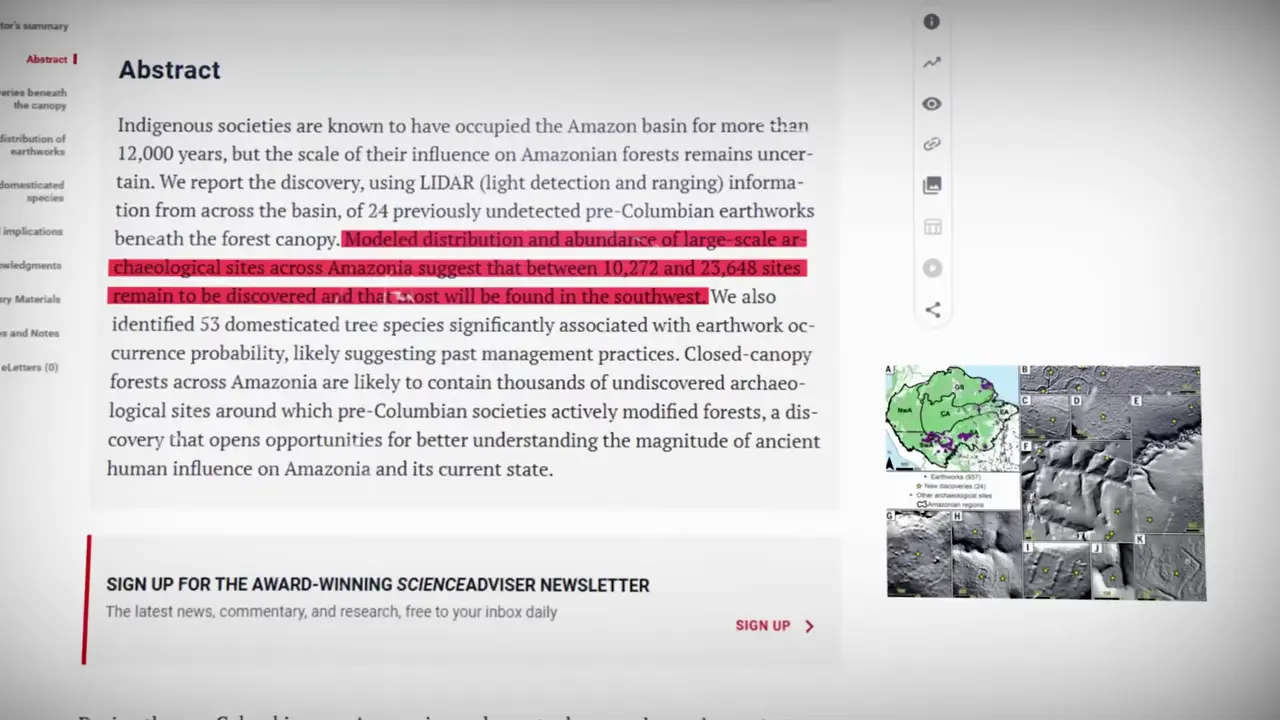
LiDAR discovered 24 earthwork sites across Amazon rainforest. Researchers suggest ancient civilizations hiding in plain sight. LiDAR scans found 24 new earthwork sites across the Amazon basin in multiple ecological zones. Statistical modeling estimates 10,000 undocumented earthworks could remain hidden, representing only a small fraction of total sites. Kotakar site in Bolivia covers 147 hectares with defensive moats, ramparts, U-shaped platforms, and 20m tall conical pyramids on 6m high terraces. Landivar site in Bolivia covers 315 hectares with double-walled defensive structures and a 7km canal system. Upano Valley in Ecuador survey found over 6,000 residential platforms arranged in town clusters with connected road networks.
LiDAR scans discovered 24 new earthwork sites in 2023 across 5,000 km of rainforest in four different ecological zones
Key facts
- LiDAR scans discovered 24 new earthwork sites in 2023 across 5,000 km of rainforest in four different ecological zones
- Statistical modeling estimates 24,000 undocumented earthworks could remain hidden, representing only 4-9% of total sites
- Kotakar site in Bolivia covers 147 hectares with defensive moats, ramparts, U-shaped platforms, and 20m tall conical pyramids on 6m high terraces
- Landivar site in Bolivia covers 315 hectares with double-walled defensive structures and a 7km canal system
- Apano Valley in Ecuador survey of 300 square kilometers found over 6,000 residential platforms arranged in 15 town clusters with 25km road networks
- Apano Valley population estimated at 10,000-30,000 people, comparable to Roman era London
- Archaeological evidence includes post holes, charred seeds, grinding stones, storage jars with maize/beans/sweet potato, and chicha beer residue
- Terra preta (Amazonian dark earth) covers 154,000 km² created deliberately over 2,500 years with charred wood, ash, bone, pottery, and food scraps
- Indigenous peoples domesticated at least 83 native plant species including maize, cacao, peppers, and palms appearing 5x more frequently near sites
- Population estimates revised from 500,000-2 million to 8-10 million people
- December 2024 expedition by Daniel Pierce and Chris Boddine found massive geometric earthworks 1,000 miles north of previously known sites in southwestern Brazilian Amazon
Sources
Laser scans reveal ancient cities hidden deep in the Amazon ...archaeologymag.com
Archaeologists have employed advanced lidar technology to unveil an ancient civilization hidden beneath the dense vegetation of the Upano Valley in eastern ...
Lost Cities of the Amazon Discovered From the Airsmithsonianmag.com
Mapping technology cut through the canopy to detect sprawling urban structures in Bolivia that suggest sophisticated cultures once existed.
24 ancient earthworks have been detected in the Amazon. There ...wral.com
Analysis of the lidar data revealed 24 previously unknown earthworks in spots scattered across the Amazon basin. These sites included a town ...
Deep in the Amazon, researchers have uncovered a complex of ...cbc.ca
Researchers have found the ruins of huge, ancient cities in the Ecuadorian depths of the Amazon, using airborne laser sensors to see what's ...
Was this story useful?
Keep exploring
Every site on this page sits on the globe, and the people who research them are on the Discord.
3D Globe · Sites by country · Story Archive · Research Library · Weekly Journal · Search
AI-generated text · images from the original sources · always verify with the sources.