

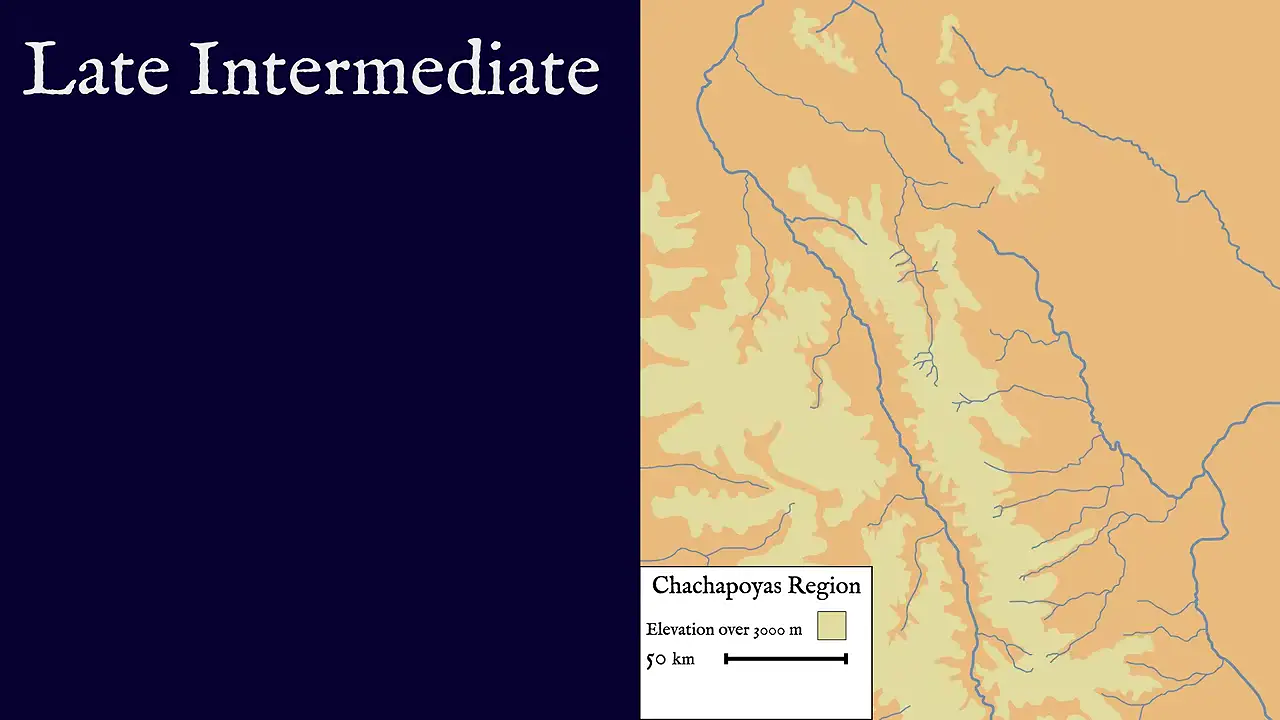
Populations moved upward to around 3,000m elevation in the Late Intermediate Period. At Tambo (7,000-10,000 people), builders created clay-rich loam terraces for water retention, deliberately removing cobbles. Typical houses were circular, 5m diameter, with elevated entrances. Gran Pajatén, inhabited since 200 BCE, features 26 buildings with elaborate relief carvings.
Late Intermediate Period settlements: stone houses and innovative earth terraces
 PeruGeneral
Site mentioned
Key facts
- Populations shifted upward to elevations around 3,000m above sea level during the Late Intermediate Period
- At Tambo (population 7,000-10,000), earth terraces made of clay-rich loam were built to retain water and drain excess, unlike stone terraces on the Pacific side
- Terraces at Tambo were constructed without cobbles, which were deliberately removed
- Typical Chachapoya houses were circular, about 5m in diameter, built of worked or unworked stone with elevated entrances and two levels
- Gran Pajatén, inhabited since 200 BCE, contains 26 buildings with elaborate human and zoomorphic relief carvings and carved faces
- Gran Pajatén is located in the Río Abiseo National Park and was rediscovered by local farmers in the 1960s
Sources
Chachapoyas sites of the Utcubamba Valleywhc.unesco.org
Chachapoya cultureen.wikipedia.org
The Chachapoya Culture of Perunmarchaeology.org
The Story of Peru's Cloud Warriorshistorytoday.com
SETTLEMENT ORGANIZATION AND ARCHITECTURE IN ...cambridge.org
Was this story useful?
Keep exploring
Every site on this page sits on the globe, and the people who research them are on the Discord.
3D Globe · Sites by country · Story Archive · Research Library · Weekly Journal · Search
AI-generated text · images from the original sources · always verify with the sources.