

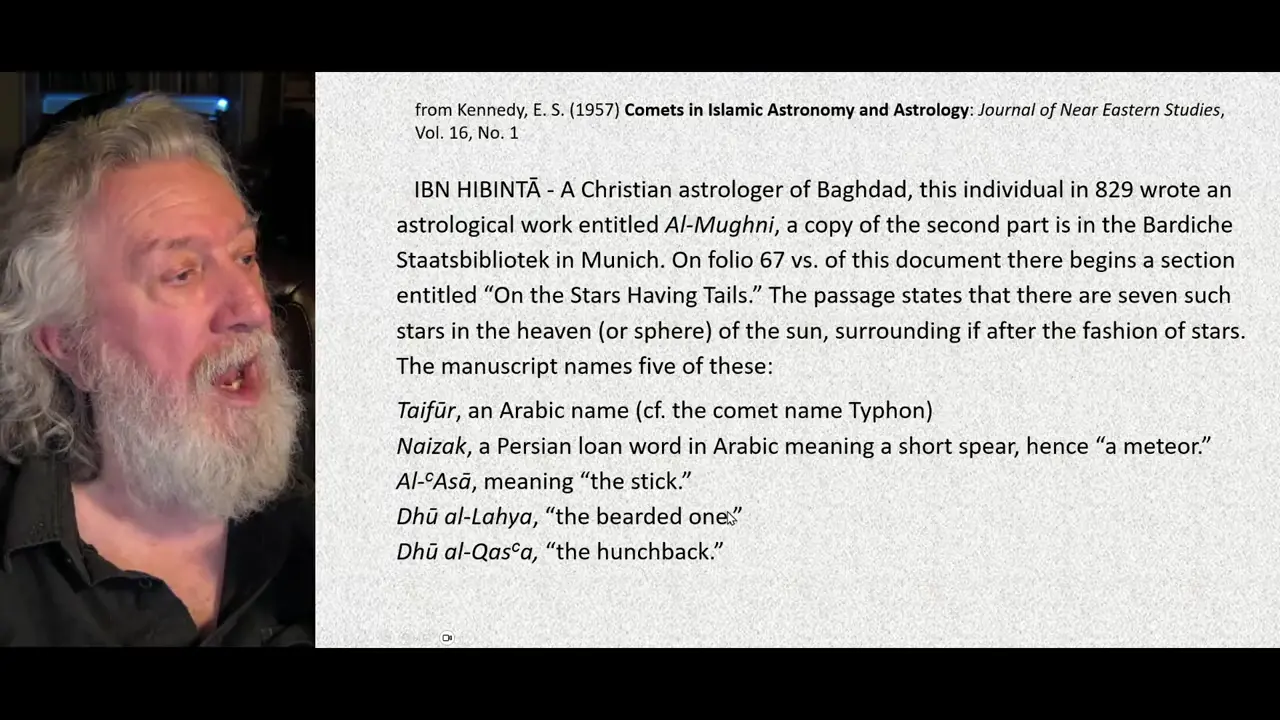
E.S. Kennedy's 1957 JNES article explored comets in Islamic astronomy, including Ibn Hibinta's treatise Al Mughini (likely 929 CE). Held at Munich's Bayerische Staatsbibliothek, its 'Stars Having Tails' section catalogs seven tailed stars with vivid names like 'Tayfur' (akin to Typhon) and 'Nazac' (spear/serpent). 📖☄️
Ibn Hibinta's Islamic astronomical treatise Al Mughuni catalogs seven tailed stars
Key facts
- E.S. Kennedy's 1957 article in the Journal of Near Eastern Studies examined comets in Islamic astronomy and astrology
- Ibn Hibinta, a Christian astrologer of Baghdad, wrote an astrological work called Al Mughini (likely 929 CE)
- A copy of the second part is held at the Bayerische Staatsbibliothek in Munich
- On folio 67, a section is titled "On the Stars Having Tails" and describes seven such stars in the sphere of the sun
- Five of these named stars are cataloged, including "Tayfur" (compared to the Greek comet Typhon)
- "Nazac" is identified as a Persian loanword in Arabic meaning a short spear, also used for comet or serpent
- Additional comet names include Dhu al-Hayya ("the bearded one") and "the hunchback"
Sources
List of Publications of ES Kennedy - N plete bibliography of his ...nyaspubs.onlinelibrary.wiley.com
... (1957): 121-41; reprinted in SIES, 253-73. "Comets in Islamic Astronomy and Astrology," Journal of Near Eastern Studies, 16 (1957): 44-51; reprinted in SZES ...
Islamic Math Biblio | UIndy - University of Indianapolisuindy.edu
E. S. Kennedy, P. Kunitzsch and R. P. Lorch. The Melon-Shaped Astrolabe in Arabic Astronomy. Texts edited with translation and commentary by the authors.
Comets and Meteors in the Islamic World | Springer Nature Linklink.springer.com
Kennedy, E. S. Comets in Islamic Astronomy and Astrology. Journal of Near Eastern Studies 16 (1957): 44–51. Google Scholar. Khan, Mohammed A. R. Muslim ...
A Survey of Muslim Material on Comets and Meteorsjournals.sagepub.com
See Kennedy's E. S. comments on the literature of comets: “Comets in Islamic astronomy and astrology”, Journal of Near Eastern studies, xvi (1957), 44–51.
[PDF] studies in the islamic exact sciences - ResearchGateresearchgate.net
For any serious student of the history of Islamic science the writings of E.S.. Kennedy are required reading. I remember photocopying all of his available.
Was this story useful?
Keep exploring
Every site on this page sits on the globe, and the people who research them are on the Discord.
3D Globe · Sites by country · Story Archive · Research Library · Weekly Journal · Search
AI-generated text · images from the original sources · always verify with the sources.