

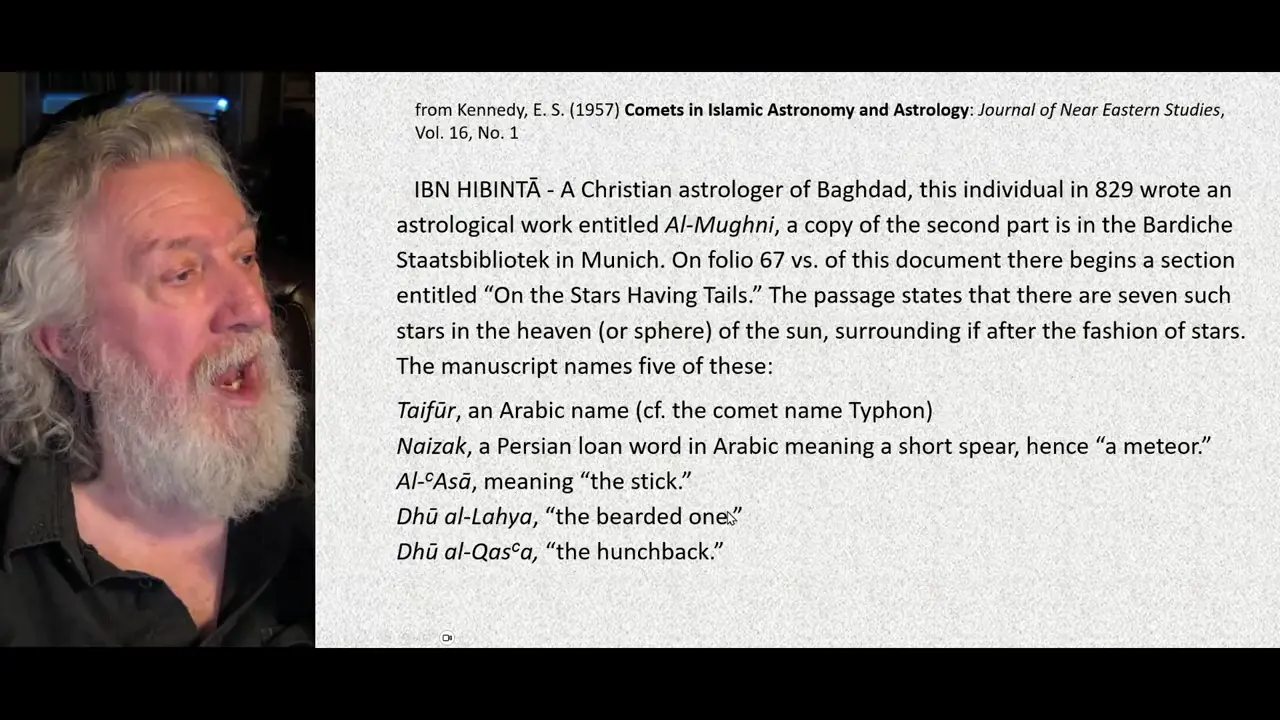
E. S. Kennedy’s 1957 JNES article “Comets in Islamic Astronomy and Astrology” examined Ibn Hibinta’s Kitāb al-Mughnī fī ʿilm al-nujūm, probably written in 929 CE. A copy of its second part is held by Munich’s Bayerische Staatsbibliothek. On fol. 67, “On the Stars Having Tails” describes seven tailed stars in the sphere of the sun. Five are named, including Tayfur (linked to Typhon) and Nazac, a Persian loanword meaning “short spear,” also used for a comet or serpent. Other names include Dhu al-Hayya (“the bearded one”) and “the hunchback.” 📖☄️
Ibn Hibinta’s al-Mughnī describes seven tailed stars
Key facts
- E. S. Kennedy’s 1957 Journal of Near Eastern Studies article was titled “Comets in Islamic Astronomy and Astrology.”
- Ibn Hibinta, a Christian astrologer of Baghdad, wrote Kitāb al-Mughnī fī ʿilm al-nujūm, probably in 929 CE.
- A copy of the second part is held by the Bayerische Staatsbibliothek in Munich.
- On fol. 67, “On the Stars Having Tails” describes seven tailed stars in the sphere of the sun.
- Five are named, including Tayfur, linked to the Greek comet Typhon, and Nazac, a Persian loanword meaning “short spear,” also used for a comet or serpent.
- Other names include Dhu al-Hayya (“the bearded one”) and “the hunchback.”
Sources
List of Publications of ES Kennedy - N plete bibliography of his ...nyaspubs.onlinelibrary.wiley.com
Comets and Meteors in the Islamic World | Springer Nature Linklink.springer.com
A Survey of Muslim Material on Comets and Meteorsjournals.sagepub.com
[PDF] studies in the islamic exact sciences - ResearchGateresearchgate.net
New Orleans Muslims, Arabs express outrage over Sen. ...lailluminator.com
JFK's Argument Against Imperialismlawfaremedia.org
Historical Documents - Office of the Historianhistory.state.gov
Was this story useful?
Keep exploring
Every site on this page sits on the globe, and the people who research them are on the Discord.
3D Globe · Sites by country · Story Archive · Research Library · Weekly Journal · Search
AI-generated text · images from the original sources · always verify with the sources.