

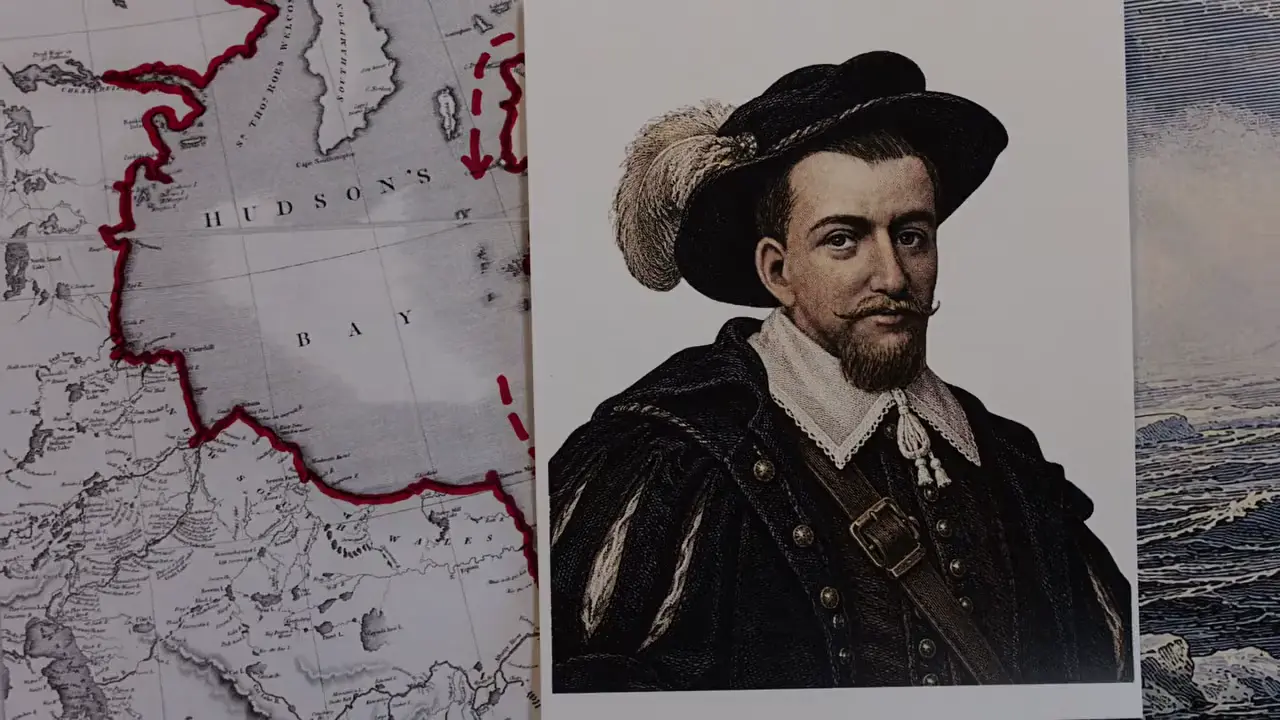
Henry Hudson's fourth voyage (1611) ended in mutiny: his crew wintered on a small island in frozen Hudson Bay, then set him, his teenage son and seven loyal men adrift in an open boat that vanished into fog. Earlier, his whale reports helped launch North Atlantic whaling ❄️
Hudson frozen in Hudson Bay, crew mutiny and sets him adrift in 1611
Key facts
- English navigators and mapmakers theorized a sea route through the icy corridors above North America, which they called the Northwest Passage, and hoped it would give England controlled access to the Pacific and Asian trade
- Historians estimate Henry Hudson was born in London around 1565; he enters the historical record in 1607 when commissioned by the Muscovy Company to sail across the North Pole toward East Asia
- On the 1607 voyage he sailed beyond Greenland to an impenetrable wall of ice and turned back, becoming the first navigator to sail as close to the North Pole as any earlier expedition
- His reports of abundant whales and walruses helped launch the lucrative North Atlantic whaling industry
- A second voyage seeking a northeast passage over Russia ended at another ice wall, and merchants began withdrawing support
- The Dutch brought him to Amsterdam, where he signed a contract with the Dutch East India Company for a third voyage; his Dutch crew, accustomed to warm Indian Ocean waters, grew disillusioned and mutinous
- Hudson gave the crew an ultimatum — sail south toward the Caspian Sea or turn west for the Northwest Passage — and the crew chose the western route, reaching Newfoundland, Chesapeake Bay and the Hudson River, sailing about 150 miles upriver until it became too shallow
- On his return Hudson was arrested by the English for passing cartographic information to a foreign power; his logs and maps were seized before his navigational skills were judged more useful than punishment
- For his fourth voyage in 1611 he handpicked 23 men and entered the ice-choked Hudson Strait, where dense fog, violent currents and an erratic magnetic compass made navigation nearly impossible
- Emerging into a large open saltwater sea, the crew spent months sailing south for an outlet to China, only to find themselves frozen at the bottom of Hudson Bay, far from the real opening to the Pacific
- Surviving the winter on a small island on frozen birds and scant rations, the crew staged a mutiny in spring and set Hudson, his teenage son and seven loyal crewmen adrift in an open boat, which then vanished into the fog behind the ship
Sources
Henry Hudson's First Voyage, 1607: The North Passageianchadwick.com
Hudson's aim was to discover a sea route over the North Pole, or as the Company wrote, "to discover a passage by the North Pole to Japan and ...
Hudsonstatic-prod.lib.princeton.edu
By the time of his first recorded voyage (1607), during which he explored the possibility of a Northeast Passage to the Orient, Henry Hudson (d. ... Hudson River, ...
Henry Hudsonallaboutexplorers.com
His first of four voyages was on a small, three-masted ship named Hopewell. He started his journey in May of 1607 and returned in September of the same year ...
Henry Hudson - Ages of Exploration - The Mariners' Museumexploration.marinersmuseum.org
Henry Hudson sailed out of Gravesend, England in April 1607 aboard the ship Hopewell. He had a crew of ten men, including his son John. It was a slow trip with ...
Henry Hudsonen.wikipedia.org
In 1607, the Muscovy Company of England hired Hudson to find a northerly route to the Pacific coast of Asia. At the time, the English were engaged in an ...
Was this story useful?
Keep exploring
Every site on this page sits on the globe, and the people who research them are on the Discord.
3D Globe · Sites by country · Story Archive · Research Library · Weekly Journal · Search
AI-generated text · images from the original sources · always verify with the sources.