

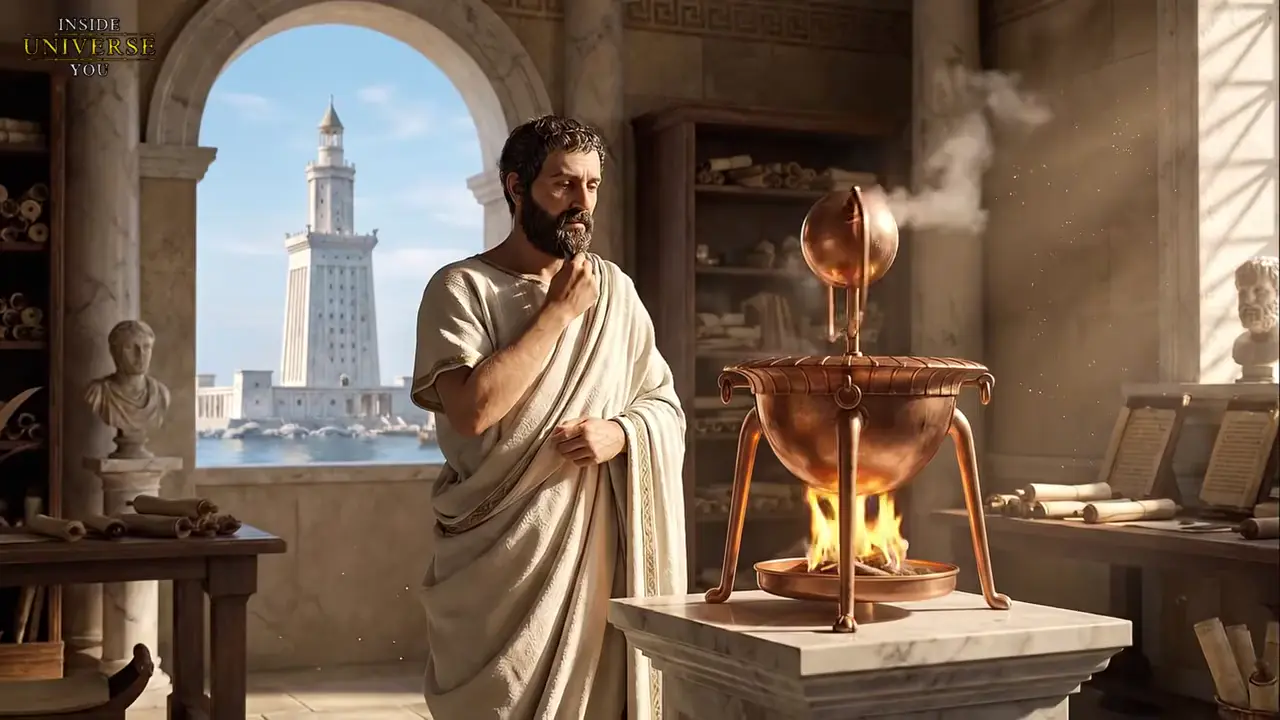
Hero of Alexandria built the world's first steam engine in the 1st century AD! ♨️ Steam from heated water spun a metal sphere via bent tubes. It worked — but the ancient world had no reason to scale it up. Fascinating demo, centuries ahead of its time! ⚙️
Hero of Alexandria's aeolipile: first steam engine in 1st century AD
Key facts
- Created by Hero of Alexandria in 1st century AD
- Known as the aeolipile or eolipile
- Sealed metal sphere mounted on axis with two bent tubes at opposite sides
- Water heated by flame produced steam traveling through pipe into hollow sphere
- Steam escaped through bent tubes, creating thrust that spun sphere
- Represented earliest known conversion of heat into mechanical motion
- Demonstrated principle that invisible vapor from heat could produce continuous motion
- Never developed into practical machine in ancient world
- Seen as fascinating demonstration rather than tool with real-world applications
- Ancient world lacked economic pressure to replace manual labor with machines
- Lacked supporting technologies like advanced metallurgy and pressure systems needed to scale it
Sources
Heron's Steam Enginesmith.edu
Aeolipile | Steam Turbine, Invention & Usagebritannica.com
Aeolipileen.wikipedia.org
How did Heron of Alexandria's aeolipile work?britannica.com
Aeolipile | National Museum of American Historyamericanhistory.si.edu
Aeolipile Mini Steam Engine Full Metal Hero's ...enginediy.com
Hero of Alexandriaen.wikipedia.org
Was this story useful?
Keep exploring
Every site on this page sits on the globe, and the people who research them are on the Discord.
3D Globe · Sites by country · Story Archive · Research Library · Weekly Journal · Search
AI-generated text · images from the original sources · always verify with the sources.