

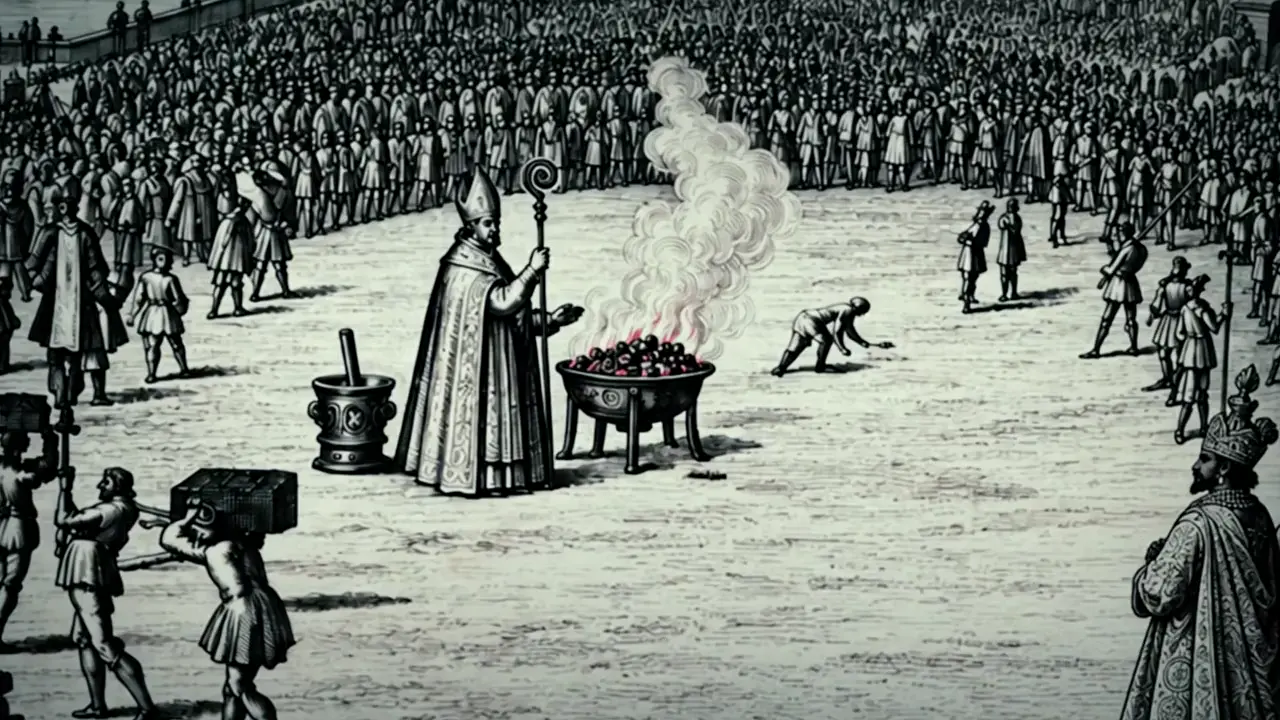
In 1561, outside the viceroy's palace in Goa, Archbishop Gaspar de Leao had the Buddha's tooth — displayed set in gold, rubies and sapphires — pounded in a mortar by hand, its powder burned on hot coals before arriving ambassadors. The relic survives today in seven golden caskets at Kandy's Temple of the Sacred Tooth. 🔥
Goa archbishop burns the Buddha's tooth in 1561; relic survives in Kandy
Site mentioned
📍 Temple of the Sacred Tooth
Key facts
- In Goa, Portuguese India, in 1561, a bronze mortar and a pan of hot coals were set up in the square outside the viceroy's palace before the Archbishop of Goa and arriving ambassadors.
- The viceroy displayed a tooth set in gold, rubies and sapphires; Portuguese soldiers who seized it called it a monkey's tooth, while buyers believed it was the Buddha's left canine.
- Almost everything known about the episode comes from Portuguese chroniclers, some writing decades later, and they do not always agree.
- One year earlier, in 1560, Viceroy Constantino de Braganca landed 1,200 soldiers outside Jaffna on the northern tip of Ceylon; a Dominican friar marched ahead with a banner of Christ crucified, and the mission was to punish Jaffna's king for massacring Christian converts.
- Inside the king's royal temple the soldiers found a tooth; one Franciscan is recorded as saying 'the devil is in that little bone.'
- In Pegu (now Myanmar), King Bayinnaung had sought the tooth for years and once sent a broom woven from his own hair to sweep the steps of its shrine.
- In 1561 the Pegu ambassadors offered 300,000 cruzados for the tooth, about 12 times the estimated 25,000 cruzados a year that Portugal's Asian empire was losing.
- Archbishop Gaspar de Leao arrived with two inquisitors; the Inquisition had operated in Goa for less than a year hunting secret converts, and the crown had ordered every idol in the colony smashed or burned.
- His argument was that selling an idol makes a person an idolater and the higher the price the greater the sin; the council was convened, a verdict signed, and the jewels were pried off and kept while the tooth was pounded in a mortar by the archbishop himself and the powder dumped on hot coals.
- Chroniclers swore the smoke stank worse than any burning bone and called it 'a pill from hell'; the ash was thrown into the river.
- Within 15 years the Christian ruler of Kotte claimed the Portuguese had burned a fake and sold what he called the real tooth to Pegu for a fortune in gold plus a shipload of rice each year.
- Sri Lankan monks insist the tooth was not in Jaffna during the raid, saying its keeper was warned in a dream, tucked the relic into his waistband and hid it beneath a giant grinding stone in the hills, which would mean a copy was burned.
- In 1592 a rebel general who had fought for the Portuguese seized the mountain kingdom of Kandy and declared himself King Vimaladharmasuriya I; for 12 centuries the island belief had held that whoever holds the tooth holds the right to rule, so he sent for the relic and built a temple for it beside his palace.
- The tooth is still enshrined at the Temple of the Sacred Tooth in Kandy, inside seven nested golden caskets; in April 2025 about 450,000 people stood in line to see it, the queue stretching 6 miles.
Sources
Kandy: The Tooth Portugal Swore It Burned in 1561guidesofia.com
'The Devil was in that Little Bone': The Portuguese Capture and Destruction of the Buddha's Tooth-Relic, Goa, 1561researchgate.net
Relic of the tooth of the Buddhaen.wikipedia.org
Was this story useful?
Keep exploring
Every site on this page sits on the globe, and the people who research them are on the Discord.
3D Globe · Sites by country · Story Archive · Research Library · Weekly Journal · Search
AI-generated text · images from the original sources · always verify with the sources.