

Five species were domesticated in the Americas: C. pubescens, C. baccatum, C. frutescens, C. chinense and C. annuum. Proto-Otomanguean likely had a word 'ki' for chili ~6,500 years ago, and wild annuum closest to domestic forms lives in northeastern Mexico — pointing to multiple domestications 🌶️
Five chili species domesticated in the Americas; C. annuum likely domesticated in several regions
Key facts
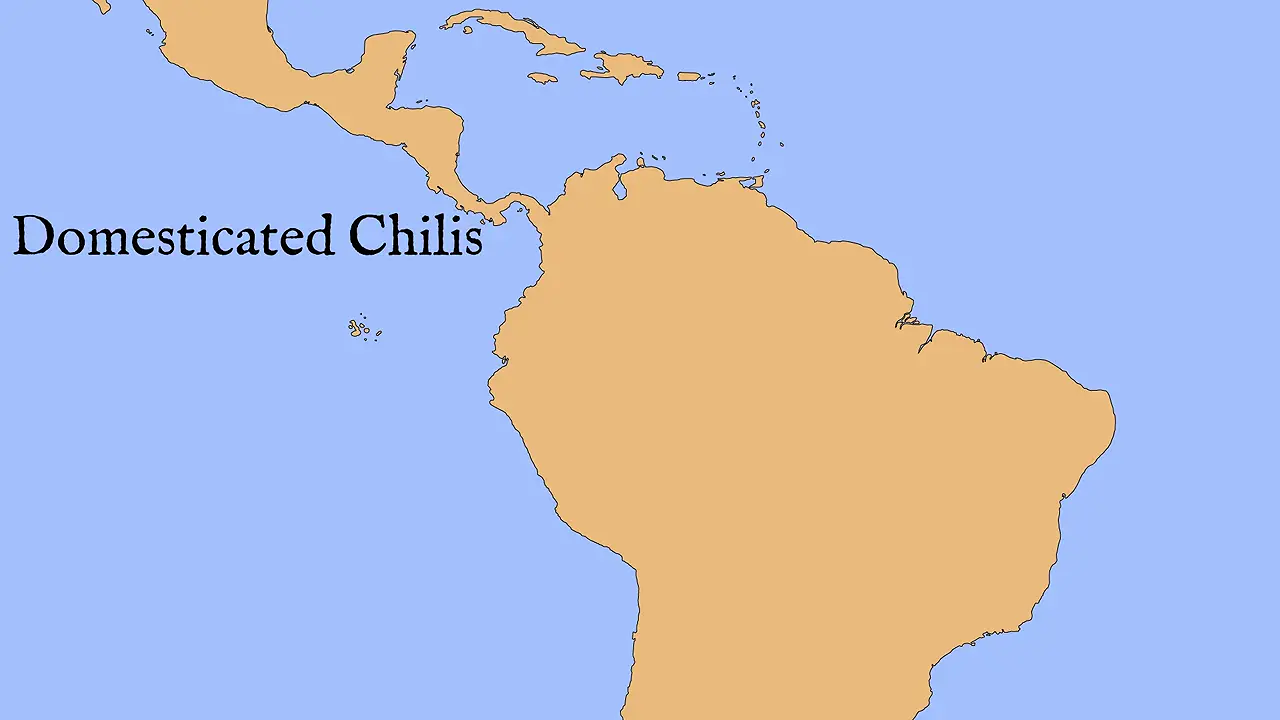
- Five species were domesticated in the Americas: Capsicum pubescens, C. baccatum, C. frutescens, C. chinense and C. annuum, grouped in the annuum, baccatum and pubescens clades.
- Capsicum pubescens (rocoto, from Quechua) has fuzzy stems and leaves, purple flowers and black seeds, ranges from 30,000 to 100,000 Scoville units, grows above 1,200 m, and its wild ancestor has never been identified and may be extinct; it was cultivated and consumed 4,000 years ago.
- Capsicum baccatum (aji amarillo, lemon drop) is the most commonly grown pepper in South America; its origin is placed in the Bolivian lowlands and valleys of Peru, with domestication around 2000 BCE, likely by Arawak or Guarani populations.
- Capsicum frutescens includes the Tabasco pepper; C. chinense (a name that is a misnomer) includes Scotch bonnet and habanero; C. annuum includes bell, jalapeno, Anaheim, cayenne and poblano.
- Genetic studies show that wild C. annuum varieties most genetically similar to domesticated ones inhabit northeastern Mexico.
- Linguistic analysis of reconstructed Mesoamerican proto-languages suggests Proto-Otomanguean probably had a word 'ki' for chili pepper dating back 6,500 years; the next oldest reconstructed words in other proto-languages are more than 3,500 years younger.
- Given the wild range and the climate 6,000 years ago, candidate domestication areas are the western and eastern coasts of Mexico, southeastern Mexico and northern Guatemala; more recent studies point to the Yucatan Peninsula and the coast of Guerrero as areas with stable Holocene environments favorable to wild C. annuum.
- The combined evidence indicates C. annuum was domesticated independently in multiple areas by different peoples, with east-central Mexico and the Yucatan as strong candidates, superseding older single-origin single-event theories.
Sources
docs.google.com
Linked in video description
Capsicum Speciesspicemad.com
Get spicy and learn about the five domesticated species of the Capsicum genus – C. annuum, C. baccatum, C. chinense, C. frutescens and C. pubescens.
Pepper variome reveals the history and key loci associated ...sciencedirect.com
by Y Cao · 2022 · Cited by 73 — About 42 species have been described in the Capsicum genus, including five domesticated species: Capsicum annuum L., Capsicum frutescens L., ...
Genomes of cultivated and wild Capsicum species provide ...scholars.duke.edu
Pepper (Capsicum spp.) is one of the earliest cultivated crops and includes five domesticated species, C. annuum var. annuum, C. chinense, C. frutescens, ...
Genomes of cultivated and wild Capsicum species provide ...nature.com
by F Liu · 2023 · Cited by 193 — includes five domesticated species, C. annuum var. annuum, C. chinense, C. frutescens, C. baccatum var. pendulum and C. pubescens.
Capsicum annuumen.wikipedia.org
It is one of the oldest cultivated crops, with domestication dating back to around 6,000. The genus Capsicum has over 30 species but Capsicum annuum is the ...
Was this story useful?
Keep exploring
Every site on this page sits on the globe, and the people who research them are on the Discord.
3D Globe · Sites by country · Story Archive · Research Library · Weekly Journal · Search
AI-generated text · images from the original sources · always verify with the sources.