

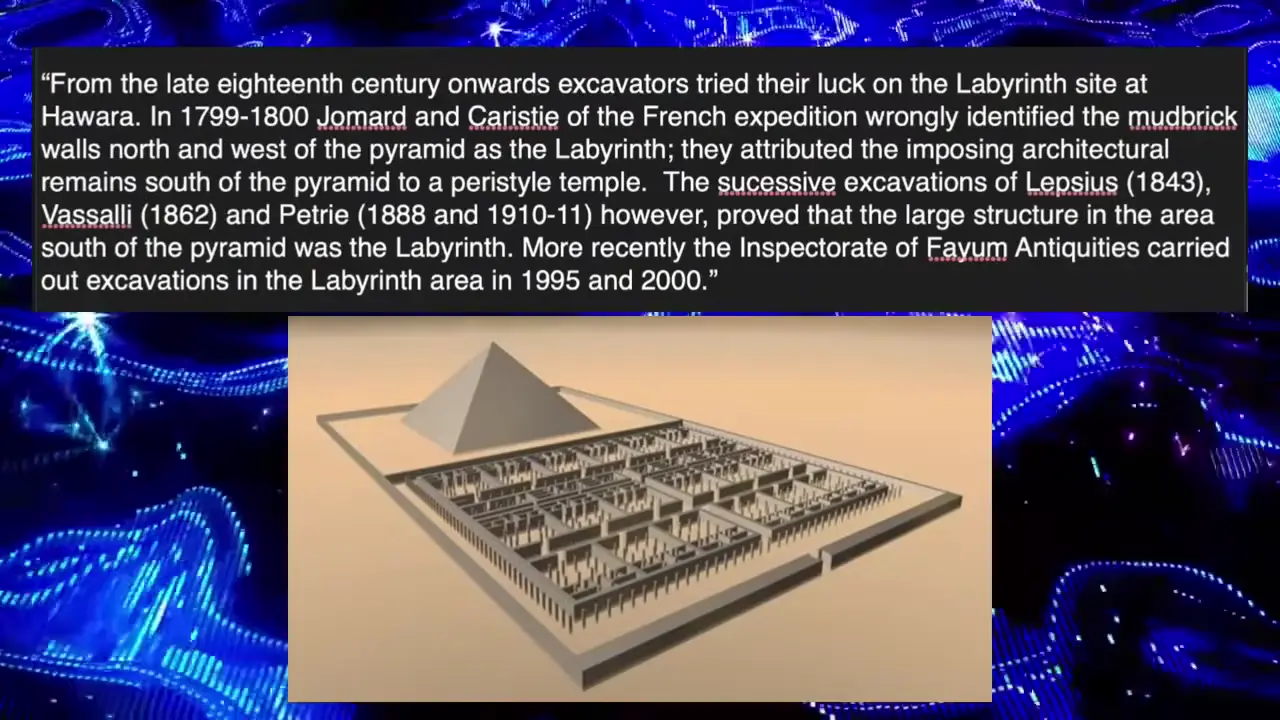
Archaeology at Hawara spans more than two centuries ⛏️ Members of Napoleon’s French expedition surveyed the site in 1799; Jomard and Carette mistook mud-brick remains for the labyrinth. Karl Richard Lepsius carried out the first major excavation in 1843, and some structures he identified were later dated to the Roman period. Flinders Petrie excavated in 1888–89 and 1910–11, linking the large complex south of Amenemhat III’s pyramid with the labyrinth. Egyptian inspectorate digs in 1995 and 2000 did not reach the underground chambers described by ancient writers. The video argues that a 2008 ground-penetrating-radar survey detected a huge underground structure at Hawara that may be the labyrinth’s below-ground portion; that identification is not established.
Excavation history of the Hawara labyrinth, from 1799 onward
 EgyptGeneral
Key facts
- Members of Napoleon’s French expedition, Jomard and Carette, surveyed Hawara in 1799 and wrongly identified mud-brick remains as the labyrinth.
- Karl Richard Lepsius excavated Hawara in 1843, conducting the first major systematic excavation there; some structures he identified were later dated to the Roman period.
- Flinders Petrie excavated at Hawara in 1888–89 and 1910–11 and identified the large complex south of Amenemhat III’s pyramid as the labyrinth.
- The Egyptian inspectorate excavated in 1995 and 2000, but these campaigns did not reach the underground chambers described in ancient accounts.
- A 2008 ground-penetrating-radar survey detected a large underground anomaly at Hawara; its identification as the labyrinth’s below-ground portion remains a hypothesis.
Sources
Space-Based Ground Penetrating Imaging of the Ancient ...papers.ssrn.com
Labyrinth of Egypten.wikipedia.org
Was this story useful?
Keep exploring
Every site on this page sits on the globe, and the people who research them are on the Discord.
3D Globe · Sites by country · Story Archive · Research Library · Weekly Journal · Search
AI-generated text · images from the original sources · always verify with the sources.