

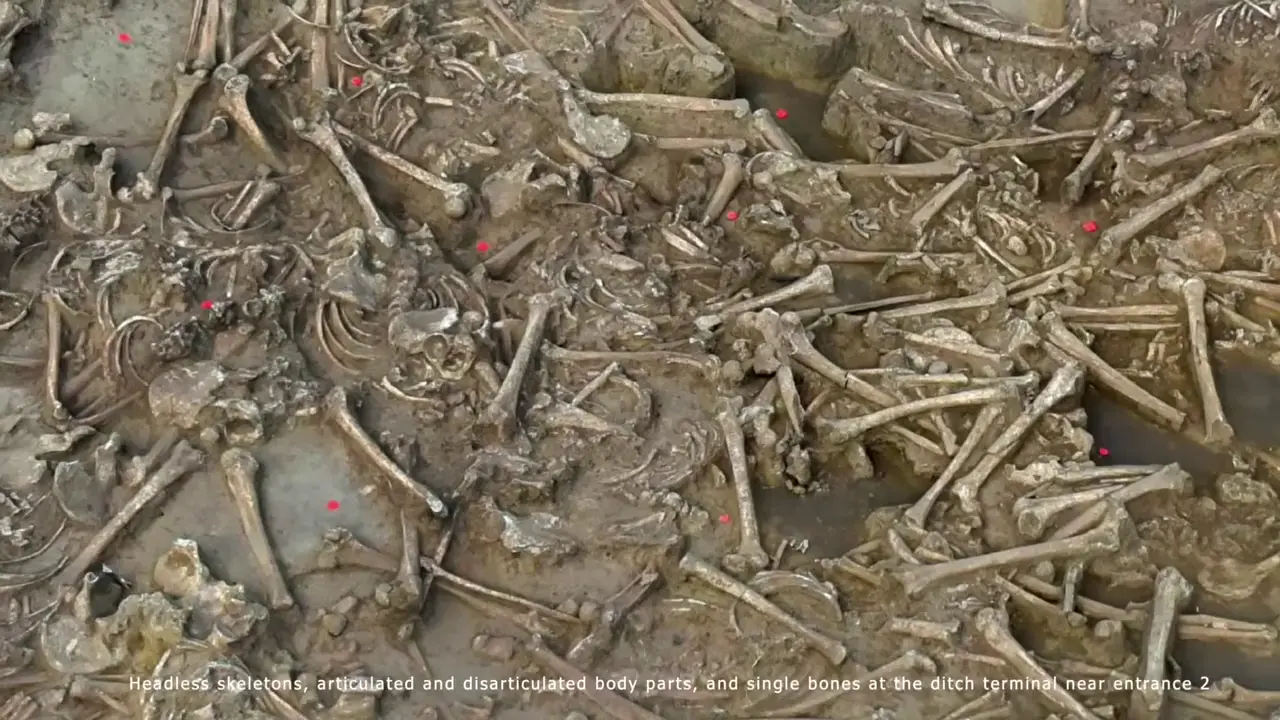
New research from Vráble suggests those headless Neolithic bodies weren't victims of massacre. Biological anthropologist Dr. Katina Fuks found cut marks on neck vertebrae indicating careful skull removal, not hacking. Articulated hands and feet suggest fresh deposits, while carefully placed pebbles hint at structured ritual practice, per Prof. Martin Furholt.
Evidence at Vráble argues against massacre interpretation
Site mentioned
📍 Vráble🌍 Show on the globe
Key facts
- Dr. Katina Fuks (biological anthropologist) identified cut marks on cervical vertebrae consistent with careful, deliberate skull removal rather than forceful chopping
- Fragile joints (hands, feet, neck) were still articulated on many individuals, suggesting relatively fresh deposit
- Thorough search of entire ditch system recovered only a handful of skull fragments
- Over 100 individuals identified across ditch system including complete formal burials with grave goods, isolated bones, paired headless individuals, and mixed groups
- Deliberate deposits of pebbles placed alongside and around bodies suggest structured, meaningful, repeated practice
- Professor Martin Furholt argues these reflect elaborate mortuary and cosmological practices where the head held particular significance
Sources
The LBK site of Vráble in Southwestern Slovakia: Selected results ...academia.edu
The excavation of the LBK site at Vráble in Southwestern Slovakia revealed key insights into the Neolithic community's social structure and settlement ...
Neolithic Settlement Vrábleen.wikipedia.org
The Linear Pottery settlement Vráble-Veľké Lehemby is a significant archaeological site from the early Neolithic in southwestern Slovakia.
Headless Neolithic Skeletons Uncovered in Slovakiaarchaeology.org
Vráble, a Neolithic site in southwestern Slovakia occupied between 5250 and 4940 B.C., according to a Live Science report. indicate that the ...
The Missing Heads of Vrábleanthropology.net
Seventy-seven headless skeletons have been excavated from a ditch at the edge of a 7,000-year-old farming village in southwestern Slovakia. They ...
Neolithic Bodies in Vráble – 7000 year-old Headless Human Skeletons in an ...cambridge.org
We present here the extraordinary find of an Early Neolithic mass deposition of headless human bodies at the LBK settlement site of Vráble-Veľk ...
Was this story useful?
Keep exploring
Every site on this page sits on the globe, and the people who research them are on the Discord.
3D Globe · Sites by country · Story Archive · Research Library · Weekly Journal · Search
AI-generated text · images from the original sources · always verify with the sources.