

In 1576 Spanish soldiers beyond the Rio Salado in Argentina reported 'an enormous piece of clean iron, 20 tons', with no mine within 100 miles — the earliest European record of a meteorite in the Americas. In 1799 a chip chiselled off it yielded the first nickel ever identified in a meteorite. 🪨
El Meson: the 20-ton Argentine meteorite mass behind the 'sky iron' legend
Key facts
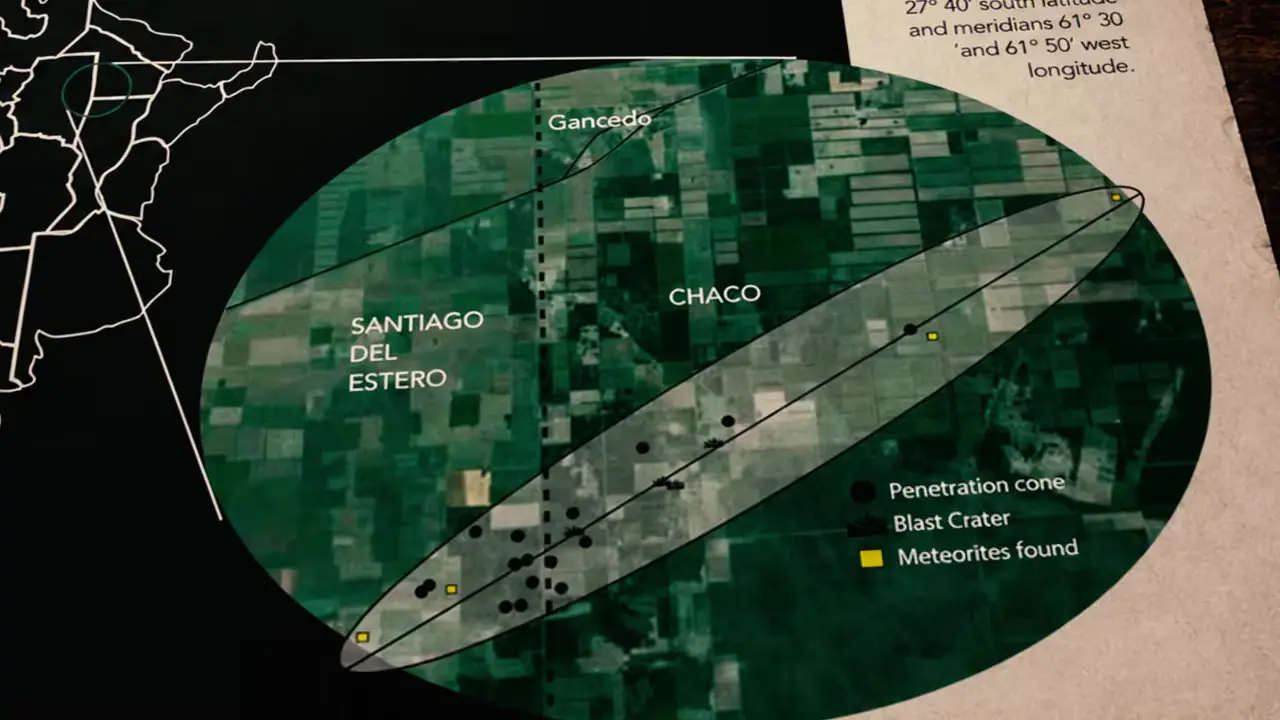
- In July 1576 Spanish soldiers riding beyond the Rio Salado in northern Argentina were ordered by the governor to find where the metal 'is bred and lies' and haul it home; they reported 'an enormous piece of clean iron, alone on a dead flat plane, 20 tons by later estimates', with no mountain or mine within 100 miles.
- This is described as the earliest European record of a meteorite in the Americas.
- Later accounts give the place an indigenous name usually translated as 'field of the sky'; the Jesuit Jose de Aguirre recorded a local story that 'the sun fell and rivers of fire ran', possibly a memory of the impact.
- The video states that about 4,000 years earlier an asteroid broke apart over the Gran Chaco, raining iron down a corridor roughly 100 m wide.
- In 1783 naval lieutenant Miguel de Rubin was sent by the king to find the silver the tribes were said to carry; he found an immense table of iron instead, dug beneath it, levered and blasted the ground below, and found only earth. The mass was left lying in the pit and was never seen again.
- In 1799 a chip chiselled from the mass yielded the first nickel ever identified in a meteorite; the 'silver' was in fact nickel.
- Provincial maps kept using the mass as a boundary marker between two provinces for about two centuries; in 1873 Santiago del Estero passed a law offering a cash prize plus 200 km of land to whoever located it, repealed in 1937 after a claim by Juan B. Rivarola, who had insisted he invented a rainmaking machine.
- In 1961 geologist William Cassidy began magnetometer surveys of the area; in 1969 his team excavated the El Chaco mass of 28 tons but never relocated El Meson.
- The video notes that no blade of 'sky iron' has ever been identified; Argentine historian Edgardo Manniti proposed that local smiths carved the mass up into knives, spurs and mate straws.
- A curled iron shaving of 19 g in Vienna's Natural History Museum, bought from a Madrid mineral dealer in 1807 and labelled 'Tucuman', has a shape consistent with iron torn violently from a larger mass.
Sources
Campo del Cielo Meteorite - Lunar and Planetary Institutegoogle.com
No information is available for this page.
Genuine Campo del Cielo Meteorite The name ...google.com
This is an iron meteorite. The first record of the Campo was in 1576. A Spanish governor learned of the iron from the Indians who reportedly ...
Meteorite/Moon Rockgoogle.com
Campo del Cielo (“Field of Heaven”) The craters, containing iron masses, were reported in 1576,
Campo del Cieloen.wikipedia.org
In 1576, the governor of a province in northern Argentina commissioned the military to search for a huge mass of iron, the Spanish translated as Campo del ...
Campo del Cielo Meteoriteaerolite.org
In 1576, an expedition in northern Argentina discovered a large mass of iron after hearing native legends of its existence–they claimed the mass had fallen ...
Was this story useful?
Keep exploring
Every site on this page sits on the globe, and the people who research them are on the Discord.
3D Globe · Sites by country · Story Archive · Research Library · Weekly Journal · Search
AI-generated text · images from the original sources · always verify with the sources.