

Incredible: the presenter owns a late 19th-century reprint of handwritten early 18th-century letters that may contain the earliest drawings of the Bent Pyramid's interior. The anonymous Italian author called the Red the "Pyramid of the Mummies open" and the Bent the "Pyramid of the Mummies closed," measured the base at 260 paces a side, and described recesses in the passage walls — an earliest known mention of those openings 📜⛏️
Early 18th-century Italian manuscript holds first drawings of the Bent Pyramid's interior
 EgyptEpigraphy
Site mentioned
Key facts
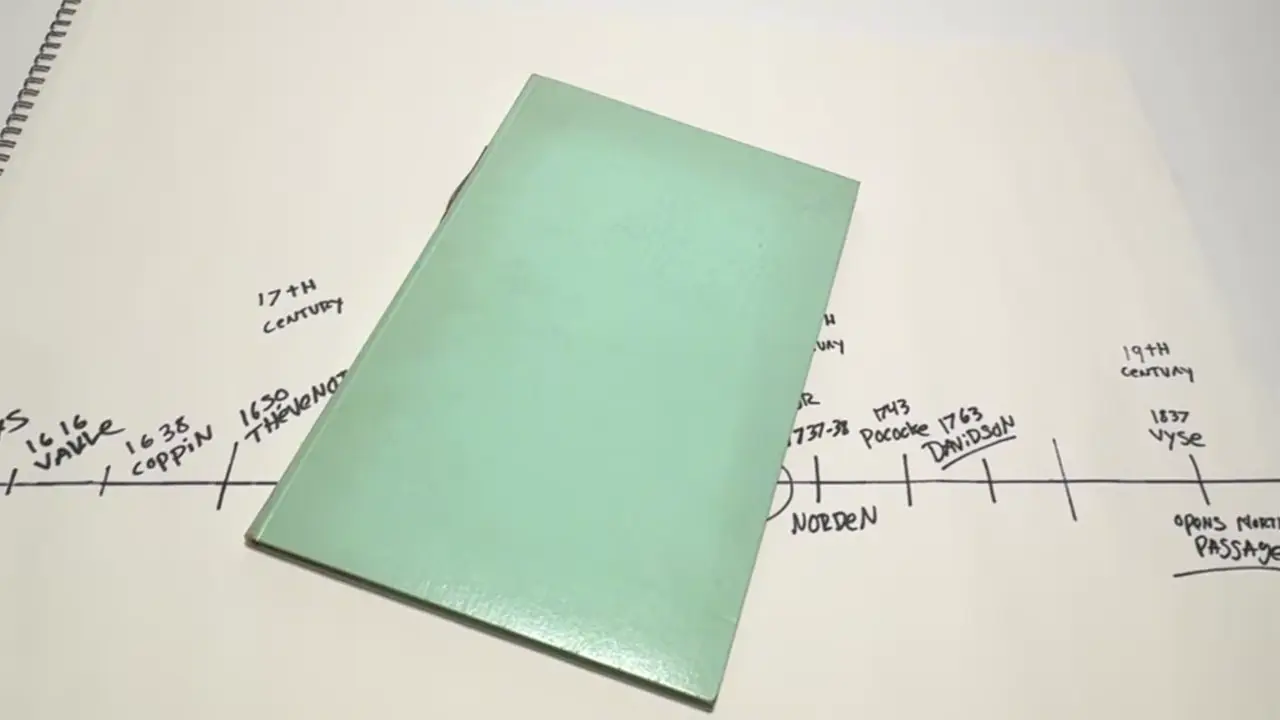
- Richard Pococke's 1743 book includes a map with legend and approximate scale distinguishing Saqqara and Dahshur; its legend identifies Pyramid P as the Red Pyramid and Pyramid Q as the Bent, and page 51 clarifies that "Pyramid of Rhodope" means the Red Pyramid; on page 52 he says the Bent Pyramid's entrance was too high and dangerous to enter and that the passage was closed.
- Nathaniel Davison climbed the Bent Pyramid in 1763, an extraordinary feat not performed by most travelers, and entered the northern passage to a depth of 174 ft, finding anything beyond extremely difficult.
- The centerpiece is a rare late 19th-century reprint of handwritten letters from the early 18th century, physically owned by the presenter, containing what he believes are the earliest drawings of the Bent Pyramid's internal structure.
- The anonymous Italian author called the Red Pyramid the "Pyramid of the Mummies open" and the Bent the "Pyramid of the Mummies closed", and corrected Pietro della Valle's account, including the Red Pyramid's chamber dimensions.
- He measured the Bent Pyramid's base at 260 of his paces per side, noted its casing was almost entirely intact and that the sides change inclination at mid-height, and recorded the entrance mouth as 30 ft above the ground, 4.5 ft high and 3 ft wide for two pertiche before narrowing to 3 ft square.
- He described shallow recesses with four-sided openings in each passage wall beyond a further two pertiche, three sides about 3 ft long and the lower side less than 1 ft, extending only about 3 ft into the walls.
- Using the Vicentini foot of 35.7 cm (the unit associated with Renaissance architect Andrea Palladio), his descent of 164 ft converts to 58.55 m (192 US ft); four pertiche of about 2.96 m each, 11.84 m, plus that distance totals 70.39 m (233.3 ft), close to the measured 243 ft of the northern passage.
- His four pertiche (38.8 ft) match the area of the continuous joint, 12.6 m (41.2 ft) from the entrance, which the video argues identifies the recesses he described — the earliest known mention of those openings.
- He crawled 30 ft horizontally on his belly into the stone- and sand-filled passage before being stopped by stone he had no time to remove.
- Vyse and Perring found the antechamber packed with small squared stones forming a steep ramp up to the lower chamber floor, and after the stones were removed, a robber's tunnel dug into the south wall up to 2 m deep; the video interprets the traveler's 30 ft burrow as having been dug mostly beneath that stone ramp.
- The traveler's text records that visitors threw stones down the Red Pyramid's horizontal passage for the echoing sound, which the video proposes as the main reason roughly 75 ft of loose stone was introduced and the Bent Pyramid's northern passage was clogged by 1763.
- The presenter located the original handwritten letters in an archive; the handwritten page 62 carries a second diagram showing the sloping northern passage and the horizontal burrow ending in the packed stone, presented here as the first time it has been shown.
Sources
81 A description of the east and some other countries 1743 ...picryl.com
A Plan of the Pyramids of Gize near Cairo - Pococke Richard - 1743. Richard ... A Plan of the Pyramids of Saccara, and Dahsour - Pococke Richard - 1743 ...
A description of the East, and some other countriesarchive.org
A description of the East, and some other countries ; Publication date: 1743 ; Publisher: London : Printed for the author, by W. Bowyer : And sold ...
Richard Pocockeirishegyptology.com
View of the Pyramids of Dashour and Saccara, Details from Pococke (1743), Plate VIII. In March, Pococke sailed from the port of Damietta to Jaffa on a pilgrim ...
A description of the east by Richard Pococke, 1743archives.lib.byu.edu
A description of the east by Richard Pococke, 1743. Early exploration of Egypt (18th and 19th centuries),
A Description of the East: And Some Other Countriesbooks.google.com
Richard Pococke author, 1743 - Botany. Views of the pyramids of Dashour. A view of two pyramids that calld the pyramid with steps and ano 148
Was this story useful?
Keep exploring
Every site on this page sits on the globe, and the people who research them are on the Discord.
3D Globe · Sites by country · Story Archive · Research Library · Weekly Journal · Search
AI-generated text · images from the original sources · always verify with the sources.