

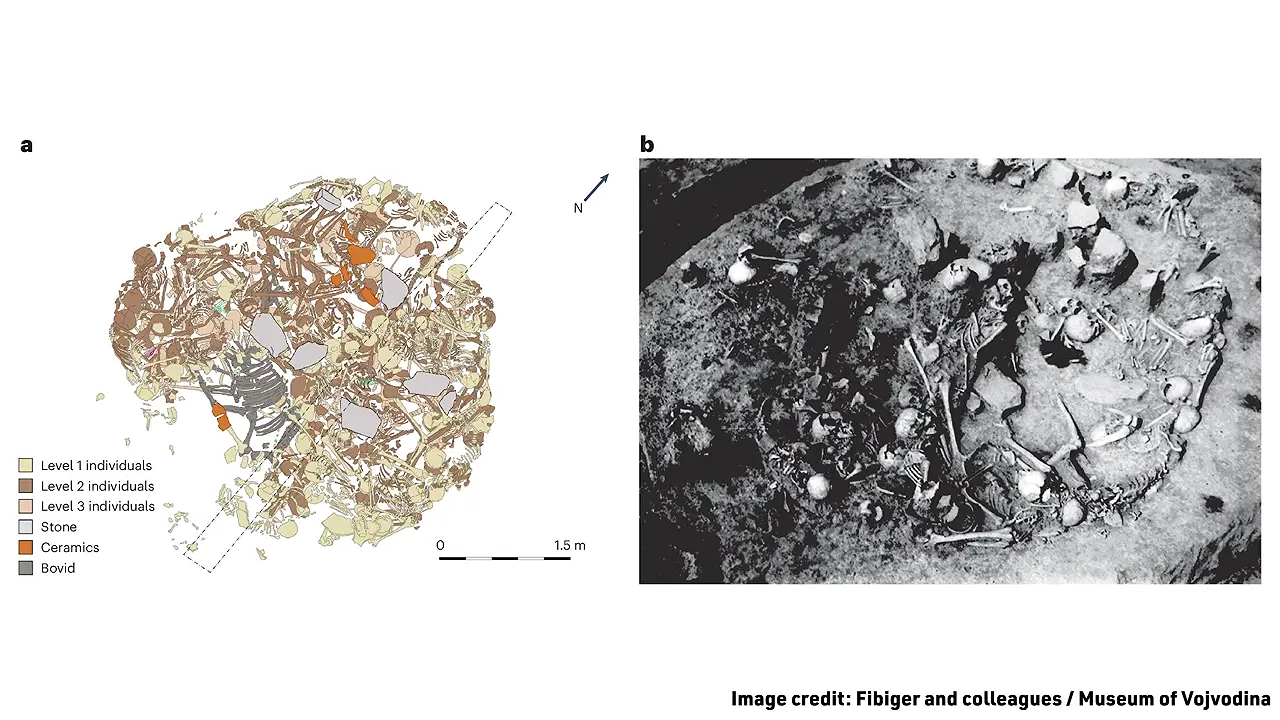
At Gomolava [Hrtkovci] in northern Serbia, a 9th-century BCE grave held 77 people, mostly children and teens. Ancient DNA found no pathogen — instead blows, cuts and pointed-weapon wounds. Of 72 sexed individuals, 51 were female, pointing to a deliberate massacre, not an epidemic ⚔️
DNA study confirms deliberate massacre of women and children at Gomolava [Hrtkovci]
Site mentioned
📍 Gomolava [Hrtkovci]🌍 Show on the globe
Key facts
- At Gomolava [Hrtkovci] in northern Serbia, archaeologists uncovered 77 individuals buried together in a grave dated to the 9th century BCE, about 2,800 years ago.
- Most of the dead were children and adolescents.
- Earlier investigators had proposed an epidemic, but a re-examination of the skeletons with ancient DNA testing published this year found no pathogen DNA.
- Instead the team documented a pattern of violent injuries: blows to the head, cuts, and injuries from pointed weapons; one cut to an upper arm was interpreted as a possible defensive injury.
- Of the 72 individuals whose sex could be determined, 51 were female, and the combination of injuries, age and sex led the team to conclude that women and young people were deliberately targeted.
- Usable DNA was recovered from 25 individuals, allowing kinship testing: a mother was buried with two daughters, while most others were not close relatives.
- Diets varied, and strontium measurements in teeth indicated that some individuals grew up outside the immediate area.
- The team interprets the event as an attack on selected members of the population, potentially a way of asserting control over land and resources, with consequences beyond one household or village.
- A young cow was placed beneath the bodies; the grave also held bronze ornaments, pottery, other animal remains, broken grain-grinding stones and burnt seeds, indicating a deliberate post-massacre ceremony.
Sources
A large mass grave from the Early Iron Age indicates ...nature.com
by L Fibiger · 2026 · Cited by 4 — Gomolava, located in Northern Serbia in the south Carpathian Basin, is one of the largest prehistoric single-event mass graves excavated so far ...
A large mass grave from the Early Iron Age indicates selective ...arch.ox.ac.uk
... 77 and biomolecular analysis of 25 individuals from a ninth-century BCE mass grave from Gomolava in the Carpathian Basin, Southeast Europe.
A 2850-year-old mass grave in Serbia reveals a shift in ...theconversation.com
The site at Gomolava, first excavated in 1971, is the second of two contemporary mass graves. It contained 77 people. Our recent study has ...
Iron Age mass grave may hold unusual victimssciencenews.org
Archaeologists found the ancient Gomolava burial pit in northern Serbia more than 50 years ago, and a new genetic study shows it held mostly ...
Iron Age mass killing in Serbia: 77 women and children ...archaeologymag.com
Archaeologists uncover a 2800-year-old mass grave in Serbia, revealing the violent deaths of 77 people, mostly women and children.
Was this story useful?
Keep exploring
Every site on this page sits on the globe, and the people who research them are on the Discord.
3D Globe · Sites by country · Story Archive · Research Library · Weekly Journal · Search
AI-generated text · images from the original sources · always verify with the sources.