

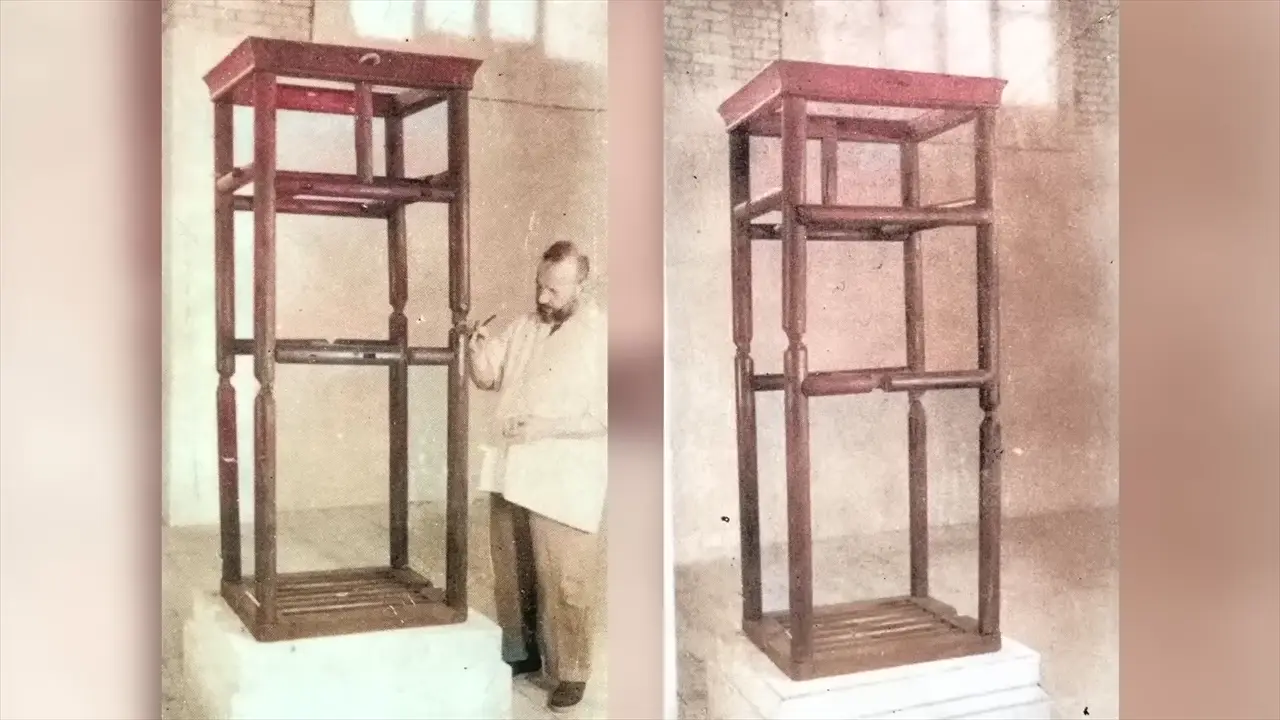
A second passageway in G2-A was discovered by chance in 1960, sealed with a T-shaped limestone closure. Inside, excavators found a wooden box containing layered cedar wood cylinders — clearly hacked apart before placement. Restored by the same craftsman who rebuilt Khufu's solar boat, Mark Lehner and Zahi Hawass identified it as a divine booth for a life-size statue. 🪵
Discovery of sealed wooden box in western serdab passageway of Pyramid G2-A
Site mentioned
📍 Pyramid G2-A
Key facts
- A second descending passageway on the western side (serdab) was discovered by chance in 1960
- A T-shaped limestone closure stone sealed the entrance, fixed to bedrock by gypsum mortar
- Three plug blocks measuring 1.2 m, 1.35 m, and 1.8 m long and weighing 1.48, 1.61, and 2.23 tons were removed
- A wooden box measuring 105 cm long, 49 cm wide, and 29 cm high was found in a niche in the south wall
- The box was secured with four nails and a rope and contained layered cylindrical pieces of cedar wood
- The wooden object had been hacked apart with an axe or chisel before placement in the box
- The object was restored by Egyptian master restorer Haj Ahmed Yusef Mustafa, who also restored Khufu's solar boat
- Mark Lehner and Zahi Hawass identified the restored object as a divine booth large enough to hold a life-size statue
Sources
A sequential double-label 2-deoxyglucose method for measuring ...pubmed.ncbi.nlm.nih.gov
A sequential double-label 2-deoxyglucose method for measuring regional cerebral metabolism.
The Georgia guardsman, vol. 10, no. 1 (January, February 1960)dlg.usg.edu
Collection: Georgia Government Publications; Title: The Georgia guardsman, vol. 10, no. 1 (January, February 1960); Creator: Georgia.
[PDF] Variability of Scribal Practices in the Copy of Retrograde Texts ...shs.hal.science
The scribe can omit some passage in order to avoid destructuration or modifies the disposition of the columns – like on the papyrus of ...
Scarab of Nebirierau I - Second Intermediate Periodmetmuseum.org
This scarab is inscribed with a large cartouche containing the royal name Sewadjenre, which is generally associated with the Theban king Nebirierau I...
The Great Gatsby Part II - by Rob Schwartz - RobSchwartzHelpsrschwartz.substack.com
Seven years after Gatsby's death, Ashes in the Garden returns us to the ruins of the Jazz Age. The East Egg lawns have grown quiet, the parties ...
Was this story useful?
Keep exploring
Every site on this page sits on the globe, and the people who research them are on the Discord.
3D Globe · Sites by country · Story Archive · Research Library · Weekly Journal · Search
AI-generated text · images from the original sources · always verify with the sources.