

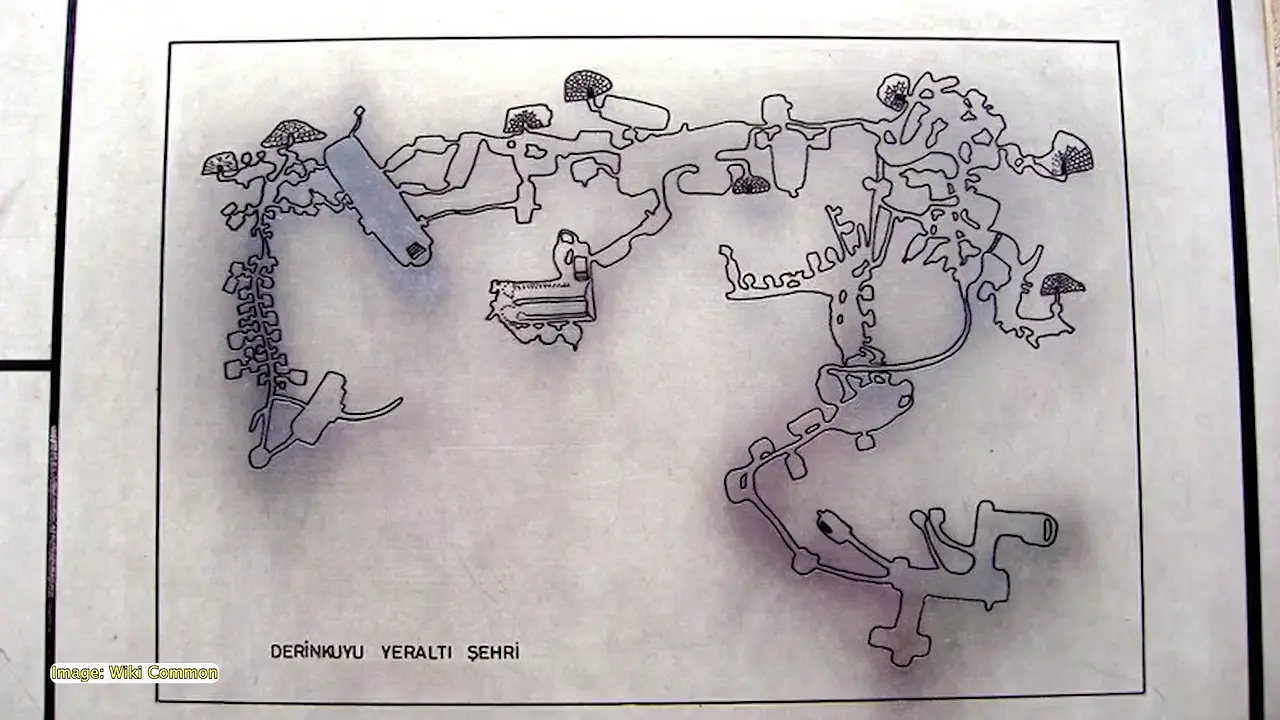
Derinkuyu Underground City, an underground city beneath the cone-shaped rocks of Cappadocia, Turkey, reaches roughly 85 m below the surface and was rediscovered in 1963 when a local's chickens kept vanishing into a crack that opened in his basement during renovation — the first of some 600 entrances. Its date is debated: the earliest theory credits Hittites or Phrygians, the oldest written reference (370 BCE) describes Anatolians living in excavated underground homes, and it was fully formed by the Roman period. Carved into soft volcanic rock with shovels and pickaxes, it reached about 18 levels and, enlarged during the Byzantine wars, could shelter around 20,000 people. Half-ton circular boulders blocked doors between levels, movable only from the inside, with small holes for thrusting spears at attackers. More than 50 ventilation shafts and wells kept it supplied, the main well dug over 55 m deep and cuttable from below. Near-surface stables kept livestock odors away from deeper houses, cellars, meeting spaces and a Byzantine missionary school. Cappadocian Greeks and Armenians used it to escape Ottoman religious persecution until the 1923 expulsion of Christians. Derinkuyu Underground City is one of roughly 200 underground cities in the region. 🕯️
Derinkuyu Underground City underground city rediscovered in 1963 via a crack in a basement
 TürkiyeGeneral
Key facts
- Derinkuyu Underground City is an underground city beneath the cone-shaped rock formations of Cappadocia, Turkey, reaching roughly 85 m below the surface.
- It was abandoned in the 1920s and largely forgotten, then rediscovered in 1963 by an anonymous local whose chickens kept disappearing into a crack that opened in his basement during renovation; digging further revealed a passageway, the first of some 600 entrances.
- Its construction date is debated; the earliest theory attributes it to the Hittites or Phrygians, while the oldest written reference, from 370 BCE, describes Anatolian people living in excavated underground homes, and the city was fully formed by the Roman period.
- Tunnels and rooms were cut into the soft volcanic rock of the region, which contains little water and could be carved with basic shovels and pickaxes, and the settlement reached about 18 levels deep.
- Originally used largely for storage, it was enlarged during the Byzantine wars to shelter residents from raiding armies, reaching a peak capacity of around 20,000 people.
- Massive half-ton circular boulders blocked the doors between levels and could only be moved from the inside, with small round holes through their centers allowing spears to be thrust at attackers.
- The city was supplied by a network of wells, water channels and more than 50 ventilation shafts; the main well was dug more than 55 m deep and could be cut off from below.
- Stables near the surface kept livestock odors and warmth away from deeper levels, which contained houses, cellars, barrel-vaulted rooms, meeting spaces and a Byzantine missionary school with study rooms on the second floor.
- Underground living continued into the 14th century and up to the 20th, with Cappadocian Greeks and Armenians using the city to escape Ottoman religious persecution; after the 1923 expulsion of Christians the city was abandoned.
- Derinkuyu Underground City is one of roughly 200 underground cities found in the region, many connected to it by tunnels and equipped with emergency escape routes.
Sources
Derinkuyu Underground City, Cappadociathemaritimeexplorer.ca
Derinkuyu underground cityen.wikipedia.org
Cappadocia's Underground Cities: Derinkuyu & Kaymaklı Guidevisitcappadocia.com
Was this story useful?
Keep exploring
Every site on this page sits on the globe, and the people who research them are on the Discord.
3D Globe · Sites by country · Story Archive · Research Library · Weekly Journal · Search
AI-generated text · images from the original sources · always verify with the sources.