

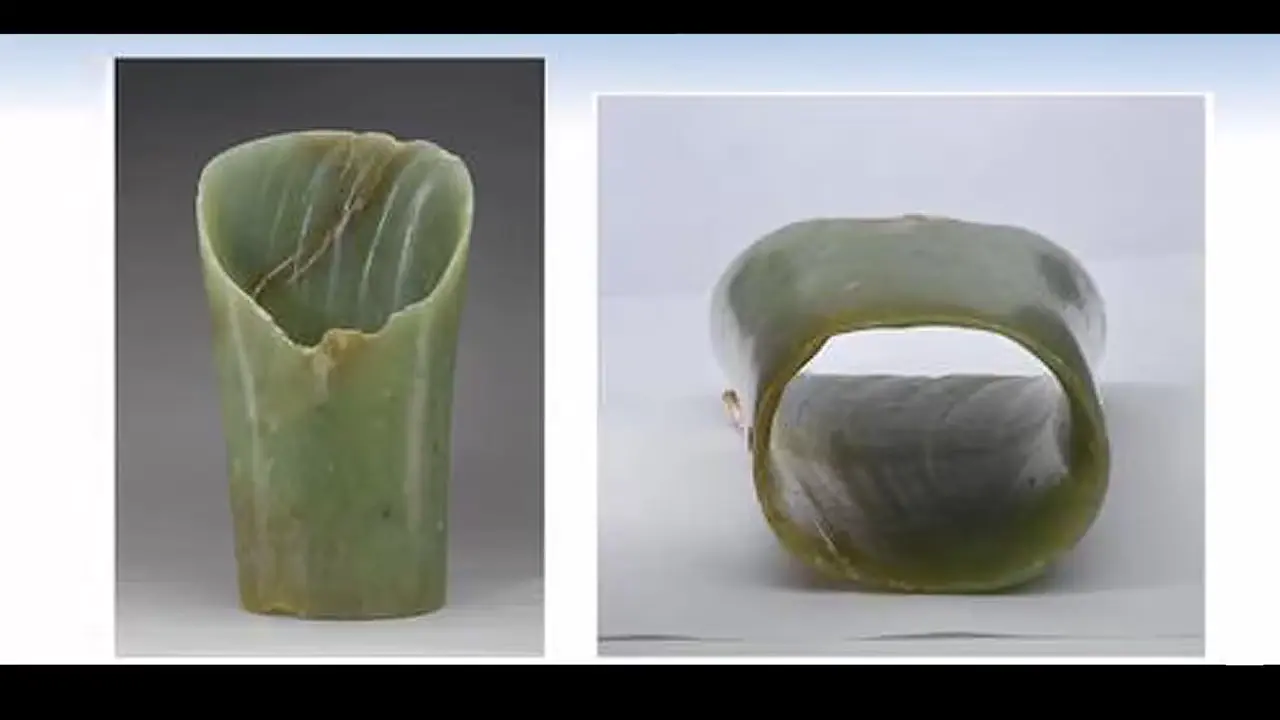
How did Neolithic craftsmen hollow out these tough nephrite tubes? They used cord saws with abrasive slurry: flexible cord (likely plant fiber or sinew) drawn back and forth while quartz sand, garnet, and corundum particles wore through the stone. Unlike rigid saws, flexible cords bow under tension, leaving curved grooves inside the tubes that researchers call "fingerprints of the craftsman." The two base holes were drilled with hollow bamboo or stone bits. Modern experimental archaeology has fully confirmed this process produces marks indistinguishable from genuine artifacts. Flawless 1mm walls required months of careful continuous labor on a single piece.
Cord saw technique with abrasive slurry confirmed by experimental archaeology
Key facts
- Interior surfaces contain gently curved, shallow concave markings—cord saw marks from the manufacturing process
- Craftsmen used flexible cord or string (likely plant fiber or sinew) drawn back and forth across the stone in a continuous sewing motion
- The cord delivered an abrasive slurry of water mixed with quartz sand, garnet, and corundum—all harder than nephrite on the Mohs scale
- The moving cord carried abrasive particles against the stone surface, wearing through material via friction
- Production process: rough shape the stone, drill a small hole through it, thread cord through and saw off the center core based on a guideline
- Unlike rigid saw blades that cut straight lines, flexible cords bow under tension, leaving curved grooves
- Those curved marks preserved inside jade objects for 5,000 years are described as 'fingerprints of the craftsman'
- Modern experimental archaeology has confirmed the process entirely—researchers produced tool marks on nephrite indistinguishable from genuine Neolithic artifacts
- The two small paired holes at the base were drilled using hollow bamboo or stone drill bits rotating against abrasive slurry
- Ancient Chinese tradition described jade working in four sequential verbs: cutting, grinding, carving, and polishing
- Flawlessly smooth, semi-translucent millimeter-thin walls required months of careful continuous labor on a single object
Sources
Wire saws for faceting boulders - Ganoksin Orchidorchid.ganoksin.com
Nephrite isn't particularly hard, but it is very tough. I wouldn't ... diamond grit in a bronze tube and braze it onto the edge of your
Sailrite® Blade™ Cordless Foam Saw 12V Packagesailrite.com
Cutting seating foam has never been easier with the Sailrite Blade Cordless Foam Saw. Cuts foam up to 8" thick. Rechargeable batteries mean you can move ...
Husky PVC Cable Saw (8-Pack) 410-262-0111 - The Home Depothomedepot.com
This exclusive Husky PVC Cable Saw is an ingeniously versatile cutter for use in confined work areas. Great addition to any plumber's tool box.
Orbitalum Pipe & Tube Sawsorbitalum.us
Available in standard, MVM and AVM models, Orbitalum's best selling GF series saws, the GF 4 and GF 6, set the standard for precise, square, burr-free cuts. To ...
The Tube Saw - Tri Tool Technologiesstore.tritool.com
The Tube Saw from Tri Tool – get lightning-fast cuts with unmatched accuracy from the first tube saw with ambidextrous operation features.
Was this story useful?
Keep exploring
Every site on this page sits on the globe, and the people who research them are on the Discord.
3D Globe · Sites by country · Story Archive · Research Library · Weekly Journal · Search
AI-generated text · images from the original sources · always verify with the sources.