

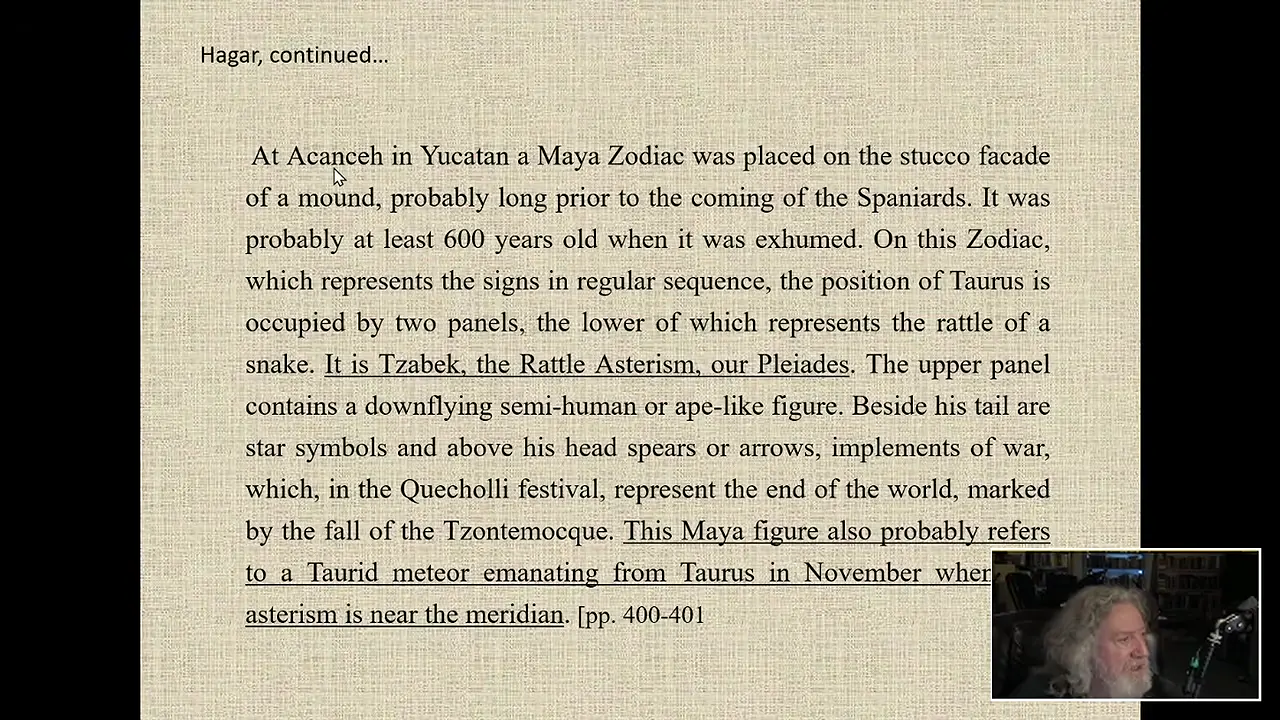
Stansberry Hagar's 1931 Popular Astronomy paper describes a Maya zodiac painted on a stucco mound facade in the Yucatan. Two panels occupy Taurus: a snake's rattle, read by Hagar as the Pleiades, and above it a down-flying ape-like figure with stars and spears — a Taurid meteor. Related traditions appear in the Vaticanus 3773. 🐍
Codex Borgia and Vaticanus 3773: Tzontemac, the Mesoamerican falling god, and the Pleiades
Key facts
- Stansberry Hagar's 1931 paper 'The November Meteors in Maya and Mexican Tradition' appeared in Popular Astronomy, volume 39, number 7.
- Hagar described a Maya zodiac painted on the stucco facade of a mound in the Yucatan, placed there long before the arrival of the Spaniards; the presenter states he visited the site, found the facade more eroded than in the 1930s, photographed it, and obtained a colorized depiction of the zodiac as it appeared in 1933, when the panel was already partly destroyed.
- In that zodiac the position of Taurus is occupied by two panels, the lower showing the rattle of a snake, identified by Hagar as the Pleiades ('rattle asterism'), and the upper containing a down-flying semihuman or ape-like figure with star symbols and spears or arrows, which the paper links to the end of the world in the Caholi festival and to a Taurid meteor.
- The Codex Borgia depicts Zanttomach (Tzontemac), a fallen god associated with the Lord of the Dead, shown with a Mayan rattlesnake glyph and six star symbols beside him; the Vaticanus 3773, which predates the arrival of the first Spaniards in Mexico, carries related traditions.
- Hagar proposed the Zanttomach were November meteors whose 'falling hair' referred to the fiery trails left behind, and that the Mexicans distinguished meteor groups, referring to the fall of Zanttomach on the day of the eagle, which pertains to Taurus, hence Taurid meteors.
- Sheet 8 of the Vaticanus 3773 shows a fallen god with upward legs adjacent to a boat- or ark-like symbol, a juxtaposition Hagar read as the fallen god with the symbol of the deluge; another figure holds a sharp implement pointed down toward the earth above an urn, which the presenter reads as the overturned urn of the great flood.
Sources
A travel advisor's guide to Dia de Muertos experiencestravelweekly.com
DIA DE LOS MUERTOSmexicanmuseum.org
The Dia de los Muertos in Historybpprivilegeclub.com
Celebrating Life on Day of the Dead in Mexicomexperience.com
Was this story useful?
Keep exploring
Every site on this page sits on the globe, and the people who research them are on the Discord.
3D Globe · Sites by country · Story Archive · Research Library · Weekly Journal · Search
AI-generated text · images from the original sources · always verify with the sources.