

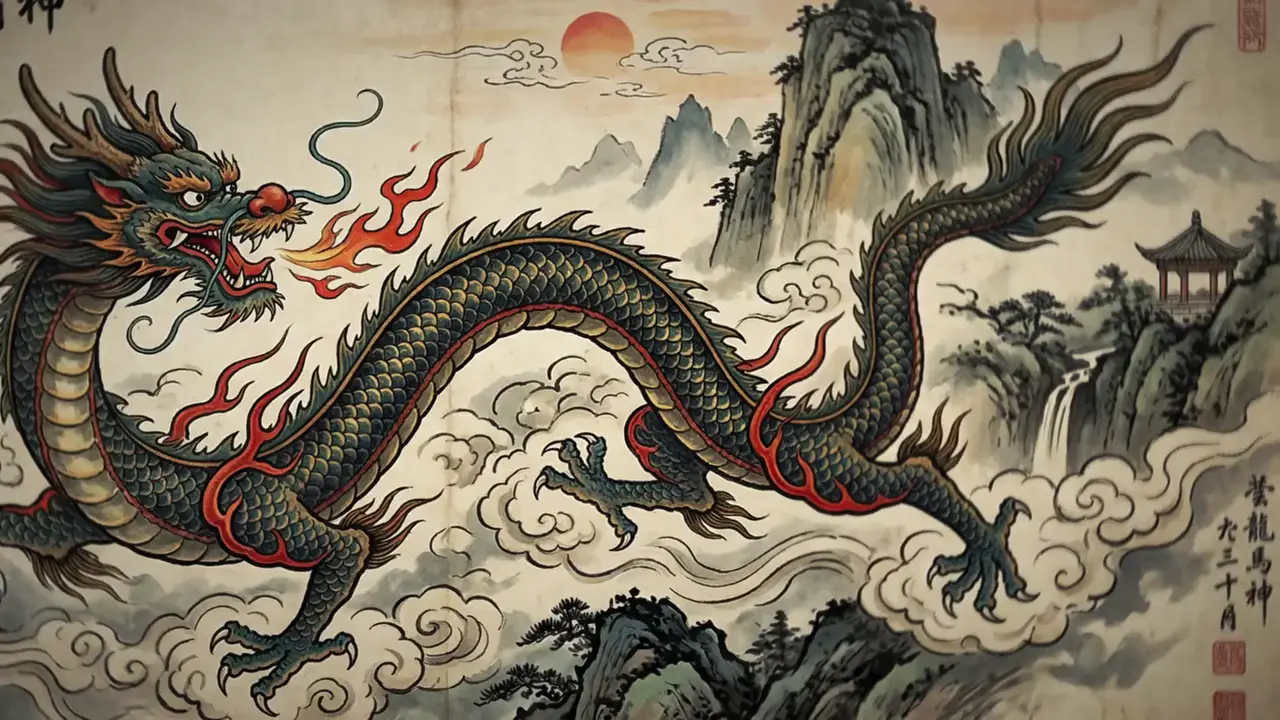
The Han dynasty adopted the dragon (Long) as the official symbol of imperial power, and for over 2,000 years only China's emperors were permitted to wear its image. They claimed to be earthly incarnations of the dragon itself. This incredible creature combined a camel's head, stag's horns, serpent body, fish scales, eagle claws, and tiger paws — controlling rain, rivers, and capable of shrinking to silkworm size or expanding to fill the entire sky.
Chinese Long Dragon Symbolized Imperial Power for Over 2,000 Years
Key facts
- Only the Emperor of China was permitted to wear the image of the dragon for over 2,000 years
- The Han dynasty, which ruled for over 400 years, adopted the dragon as the official symbol of imperial power
- Chinese emperors claimed to be the earthly incarnation of the dragon itself
- The Long was described as having the head of a camel, horns of a stag, ears of an ox, body of a serpent, scales of a fish, claws of an eagle, and paws of a tiger
- The Chinese dragon controlled rain, governed rivers, and could shrink to the size of a silkworm or expand to fill the entire sky
Sources
Chinese Imperial Dragons | Animal Legends - Online Exhibitionsexhibits.library.cornell.edu
Chinese dragon - Wikipediaen.wikipedia.org
The Dragon in Ancient China: Symbol, Myth, and Powerbrewminate.com
A Long Tradition: Dragons in the East Asian Collectioncincinnatiartmuseum.org
A Long Tradition: Dragons in the East Asian Collectioncincinnatiartmuseum.org
Was this story useful?
Keep exploring
Every site on this page sits on the globe, and the people who research them are on the Discord.
3D Globe · Sites by country · Story Archive · Research Library · Weekly Journal · Search
AI-generated text · images from the original sources · always verify with the sources.