

Built by Emperor Justinian in 532 CE, the same emperor who commissioned Hagia Sophia, Istanbul's Basilica Cistern could hold 80,000 cubic meters of water across its two football field-sized floor. 98 marble columns rise from the dark water—arranged in 12 rows of 9, with some topped by ornately carved Corinthian capitals from different eras. In the northwest corner lie two massive Roman Medusa heads buried in silt since antiquity—one on its side, one completely upside down. These spolia from different eras may represent deliberate inversion of pagan symbols, possibly from Constantinople's Forum. The cistern was only rediscovered and drained in the mid-1980s.
Basilica Cistern Medusa Heads Still Unexplained After 1500 Years
 TürkiyeArchitecture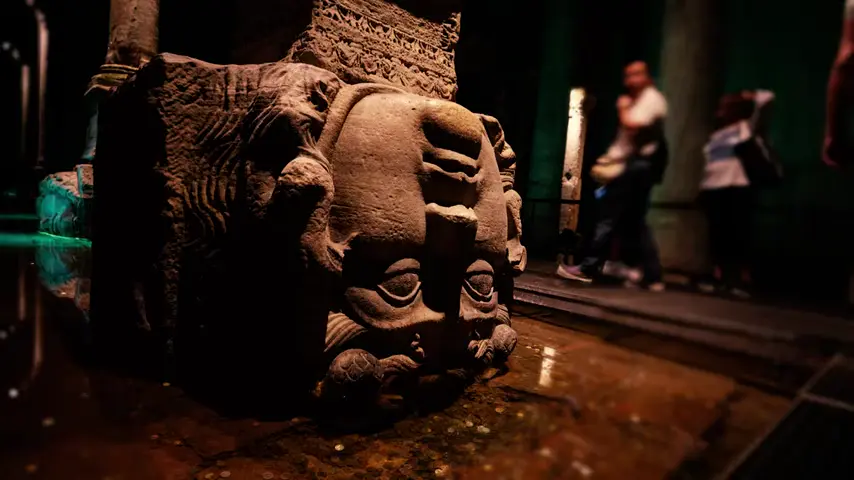
Site mentioned
Key facts
- Cistern built in 532 AD by Emperor Justinian, same ruler who built Hagia Sophia
- Capacity of 80,000 cubic meters of water, enough to fill 32 Olympic swimming pools
- 336 marble columns rise from dark water, space the size of two football fields
- Two massive Medusa heads found in northwest corner buried in silt since antiquity
- One Medusa head lies on its side, the other is completely upside down
- Heads are Roman spolia from different eras, possibly from Forum of Constantine
- Istanbul drained the cistern in 1985, workers removed 50,000 tons of mud
- Heads positioned as pedestals may represent deliberate inversion of pagan symbols
- Folk tradition holds they were turned to prevent Medusa's gaze from falling on visitors
Sources
Basilica Cistern İstanbul GoTürkiyegoistanbulturkiye.com
Built in the 6th century during the reign of Emperor Justinian I, this cistern served as an incredible hub of water filtration systems for many empires.
Basilica Cistern - Wikipediaen.wikipedia.org
The cistern, located 150 metres (490 ft) southwest of the Hagia Sophia on the historical peninsula of Sarayburnu, was built in the 6th century during the reign ...
Basilica Cistern & Its Legend - İstanbul Airportistairport.com
The Basilica Cistern was built during the reign of Byzantine Emperor Justinian I as a water reserve precaution against seiges. It is the largest cistern in ...
Basilica Cistern - The Byzantine Legacythebyzantinelegacy.com
The Basilica Cistern, along with churches like Hagia Sophia, gives an impression of the massive construction projects once undertaken by Justinian I (527-565).
Basilica Cistern Istanbul | Explore a Byzantine Legacy - Headoutheadout.com
The Basilica Cistern, also known as the Sunken Palace, is a stunning underground water reservoir built in the 6th century during the reign of Byzantine Emperor ...
Was this story useful?
Keep exploring
Every site on this page sits on the globe, and the people who research them are on the Discord.
3D Globe · Sites by country · Story Archive · Research Library · Weekly Journal · Search
AI-generated text · images from the original sources · always verify with the sources.