

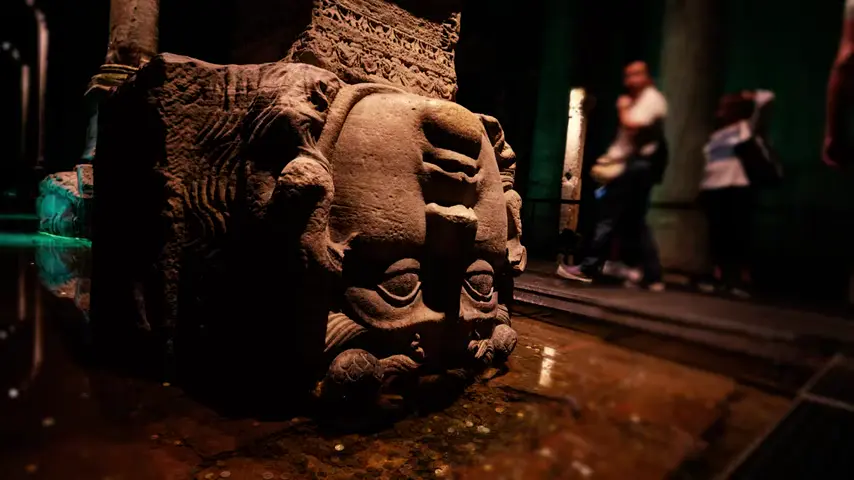
Work on Istanbul's Basilica Cistern began in 532 under Emperor Justinian I, who also commissioned Hagia Sophia, and was completed around 537. It could hold about 80,000 cubic metres of water across roughly 9,800 square metres—about two football fields. Its dark water is supported by 336 marble columns arranged in 12 rows of 28, with carved Corinthian capitals reused from earlier buildings. In the northwest corner, two reused ancient Medusa heads sit on pedestals—one on its side and the other upside down. Their original locations and the reason for their inverted placement remain debated. The video argues that they may have come from the Forum of Constantine and that their placement deliberately reversed pagan symbols or warded off Medusa's gaze. The cistern was drained for restoration in 1985, when workers removed about 50,000 tons of mud.
Basilica Cistern Medusa Heads Have Uncertain Origins
 TürkiyeArchitecture
Site mentioned
Key facts
- Construction began in 532 under Justinian I and was completed around 537; Justinian also commissioned Hagia Sophia.
- The cistern contains 336 marble columns arranged in 12 rows of 28, not 98 in 12 rows of nine.
- Its capacity is about 80,000 cubic metres—roughly 32 Olympic pools—and its floor covers about two football fields.
- Two reused ancient Medusa heads are displayed in the northwest corner, one on its side and the other upside down.
- The proposed Forum of Constantine origin and deliberate-inversion or evil-eye explanation are debated theories, not established facts.
- The cistern was drained and restored in 1985, when about 50,000 tons of mud was removed; it was not first rediscovered then.
Sources
Basilica Cistern İstanbul GoTürkiyegoistanbulturkiye.com
Built in the 6th century during the reign of Emperor Justinian I, this cistern served as an incredible hub of water filtration systems for many empires.
Basilica Cistern - Wikipediaen.wikipedia.org
The cistern, located 150 metres (490 ft) southwest of the Hagia Sophia on the historical peninsula of Sarayburnu, was built in the 6th century during the reign ...
Basilica Cistern & Its Legend - İstanbul Airportistairport.com
The Basilica Cistern was built during the reign of Byzantine Emperor Justinian I as a water reserve precaution against seiges. It is the largest cistern in ...
Basilica Cistern - The Byzantine Legacythebyzantinelegacy.com
The Basilica Cistern, along with churches like Hagia Sophia, gives an impression of the massive construction projects once undertaken by Justinian I (527-565).
Basilica Cistern Istanbul | Explore a Byzantine Legacy - Headoutheadout.com
The Basilica Cistern, also known as the Sunken Palace, is a stunning underground water reservoir built in the 6th century during the reign of Byzantine Emperor ...
Serving the Great Palace 532-1100 · The Basilica Cistern and ...hum54-15.omeka.fas.harvard.edu
While the year 532 served as the year of construction for the cistern, it also served as the year of the Nika Riots, a revolt against Justinian which resulted ...
Basilica Cistern History | The Secret Behind its Constructionbasilica-cistern.com
The history about Basilica Cistern states that it was commissioned by Emperor Justinian I in 532 AD and originally supplied water to Byzantine palaces and ...
The Secrets of the Basilica Cisternthetraveladdict.com
Built by Roman Emperor Justinian I in the year 532, the Basilica got its name from being built beneath the former site of the Stoa Basilica.
Was this story useful?
Keep exploring
Every site on this page sits on the globe, and the people who research them are on the Discord.
3D Globe · Sites by country · Story Archive · Research Library · Weekly Journal · Search
AI-generated text · images from the original sources · always verify with the sources.