

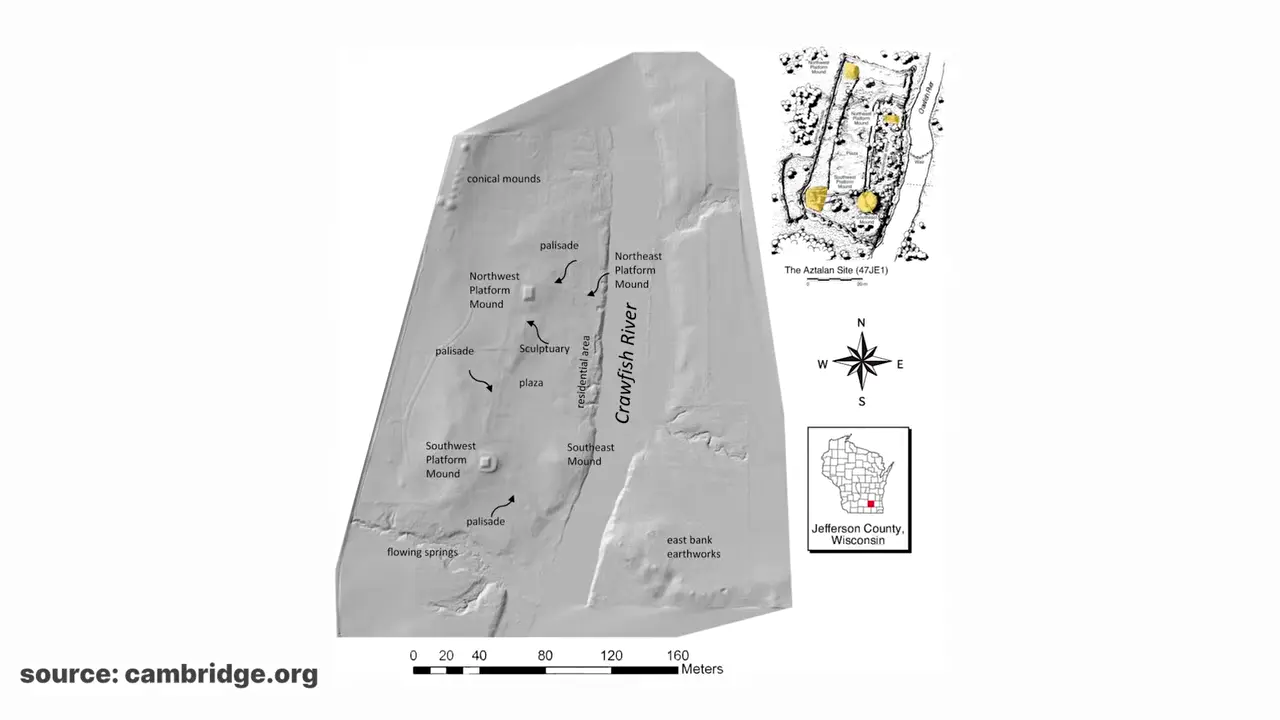
Aztalan, on the Crawfish River about an hour west of Milwaukee, was a short-lived walled Mississippian colony broadly dated 1000–1200 CE. It burned to the ground, and archaeologists tie that burning to Cahokia's abandonment around 1200. Its palisade ran about half a mile, 10 ft tall, with 33 guard towers, and a central plaza of roughly 20 acres held three small mounds, the largest two-tiered at 20 ft and 150 by 150 ft at the base. An interior palisade with watchtowers split the houses into two groups, hinting at internal social divisions; about 500 people lived inside the walls with thousands more around the edges. Around 70 storage pits, each 2 m deep and 2 m wide, were cut into a sculpted tiered platform — believed to have held corn, a practice Cahokia isn't known for. Cahokia-type ceramics, SECC art, Gulf shell, Upper Michigan copper and rare long-nose ear ornaments all appeared by the mid-1000s, supporting a Cahokia colonial origin. A north-south line of modest mounds outside the wall each held a single thick post; at the north end a 50-ft-wide, 6-ft-tall conical mound held one grave, the "princess burial" found by Samuel Barrett in 1919 and removed to the Milwaukee Public Museum — a woman in her 20s with about 2,000 shell beads in three belt wraps. Wisconsin has the world's largest concentration of effigy mounds: tens of thousands once existed, about 4,000 survive, and a 1980s survey recorded roughly 500 sites around Aztalan. The site was rediscovered in 1835 by Timothy Johnson and named by amateur archaeologist Nathaniel Hyer, who misread Alexander von Humboldt's Aztlan as "Azlan"; Increase Lapham mapped it in 1850 and Barrett excavated in 1919, 1920 and 1932. Barrett's cannibal claim is now attributed to burned charnel house remains. Wisconsin bought the land in 1948 and Aztalan State Park opened in 1952; Lynne Goldstein worked there for 20 years and found the storage pits in 1996, while the Laboratory of Wisconsin now uses ground-penetrating radar on the palisade. Aztalan is regarded as sacred by the Ho-Chunk Nation, though no single tribe has federal recognition as direct descendants. 🪵
Aztalan: Cahokia's walled Wisconsin colony burned around 1200
Site mentioned
📍 Aztalan
Key facts
- Aztalan, on the Crawfish River about an hour west of Milwaukee, was a short-lived walled Mississippian colony broadly dated 1000-1200 CE; it burned to the ground, and archaeologists tie the burning to Cahokia's abandonment around 1200.
- Its palisade wall was about half a mile long, 10 ft tall, with 33 guard towers; a central plaza of about 20 acres held three small earthen mounds, the largest two-tiered, 20 ft tall and 150 by 150 ft at the base.
- Houses within the walls were split into two groups by an interior palisade wall with watchtowers, suggesting internal social divisions; an estimated 500 people lived inside the walls, with thousands more around the periphery.
- About 70 storage pits, each 2 m deep and 2 m in diameter, were cut into a sculpted tiered platform off the main plaza and are believed to have held corn - a practice Cahokia is not known for.
- Cahokia-type ceramics, SECC art, Gulf of Mexico shell, Upper Michigan copper and long-nose ear ornaments appeared in the mid-1000s, supporting a Cahokia colonial origin; the long-nose ornaments are rare outside Cahokia and Spiro.
- A north-south line of modest mounds outside the palisade each held a single thick post; at its north end a conical mound 50 ft in diameter and 6 ft tall held a single grave, the 'princess burial,' found and named by Samuel Barrett in 1919 and removed to the Milwaukee Public Museum - a woman in her 20s with about 2,000 shell beads in three belt wraps, buried outside the walls.
- Wisconsin has the largest concentration of effigy mounds in the world; tens of thousands once existed and about 4,000 survive in public parks and on private land, and a 1980s regional survey recorded about 500 sites around Aztalan whose houses were circular with local ceramics.
- The site was rediscovered in 1835 by Timothy Johnson and named by amateur archaeologist Nathaniel Hyer, who misread Alexander von Humboldt's Aztec northern origin place, Azlan; Increase Lapham made a professional map in 1850 and Samuel Barrett excavated in 1919, 1920 and 1932, first recognizing Aztalan as Mississippian.
- Barrett also claimed Aztalan's people were cannibals based on burned and broken human bones, which the video attributes to burned charnel house remains.
- The state of Wisconsin bought the land in 1948 and Aztalan State Park opened in 1952; Lynne Goldstein of the University of Wisconsin-Milwaukee worked at the site for 20 years from the 1970s, surveying over 500 regional sites, identifying Late Woodlands origins and discovering the 70 storage pits in 1996; current work by the Laboratory of Wisconsin uses ground-penetrating radar to map the palisade.
- Aztalan is regarded as sacred by the Ho-Chunk Nation and other First Nations, though no single tribe has federal recognition as direct descendants, and some grave goods have been repatriated.
Sources
Ancient Aztalan, WI: A Diverse Communityschroeder.labs.wisc.edu
Aztalan is a prehistoric Native American village in southern Wisconsin that was occupied between 800-1000 years ago.
Aztalan State Parken.wikipedia.org
Aztalan is the site of an ancient Mississippian culture settlement that flourished during the 10th to 13th centuries. The indigenous people constructed massive ...
Aztalan State Park | Wisconsin DNRdnr.wisconsin.gov
Aztalan State Park is a National Historic Landmark and contains one of Wisconsin's most important archaeological sites, showcasing an ancient Middle- ...
History | Aztalan State Park - Wisconsin DNRdnr.wisconsin.gov
The ancient Indian town of Aztalan is Wisconsin's premier archaeological site and a National Historic Landmark. Located on the Crawfish River, successive ...
Aztalan State Parkwisconsinfirstnations.org
Located on the Crawfish River, one mile east of Lake Mills, Wisconsin, Aztalan is Wisconsin's premiere archaeological site. Prior to a.d. 1050, ...
Was this story useful?
Keep exploring
Every site on this page sits on the globe, and the people who research them are on the Discord.
3D Globe · Sites by country · Story Archive · Research Library · Weekly Journal · Search
AI-generated text · images from the original sources · always verify with the sources.