

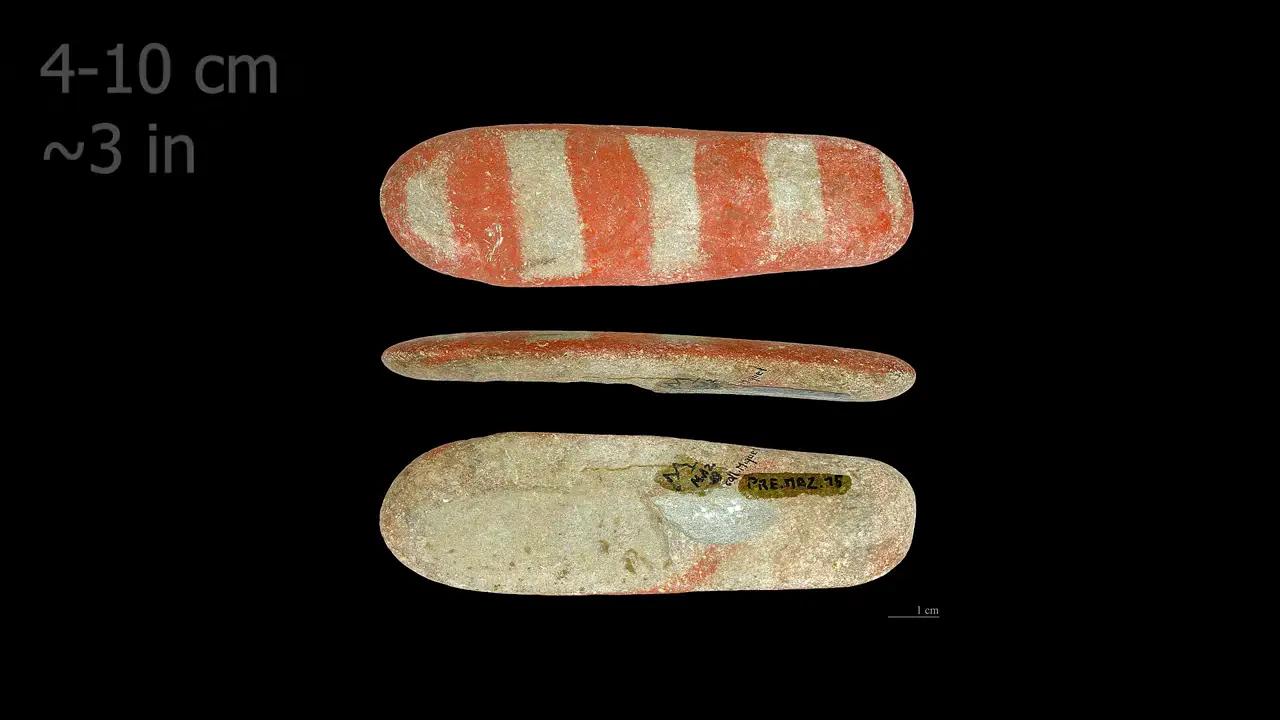
Azilian painted pebbles date to roughly 12,000–9,000 BP (about 10,000–7,000 BC) — more than 20,000 years after the Aurignacian symbolism of southwestern Germany. They're tiny flat river stones, usually 4–10 cm across, painted with iron oxide ochre using a finger, with shells used as pigment pots. Motifs include parallel bars, dot rows, chevrons, crosses, grids and ovals, and over 2,000 are catalogued from France, Spain, Italy and Switzerland. 🪨🎨
Azilian painted pebbles: ochre-marked schist stones spread across Western Europe
Key facts
- Azilian painted pebbles date to roughly 12,000–9,000 BP (about 10,000–7,000 BC), more than 20,000 years after the Aurignacian symbolic tradition of southwestern Germany (43,000–34,000 years ago).
- With the end of the Ice Age, Europe's open landscapes turned to forest, reindeer crucial to Magdalenian hunters retreated from most of Western Europe, and red deer became common; the Younger Dryas brought another cold phase before the Holocene began around 9700 BC.
- Azilian sites occupy many former Magdalenian sites and reach elevations of around 1,000 m in the Cantabrian Mountains.
- A major genetic turnover is represented by the ~14,000-year-old Villabruna individual from Italy, whose genome became widespread across Western Europe, while Magdalenian-related ancestry persisted especially in Iberia.
- Distinct contemporaneous traditions include Federmesser groups in northern Europe, Swiderian in the Netherlands, Romanelli in Italy and Creswellian in Britain, with the Azilian among them.
- Elaborate Magdalenian animal representations became less common, while geometric decoration on small portable objects became characteristic of the Azilian.
- At Rocher de l'Impératrice in Brittany, 45 engraved schist fragments associated with the early Azilian depict detailed horses and aurochs.
- The pebbles are unusually small, flat river stones, usually 4–10 cm across; many Mas d'Azil examples are locally sourced gray schist from the Arize River.
- The red pigment comes from iron oxides (hematite/ochre) and was probably applied with a finger; shells were used as paint pots for pigment preparation, with marine scallop shells carried inland.
- Motifs include parallel bars, rows of dots, longitudinal lines, crosses, chevrons, grids, ovals and more abstract designs; some stones are painted on both sides and some designs continue around the edges.
- More than 2,000 painted pebbles have been catalogued across dozens of sites in France, Spain, Italy and Switzerland, with Mas d'Azil holding the largest concentration, though not all have secure archaeological context.
Sources
persee.fr
Linked in video description
painted pebblebritishmuseum.org
Used for religious services in the 16th and 17th centures, last Ice Age about 14,000 - 10,000 years ago. it was occupied from about 38,000 years ago.
Painted pebbles from Le Mas d'Azil (Ariège)...journals.openedition.org
by JF Tolksdorf · 2016 — 11Today, the archaeological collections from Saxony contain 32 painted pebbles from Le Mas d'Azil, 31 of which are from the 1899 collection. The inventory ...
File:Azilian painted pebbles from the cave of Le Mas d'Azil. ...commons.wikimedia.org
Azilian painted pebbles from the cave of Le Mas d'Azil. Click on a date/time to view the file as it appeared at that time.
The Azilian Epipaleolithic Industry of Spain and Francenovoscriptorium.com
Assemblages labelled as 'Azilian' can be found in deposits dating from as old as 12,000 B.P. to as recent as 9,000 B.P. Azilian painted pebbles ...
Painted Pebblestonetoolsmuseum.com
This painted river pebble from Mas d'Azil Cave in France dates to the Azilian period, ca. 10,000-12,500 BP. The function or meaning of these painted pebbles ...
Was this story useful?
Keep exploring
Every site on this page sits on the globe, and the people who research them are on the Discord.
3D Globe · Sites by country · Story Archive · Research Library · Weekly Journal · Search
AI-generated text · images from the original sources · always verify with the sources.