

The Atrahasis epic, dated to around 1700 BC, has the god Enlil send a flood because humans multiplied too much and their noise bothered the gods. One man, warned by a god opposing the plan, builds a boat that saves his family and animals — and afterwards the gods regret it, since nobody is left to farm. Genesis, written roughly 900–400 BC, follows the same boat-and-survival structure. Sumerian creation tales speak of humans made from clay mixed with divine blood; Genesis has man formed from dust with God breathing life in. Genesis even places Eden between the Tigris and Euphrates — "Eden" deriving from a Sumerian word for flat terrain. The video suggests exiled writers in Babylon reworked this older material around a single, moral god 🌊📜
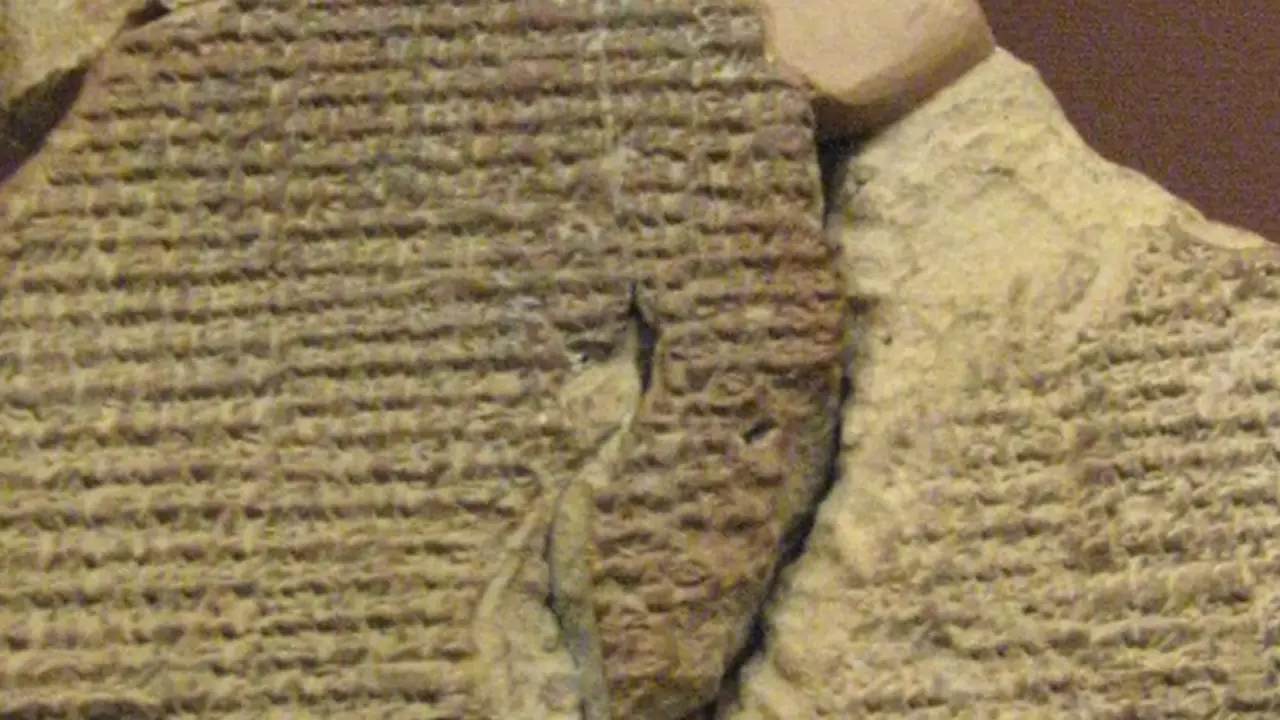
Atrahasis epic (c. 1700 BC) flood and creation tales parallel Genesis narratives
Key facts
- The Atrahasis epic, dated to 1700 BC, has Enlil send a flood because humans had multiplied too much and their noise disturbed the gods
- One man, warned by a god who opposes Enlil's plan, builds a boat that saves his family and the animals; after the flood the gods regret the decision because no one remains to farm
- The Genesis flood narrative was written between roughly 900 and 400 BC and follows the same structure of boat-building and survival as the Mesopotamian text
- The Sumerian creation account describes humans made from clay mixed with divine blood, while Genesis describes man formed from dust with God breathing life into him
- Genesis locates the garden between the Tigris and Euphrates rivers of ancient Mesopotamia, and the name Eden derives from a Sumerian word meaning flat terrain
- The video argues that the writers of Genesis, exiled in Babylon and familiar with these traditions and texts, reworked older Mesopotamian material around a new concept of a single, moral and intentional god
Sources
livius.org
Linked in video description
nbcnews.com
Linked in video description
oldtestamentquestions.com
Linked in video description
Atra-Hasisen.wikipedia.org
The epic of Atra-Hasis contains the myth of the creation of mankind by Enlil, Anu and Enki, also known as Anunnaki and Igigi, the superior and the inferior gods ...
Athrasis Epic | Summary, Importance & Analysis - Lessonstudy.com
'Atrahasis' is an epic from ancient Mesopotamia. The story exists in many versions, though the most complete text dates from about 1700 B.C. from Babylonia.
The Atrahasis Epic and Its Significance for Our ...jstor.org
by T Frymer-Kensky · 1977 · Cited by 132 — The [land] was bellowing [like a bull]. The gods were disturbed with [their uproar]. [Enlil heard] their noise. [and addressed] the great gods.
Gilgamesh, Atrahasis and the Flood - Articlebiologos.org
Atrahasis, through the help of the god Ea, escapes the wrath of Enlil by building a large boat in which to save humanity. Some scholars ...
Was this story useful?
Keep exploring
Every site on this page sits on the globe, and the people who research them are on the Discord.
3D Globe · Sites by country · Story Archive · Research Library · Weekly Journal · Search
AI-generated text · images from the original sources · always verify with the sources.