

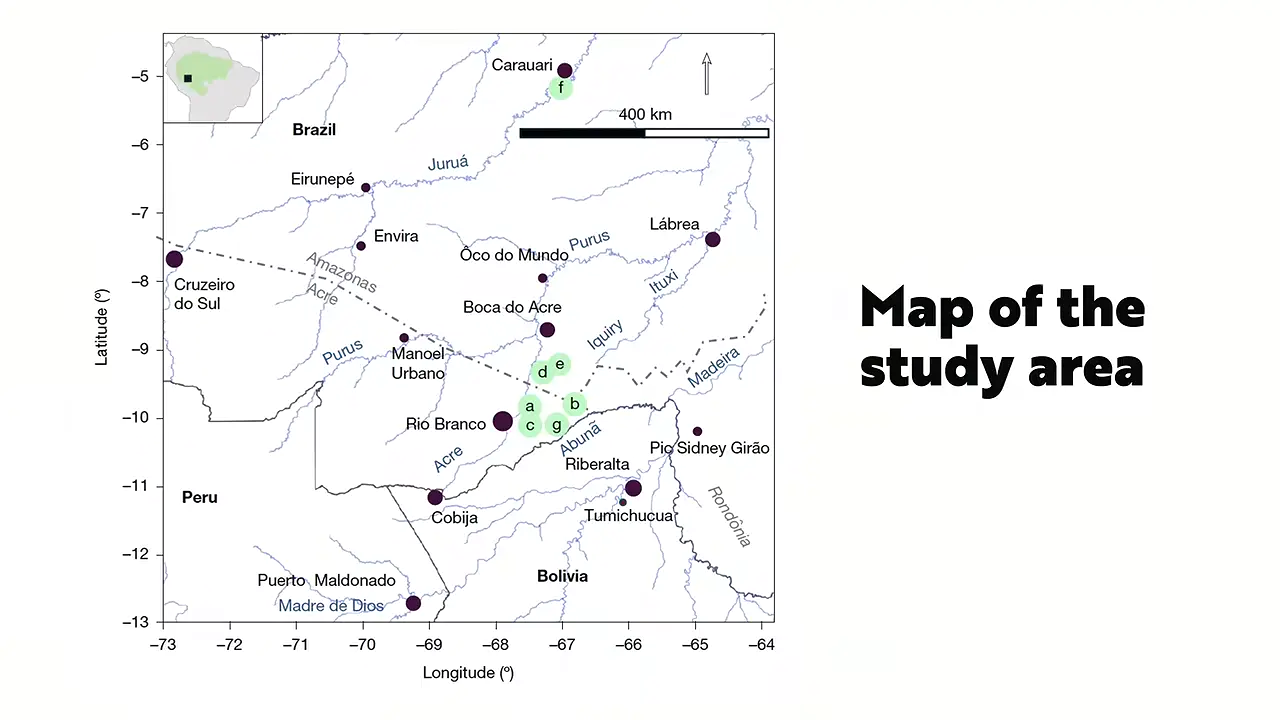
The Aquiry civilization may have peaked between 100–300 AD with 1.25 to 3 million people — far more than the 60,000 earlier estimates suggested! Population density in the 85,000 km² core could have reached 13–33 people per km². These weren't fortifications but ceremonial gathering centers. The Aquiry cultivated maize, sweet potatoes, chili peppers, and managed Brazil nut trees and edible palms — evidence of their management still shapes today's forests. What a find! 🌽🌳
Aquiry civilization estimated at 1.25–3 million people, reshaped Amazon forest
Key facts
- Civilization peaked between 100 and 300 AD with an estimated 1.25 to 3 million inhabitants
- Within an 85,000 km² core area, population density may have reached 13 to 33 people per square kilometer
- Previous estimates based on 200 known earthworks suggested only 60,000 people; revised estimates are in the millions
- Experts believe the earthworks were public, political, and ceremonial gathering centers rather than year-round residences or military fortifications
- Population calculations use evidence from later mound villages and indigenous ceremonial centers as comparators
- The Aquiry cultivated chili peppers, peanuts, sweet potatoes, squash, and maize, and grew Brazil nut trees and edible palm species
- Modern distribution of Brazil nut trees and edible palms reflects centuries of human planting and management
- They burned bamboo-rich areas to maintain fertile soils and managed water sources, agricultural plots, and forest gardens
- Later communities built mound villages in parts of the same region, suggesting cultural transformation rather than complete abandonment
Sources
nature.com
Linked in video description
arkeonews.net
Linked in video description
agencia.fapesp.br
Linked in video description
Ancient Amazon Geoglyphs Revealed a Massive Lost ...popularmechanics.com
The Aquiry civilization likely emerged around 600 B.C.E., with villages of roughly 300 inhabitants living in longhouses and cultivating crops ...
Scientists Uncover Hundreds of Hidden Structures Beneath ...sciencealert.com
... population of up to 3 million people around 200 CE. ... By extrapolating their results, combined with existing surveys, the researchers estimated ...
Researchers Uncover a Forgotten Amazon Civilization ...scitechdaily.com
Detailed archaeological surveys and radiocarbon dating indicate that between 1.25 million and 3 million people lived within Aquirian territory ...
Over 20000 precolonial earthworks in the Southwest ...nature.com
by M Pärssinen · 2026 · Cited by 5 — Estimation of the number of earthworks and total population. First, we defined the area of the Aquiry civilization by the presence of geoglyph- ...
Mysterious Shapes Hidden Beneath the Amazon Canopy ...smithsonianmag.com
Scientists think the Aquiry civilization first emerged around 600 B.C.E. They estimate people lived in villages of roughly 300 inhabitants on ...
Was this story useful?
Keep exploring
Every site on this page sits on the globe, and the people who research them are on the Discord.
3D Globe · Sites by country · Story Archive · Research Library · Weekly Journal · Search
AI-generated text · images from the original sources · always verify with the sources.