

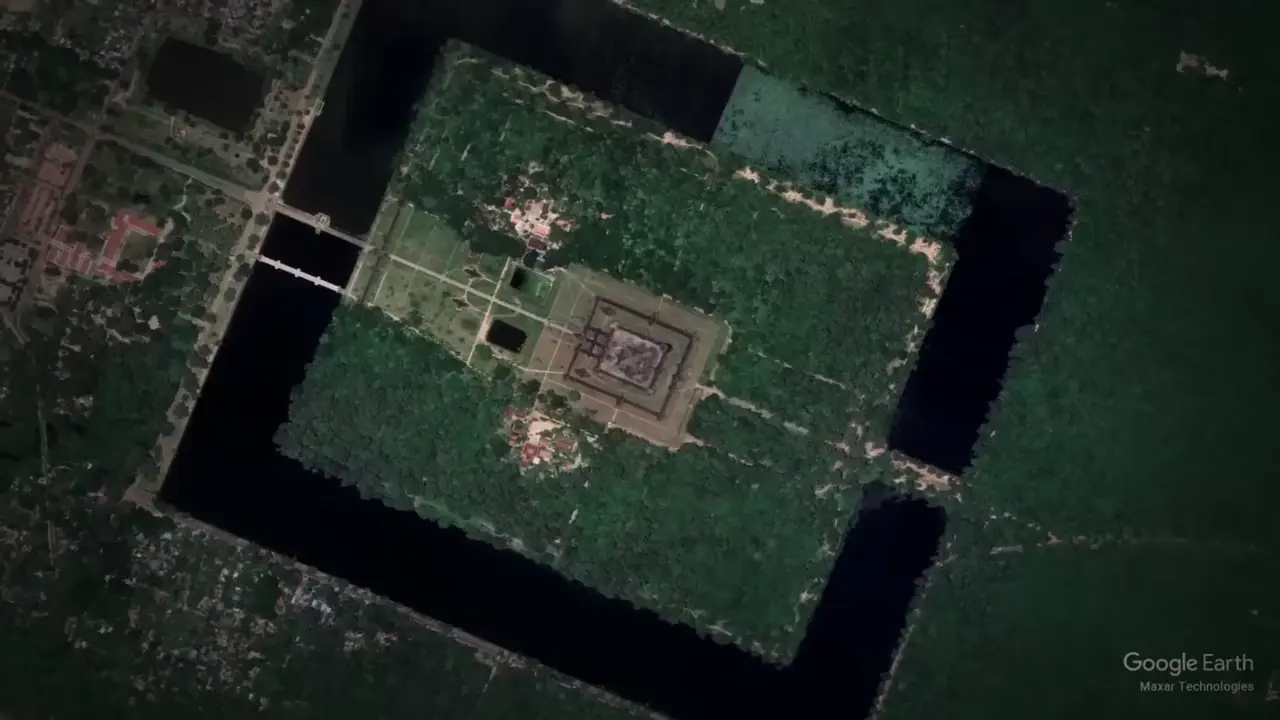
Lidar surveys beginning in 2012—and expanded later—mapped roughly 1,000 km² (386 sq mi) of hidden roads, canals, reservoirs and farms around Angkor. Greater Angkor was the Khmer Empire's capital and a vast medieval city, with peak population estimates approaching 1 million—not an empire. Angkor Wat covers about 402 acres and used an estimated 5–10 million closely fitted sandstone blocks, some up to 1.5 tonnes, hauled about 37 km from Phnom Kulen. Built in the early 12th century under Suryavarman II for Vishnu, its central tower symbolizes Mount Meru and its moat the cosmic ocean. The main axis frames the equinox sunrise. The video also argues for solar and lunar meanings in its dimensions and for telescope, Pluto and dinosaur readings in its carvings; these remain disputed interpretations, not archaeological fact.
Angkor Wat: Up to 10 million blocks and a lidar-mapped city near 1 million
 CambodiaExcavation
Site mentioned
Key facts
- Angkor Wat covers about 402 acres and is commonly estimated to contain 5–10 million sandstone blocks, some weighing up to 1.5 tonnes.
- The blocks came from Phnom Kulen about 37 km (23 miles) away; Angkor Wat is roughly 3.3 times Vatican City's area and has more blocks than the Great Pyramid's estimated 2.3 million.
- Built in the early 12th century under Khmer king Suryavarman II as a Hindu temple to Vishnu, Angkor Wat later became a Buddhist sanctuary.
- The moat's main symbolic role was the cosmic ocean around Mount Meru; it also affected groundwater around the foundations and was not primarily a defensive work.
- Lidar surveys began in 2012 with about 300 km² mapped and later expanded to roughly 1,000 km² (386 sq mi), revealing roads, canals, ponds, embankments, neighborhoods and hydraulic works.
- Peak population estimates for Greater Angkor approach 1 million. It was the Khmer Empire's capital and a vast medieval city, not the world's largest medieval empire.
- The central tower represents Mount Meru, and Angkor Wat's main east–west axis aligns approximately with the equinox sunrise when viewed eastward from the western entrance.
- The video argues that some tower and chamber dimensions encode a solar year and lunar cycle; these are interpretations, not established measurements.
- The video presents the telescope-user, Pluto, four-tusked-elephant and dinosaur-like carving readings as disputed possibilities, not established identifications.
- Zhou Daguan wrote that local people told him a divine architect built the temple in a single night; this was their claim, not his factual finding.
Sources
NASA Radar Reveals Hidden Remains at Ancient Angkorjpl.nasa.gov
New evidence of a prehistoric civilization and remnants of ancient temples in Angkor, Cambodia have been discovered by researchers.
Laser Scanning Reveals New Parts of an Ancient Cambodian Citytechnologyreview.com
Airborne laser scanning has revealed the remnants of a vast urban structure in the vicinity of Angkor Wat, a famous temple in Cambodia.
Uncovering archaeological landscapes at Angkor using lidar - PMCpmc.ncbi.nlm.nih.gov
Here we describe the use of airborne laser scanning (lidar) technology to create high-precision digital elevation models of the ground surface beneath the ...
Laser Scans Reveal Massive Khmer Cities Hidden in the ...smithsonianmag.com
Using Lidar technology, researchers are discovering the extent of the medieval Khmer empire.
Airborne laser spots ancient city complex of roads, canals hidden ...globalnews.ca
The laser scanning revealed a previously undocumented formal urban planned landscape integrating the 1,200-year-old temples. The airborne lasers ...
ScienceShot: Building Angkor Watscience.org
But how did the 5 million to 10 million blocks, some weighing more than 1500 kilograms, reach Angkor? of 37 kilometers or so.
Mystery of Angkor Wat's huge stones solvedcbsnews.com
The findings shed light on how the site's 5 million to 10 million bricks, some weighing up to 3,300 pounds, made it to the temple from quarries ...
Google Earth reveals the secret of Angkor Wat's constructiongearthblog.com
The Cambodian Hindu temple of Angkor Wat was built using 5-10 million enormous sandstone blocks, some weighing nearly two tons, but no one has ...
Was this story useful?
Keep exploring
Every site on this page sits on the globe, and the people who research them are on the Discord.
3D Globe · Sites by country · Story Archive · Research Library · Weekly Journal · Search
AI-generated text · images from the original sources · always verify with the sources.