

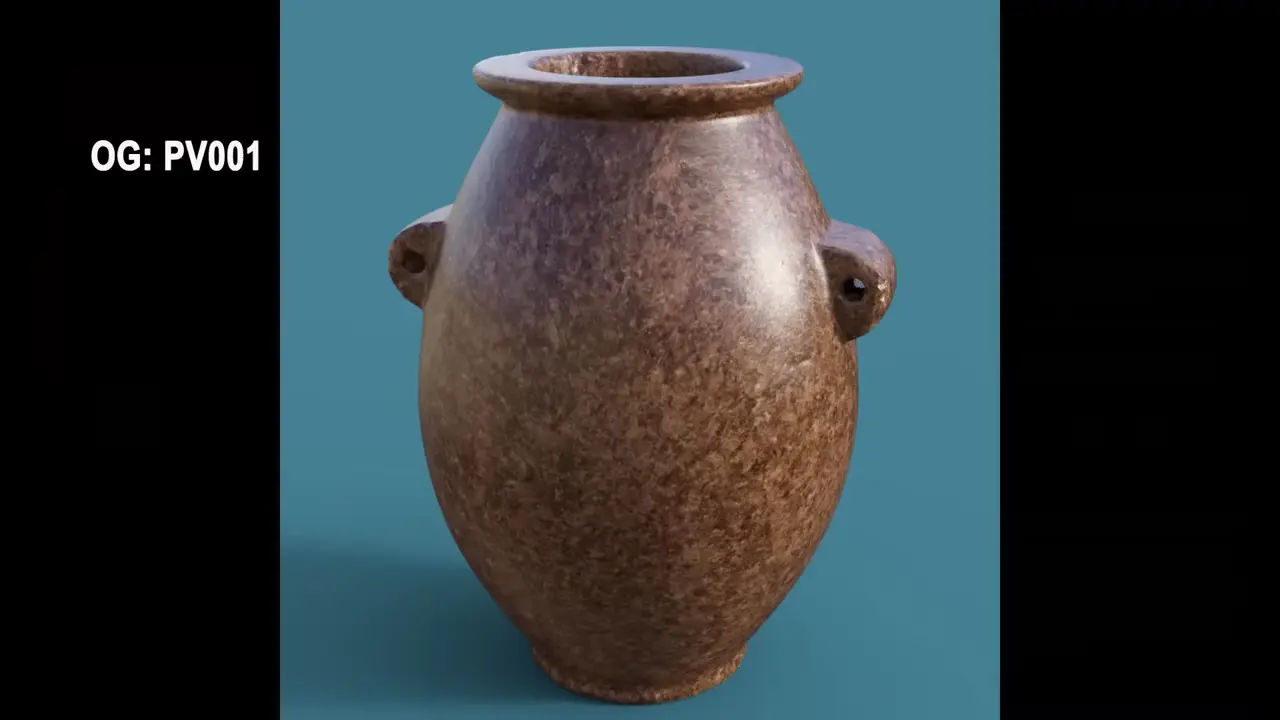
Mark Qvist, who in 2023 argued PV1 was too precise for modern CNC replication, reversed his stance after 2025 scanning data. He now concludes the stone vase (from Adam Young's collection) is likely a modern replica, contemporary piece, or was reworked after acquisition. He cited the 'demonstrably horrible track record of the Artifact Foundation' as reason for his reversal. Originally claimed the vase displayed mathematically coherent design principles from 5,000+ years ago.
Analysis compared lug handle characteristics across nine authenticated predynastic museum specimens (heights 6-14.4 cm) with two OG vases (PV1 and V18)
Site mentioned
📍 Petri Museum
Key facts
- Analysis compared lug handle characteristics across nine authenticated predynastic museum specimens (heights 6-14.4 cm) with two OG vases (PV1 and V18)
- Authenticated museum artifacts display three consistent handle characteristics: (1) symmetric C-shaped or arch handles with uniform thickness, (2) handle holes aligned with vessel body outline touching or tangent to body, (3) handle hole diameters proportional to handle thickness
- PV1 handles deviate from all three museum standards: much thicker handles with proportionally smaller holes, holes positioned away from body (D-shaped not C-shaped), handles slightly droopy and lopsided rather than symmetric
- V18 exhibits similarly non-authentic features: mild droop, set ears rather than lifted ears, asymmetrical handle roots with one side sloping more than the other
- Museum artifacts show diagonal or crisscross abrasion marks from handheld rubbing stones typical of predynastic polishing technique
- PV1 and OG vessels lack the faint diagonal abrasion marks present on authenticated museum specimens
- Max specified OG vessels lack weathering and damage expected of 6,000-year-old artifacts; they appear recently made with no scratches, chips, or nicks
- Despite micron-level precision in OG vases, their stylistic features deviate significantly from Naqada era aesthetic standards
Sources
https://www.lingexp.uni-tuebingen.de/z2/Morphology...lingexp.uni-tuebingen.de
... so may our what into two no these people only after any ! her she over than work them n't most such then my many information where years use now year should ...
3 - Hugging Facehuggingface.co
... he at from his an are : this be were has or which but i have not they had one their also its who first you new after all been her she more / when two ...
923 kB - Hugging Facehuggingface.co
... he 45322094 ·you 45064032 ·đã 44870971 ·his 44809212 ·: 42644497 ·an ... after 11882477 ·could 11770363 ·no 11710906 ·cấp 11654934 ·only ...
ME/2 - Bar Ilan NLP Labnlp.biu.ac.il
... she any now only pm first than good > into its these us see here make home 3 very over most then know said after well use two % did could day great free ...
1 - Amazon S3s3.eu-central-1.amazonaws.com
... to and in a " 's for - that on is was said with he as it by at ( ) from his '' `` an be has are have but were not this who they had i which will their : or its ...
Was this story useful?
Keep exploring
Every site on this page sits on the globe, and the people who research them are on the Discord.
3D Globe · Sites by country · Story Archive · Research Library · Weekly Journal · Search
AI-generated text · images from the original sources · always verify with the sources.