

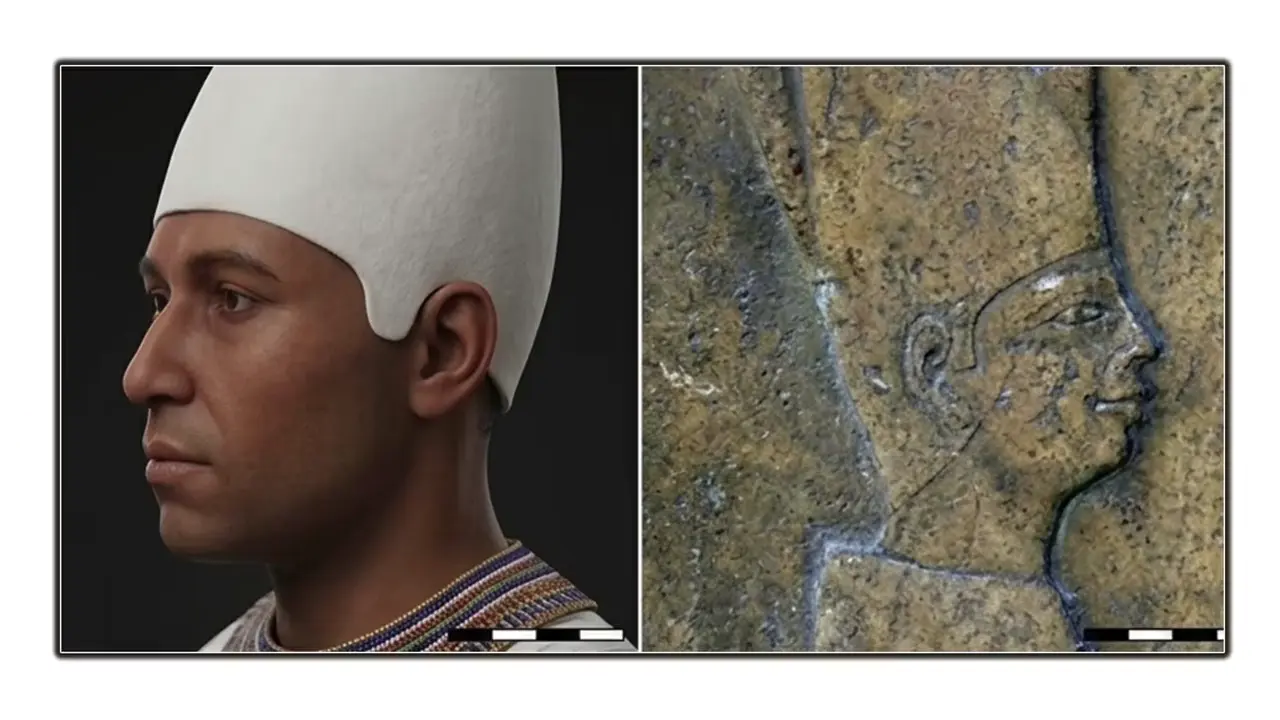
AI tools reconstructed a face from 1910 skull photographs. The 3D model got tissue depth markers, muscle and skin layers, and was crowned with Upper Egypt's white crown. It shares a prominent nasal bridge and strong rounded chin with Sneferu portraiture. AI suggested a royal relative; the presenter argues it's Sneferu himself and calls for professional forensic analysis. 🤖
AI facial reconstruction from Mastaba 17 skull compared to Sneferu statues
Site mentioned
📍 Mastaba 17
Key facts
- AI tools were used to reconstruct the face from 1910 skull photographs
- Process: photos converted to a high-resolution 3D model, tissue depth markers applied using demographic data, then muscle and skin layers added
- Reconstruction was given the white crown of Upper Egypt and royal makeup
- AI analysis found high congruence with ancient depictions, including a sharp brow-to-nose-bridge angle
- Reconstruction shares a prominent nasal bridge morphology with known Sneferu depictions
- The skull's highly robust mandible produced a reconstruction with a strong, rounded chin matching Sneferu's portraiture
- AI concluded the skull likely belonged to a prince or close royal relative, not identifying it as Sneferu
- The video presenter argues the skull is in fact Sneferu's, calling for professional forensic reconstruction similar to that done for Richard III
Sources
Sneferu (Disambiguation)worldhistory.org
AI-generated summary based on World History artificial intelligence can make mistakes. please read the source articles linked above. King Sneferu perfected the ...
Revealing the face of Ramesses II through computed tomography ...sciencedirect.com
3D facial depictions of the Pharaoh at two different ages were produced: one at 90 years old (age of death) and one at age 45 years when he was at the peak of ...
Faces From Ancient Egypt Are Coming Back to Life in Extraordinary ...newsweek.com
Researchers from the Liverpool John Moores University Face Lab were able to reconstruct the bygone ruler's face using computer software and a ...
Sneferu (-2620 - -2547) - Genealogy - Geni.comgeni.com
Snefru was the first king of the fourth dynasty of Ancient Egypt, who according to Manetho reigned for 24 years (2613-2589 BC).
Sneferu - Wikipediaen.wikipedia.org
Sneferu or Soris (c. 2600 BC) was an ancient Egyptian monarch and the first pharaoh of the Fourth Dynasty of Egypt, during the earlier half of the Old Kingdom ...
Was this story useful?
Keep exploring
Every site on this page sits on the globe, and the people who research them are on the Discord.
3D Globe · Sites by country · Story Archive · Research Library · Weekly Journal · Search
AI-generated text · images from the original sources · always verify with the sources.