

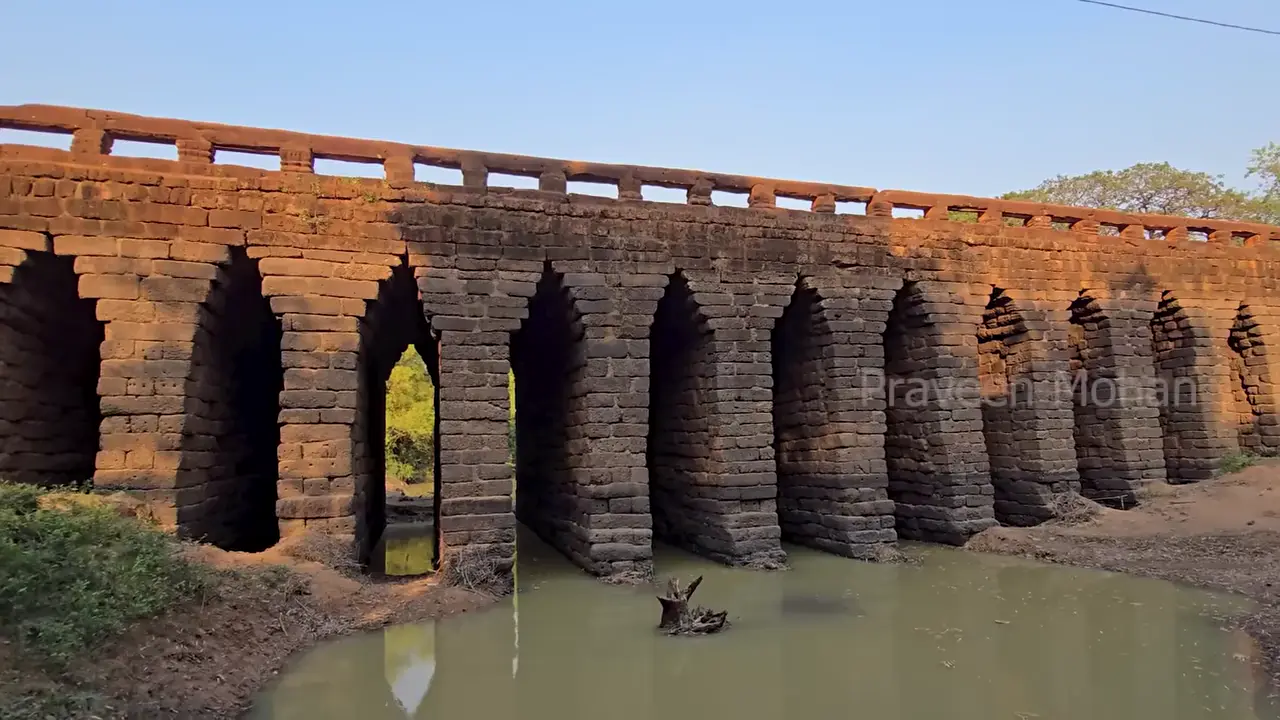
The engineering here is mind-blowing for 1,000 years ago. Inward-sloping laterite walls resist earth pressure, a V-shaped riverbed self-cleans to prevent stagnation, and 23 feet of headroom clears triple the normal flood level. The trick: smooth sandstone on the outside, rough laterite core inside, basically ancient rebar-and-concrete logic! 🏗️💡
Advanced hydraulic and structural engineering of Spean Praptos
Site mentioned
📍 Spean Praptos
Key facts
- Laterite retaining walls slope inward toward the water channel to increase base mass and resist lateral earth pressure (gravity-based engineering)
- The riverbed is V-shaped rather than flat or box-shaped, a self-cleaning design that prevents water stagnation, mosquito breeding, and sediment buildup
- The bridge provides approximately 23 feet of headroom above the normal annual flood watermark (about 8 feet of staining visible on piers), approximately three times the normal flood level
- The arches are true corbelled arches, with each stone leaning progressively further inward, leaving a thin crack of light at the apex
- Visible surfaces are smooth, precisely cut sandstone transported from mountain quarries miles away, while the internal structure (roughly 90%) is rough, porous laterite — a deliberate layering of fine exterior over a strong core, similar to modern rebar-in-concrete construction
Sources
Oldest and longest corbeled stone-arch bridge - Asia Book of Recordsasiabookofrecords.com
The nearly 1,000 years old bridge is 85 metres long and 14 metres high. The bridge has 22 spans, all built of laterite without any binder. It is ...
Corbel arch - Wikipediaen.wikipedia.org
The Arkadiko Bridge is one of four Mycenean corbel arch bridges, which are part of a former network of roads, designed to accommodate chariots, between Tiryns ...
[PDF] The True and the Corbel Arch in Mainland Southeast Asian ...resolve.cambridge.org
Furthermore, laterite is such a hard material that it cannot be hewn into other than very rough blocks, which ipso facto prohibits its use in the construction ...
Corbel arch Facts for Kidskids.kiddle.co
A corbel arch is a special way to build an arch shape without using a "true" arch. Imagine stacking stones or bricks, each one sticking out a little further.
Corbel arch bridges from around the world - Structuraestructurae.net
Corbel arch bridges are actually not true arch bridges as they are formed by incrementally cantilevering blocks of stone to span a small distance.
Was this story useful?
Keep exploring
Every site on this page sits on the globe, and the people who research them are on the Discord.
3D Globe · Sites by country · Story Archive · Research Library · Weekly Journal · Search
AI-generated text · images from the original sources · always verify with the sources.