

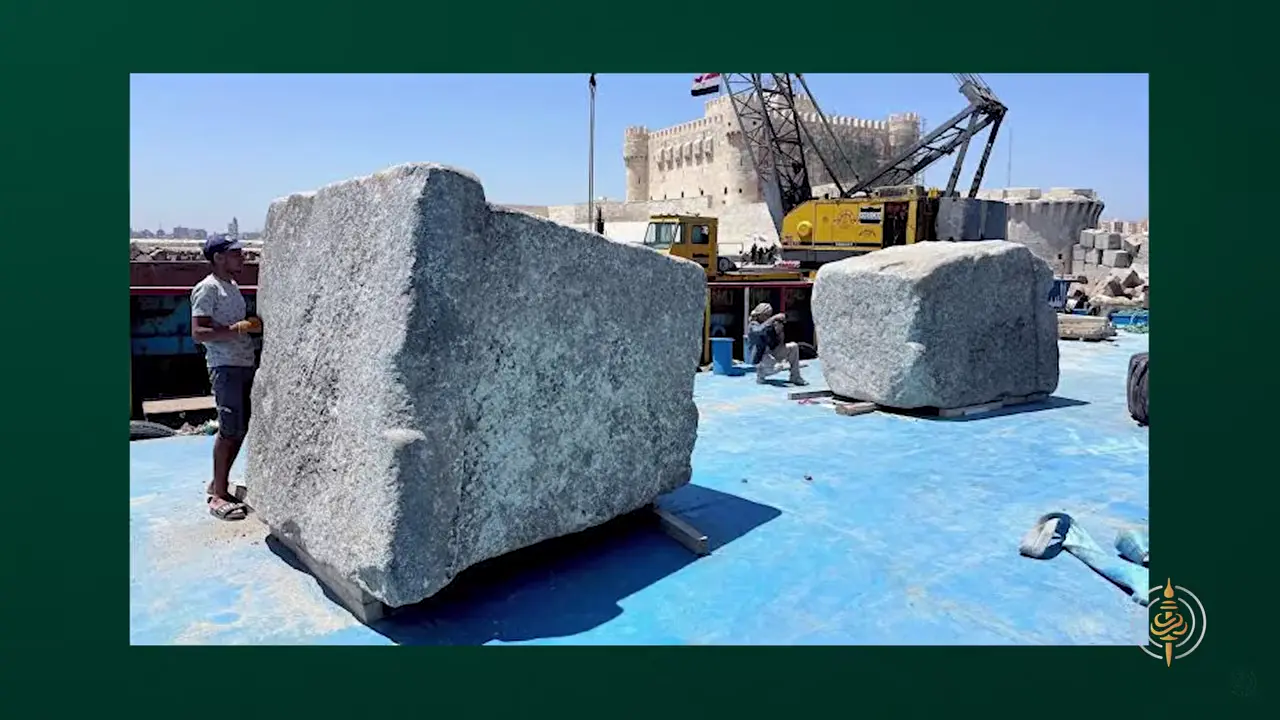
Underwater archaeologists raised 22 massive blocks (70-80 tons each!) of the ancient Lighthouse of Alexandria, originally built in the 3rd century BC. The CNRS-led Pharos project uncovered a pylon blending Egyptian and Greek techniques. The ambitious goal: a full digital twin, not a physical rebuild. Cool stuff!
22 massive blocks of the Lighthouse of Alexandria raised for digital reconstruction
Key facts
- The Lighthouse of Alexandria (the Pharos) was constructed in the early 3rd century BC under Ptolemy I and completed under Ptolemy II; architect was Sostratus of Cnidus.
- Structure stood over 100 meters (300+ feet) tall with a square base, octagonal middle section, and cylindrical upper tower topped by a fire.
- It stood for more than 1,600 years before being destroyed by a series of earthquakes between approximately 900 AD and 1303 AD; remnants sat underwater for roughly 700 years.
- The Pharos project, run by France's National Center for Scientific Research (CNRS) with Egypt's Ministry of Tourism and Antiquities, recovered 22 blocks weighing 70–80 tons each, including door lintels, thresholds, and foundation slabs.
- Lead archaeologist and architect is Isabelle Harry (France).
- A previously unknown element was discovered: a pylon—an Egyptian-style doorway built using Greek construction techniques, blending both civilizations.
- Goal is a "digital twin" — a full virtual reconstruction — rather than a physical rebuild.
- Over 100 blocks have been scanned underwater over the past decade, with approximately 5,000 individual pieces mapped to date.
- Many blocks are returned to the seabed after scanning because the underwater environment preserves the stone better than open air.
- Project lead stated the work is "generations from completion."
Site mentioned
📍 Lighthouse of Alexandria (Pharos)
Sources
The Lighthouse of Alexandria | Short History Of... - Noisernoiser.com
Built in the third century BC on the small island of Pharos, it was the first lighthouse in recorded history and the last of the Seven Wonders of the Ancient ...
Lighthouse of Alexandria - Wikipediaen.wikipedia.org
The Lighthouse of Alexandria, sometimes called the Pharos of Alexandria, was a lighthouse built by the Ptolemaic Kingdom of Ancient Egypt, during the reign of ...
Structural Analysis of the Lighthouse at Alexandria - HumTech - UCLAhumtech.ucla.edu
More than 2,000 years ago the ancient Pharos Lighthouse towered 129 meters over Alexandria, equivalent to a 35-story modern building. Compared to earlier ...
Lighthouse of Alexandria | History, Location, & Facts - Britannicabritannica.com
The Lighthouse of Alexandria, also known as the Pharos of Alexandria, was built around 280 BCE on the island of Pharos in Alexandria, Egypt. It ...
A Reverse History of the Pharos Lighthouse of Alexandria: From the ...asor.org
The Pharos Lighthouse of Alexandria on the Mediterranean coastline of Egypt existed for 1600 years, through three major political systems, and was rebuilt and ...
Was this story useful?
Keep exploring
Every site on this page sits on the globe, and the people who research them are on the Discord.
3D Globe · Sites by country · Story Archive · Research Library · Weekly Journal · Search
AI-generated text · images from the original sources · always verify with the sources.