

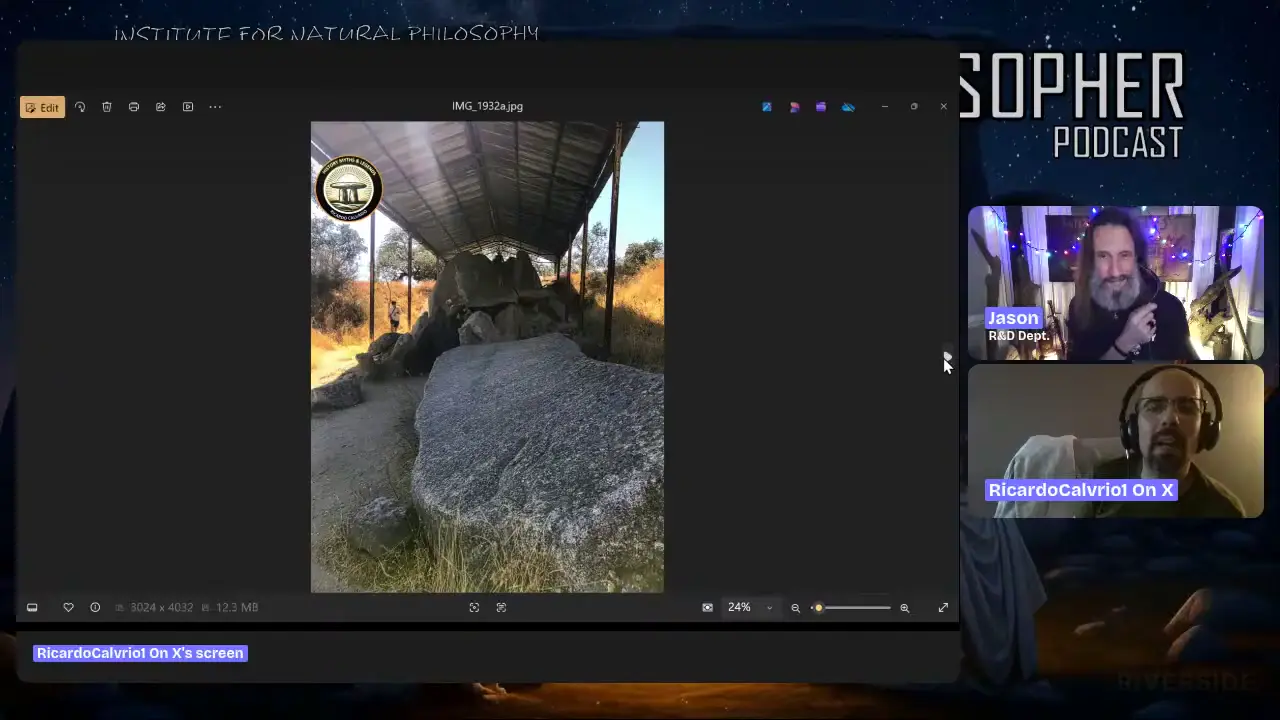
The Anta Grande do Zambujeiro, about 10 km west of Évora, is a Neolithic dolmen whose burial chamber was later adapted as a small Christian chapel. Often described as the largest burial chamber in the Iberian Peninsula, it has enormous supporting stones and a massive capstone; part of the roof collapsed in the 1755 Lisbon earthquake and was not replaced. It is generally dated to the fourth or third millennium BCE, about 5,000–6,000 years ago, and was fenced off when filmed. It is a different site from the Cromlech of Almendres, a separate Neolithic complex of seven dolmens.
Évora's Anta Grande do Zambujeiro dolmen was later used as a chapel
Site mentioned
📍 Dolmen Nela🌍 Show on the globe
Key facts
- The chapel-converted monument is the Anta Grande do Zambujeiro, about 10 km west of Évora, not the Cromlech of Almendres.
- The Anta Grande do Zambujeiro is a Neolithic dolmen, conventionally dated to the fourth or third millennium BCE—roughly 5,000–6,000 years ago—and is described as the largest burial chamber in the Iberian Peninsula.
- Its burial chamber was adapted into a small Christian chapel. Part of its massive capstone or roof collapsed during the 1755 Lisbon earthquake and was not replaced.
- The monument was fenced off when the presenter filmed it; the 40-minute walk refers to the presenter's route.
- Calling the builders simply hunter-gatherers is not an established attribution; the monument belongs to Neolithic Iberia, whose monument builders are generally associated with farming and herding.
- The Cromlech of Almendres is a separate Neolithic complex of seven dolmens; only part of it survives in good condition.
- The claim that the Roman Temple of Diana stands over a much older structure is the presenter's interpretation, not an established conclusion.
- The nearby church's Latin inscriptions and emblem interpreted as Templar were described by the presenter; the claim that the emblem is unique is the presenter's claim.
Sources
A Chapel Made of... Human Bones?! - A Portuguese Affairaportugueseaffair.com
The Capela dos Ossos can be found next to the Church of St. Francis, in Évora and it's one of the most unusual places you'll visit in Portugal.
Bones and stones of Evora explain: you can't take it with youkyoungtravels.com
Dolmen: a burial chamber made of huge upright stones. Paleolithic: the oldest stone age, 1.4 million years ago to roughly 10,000 BCE, when ...
Capela dos Ossos - Wikipediaen.wikipedia.org
The Capela dos Ossos (English: Chapel of Bones) is one of the best-known monuments in Évora, Portugal. It is a small interior chapel located next to the ...
The mysteries of Portugal's 7,000-year-old 'Stonehenge' - BBCbbc.com
The Cromlech of the Almendres is a megalithic complex in Evora, Portugal, dating back 7,000 years ago. This makes the sacred stone sites ...
A Bone-Chilling Place? - by Carol A. Wilcox - Our Portugal Journeyourportugaljourney.com
Initiated by three Franciscan monks and built in the 17th century, the Capela dos Ossos de Évora (Chapel of Bones) is in the Alentejo region of ...
Anta Grande do Zambujeirogdh.org
Located in the Alentejo, 10 km west from Évora. It is considered the largest burial chamber (dolmen) in the Iberian Peninsula, and one of the largest in Europe.
Anta do Sobralen.wikipedia.org
The Anta do Sobral is a megalithic dolmen, or burial chamber, located in the parish of São João Baptista in the municipality of Castelo de Vide in the ...
Anta de Santa Luzia Dolmen, Évoramegalithic.co.uk
Anta de Santa Luzia is a dolmen or anta located near by the village of Rosário, in the municipality of Alandroal, in the Évora district. This ...
Was this story useful?
Keep exploring
Every site on this page sits on the globe, and the people who research them are on the Discord.
3D Globe · Sites by country · Story Archive · Research Library · Weekly Journal · Search
AI-generated text · images from the original sources · always verify with the sources.