

Week of October 12: 10,500-Year-Old Staked Auroch Skull at Duvensee, 6,000-Platform Upano Valley Network, and More
Archaeologists in Schleswig-Holstein recovered an approximately 10,500-year-old auroch skull impaled on a wooden stake at Duvensee moor, just metres from Germany's oldest known grave, with excavation leader Harald Lüchmann linking the two to a protective burial ritual. Airborne LiDAR in Ecuador's Upano Valley revealed a network of more than 6,000 earthen platforms across roughly 300 square kilometres, dated to about 2,500 years ago and described as the largest known Amazonian urban network at publication. Other coverage examined Mesolithic worked timbers recovered from Lake Arendsee at roughly 20 m depth, the Bent Pyramid's chimney masonry shown to be contemporary with its lower chamber, and LiDAR surveys identifying more than 60,000 Maya structures in Guatemala's Petén region.
Archaeologists in Schleswig-Holstein recovered an approximately 10,500-year-old auroch skull impaled on a wooden stake at Duvensee moor, just metres from Germany’s oldest known grave, with excavation leader Harald Lüchmann linking the two to a protective burial ritual. Airborne LiDAR in Ecuador’s Upano Valley revealed a network of more than 6,000 earthen platforms across roughly 300 square kilometres, dated to about 2,500 years ago and described as the largest known Amazonian urban network at publication. Other coverage examined Mesolithic worked timbers recovered from Lake Arendsee at roughly 20 m depth, the Bent Pyramid’s chimney masonry shown to be contemporary with its lower chamber, and LiDAR surveys identifying more than 60,000 Maya structures in Guatemala’s Petén region.
New Excavations & Fieldwork
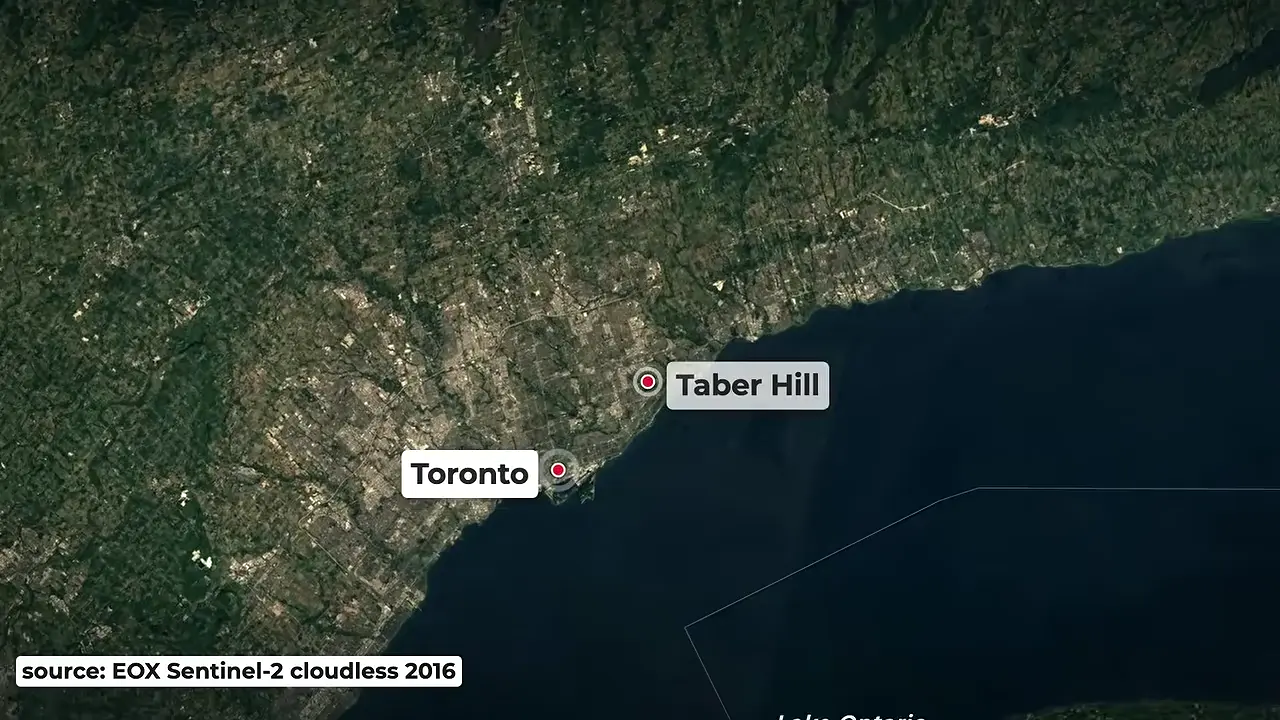
Taber Hill, also spelled Tabor Hill, is a Toronto archaeological burial mound or ossuary in Taber Hill Park at 525 Bellamy Road North, described as approximately 70 feet tall [V1]. The supplied chronology places it in the 14th century, or 1250–1400 CE. A broader range is attributed to salvage archaeologist Walter Kenyon, although the basis for the assignment is not shown. The often-repeated figure of more than 500 burials should therefore be treated as an estimate attributed to Kenyon, not as a documented excavation tally, skeletal catalogue, or minimum-number-of-individuals count. Nor is the presenter’s description of the mound as the third-tallest pyramid north of Mexico established by the supplied evidence: no comparative survey or standardized measurements are provided.
Chemical analysis reportedly found that stone from Cansot is compositionally similar to the 24-ton El Silencio sphere; located only about 1 km away, the quarry and workshop form a plausible local source [V2]. However, the available record presents no quantitative analytical results, and compositional similarity does not uniquely prove that the sphere was quarried at Cansot; other sources remain possible.
Cansot has been identified as a probable pre-Columbian quarry and sphere workshop containing an intact sphere alongside numerous large gabbro blocks. Its proximity to El Silencio also weakens any generic explanation involving a 50-mile journey through jungle and rivers, although the video acknowledges that more distant spheres may have been transported over longer distances [V2]. Broader museum context notes that Diquís spheres were commonly fashioned from igneous rocks widespread in the region, but it does not identify the specific lithology of the El Silencio sphere or independently corroborate the Cansot chemical comparison [1]. The evidence therefore points strongly toward a local connection while stopping short of establishing Cansot as the sphere’s definitive origin.
Artifact Discoveries
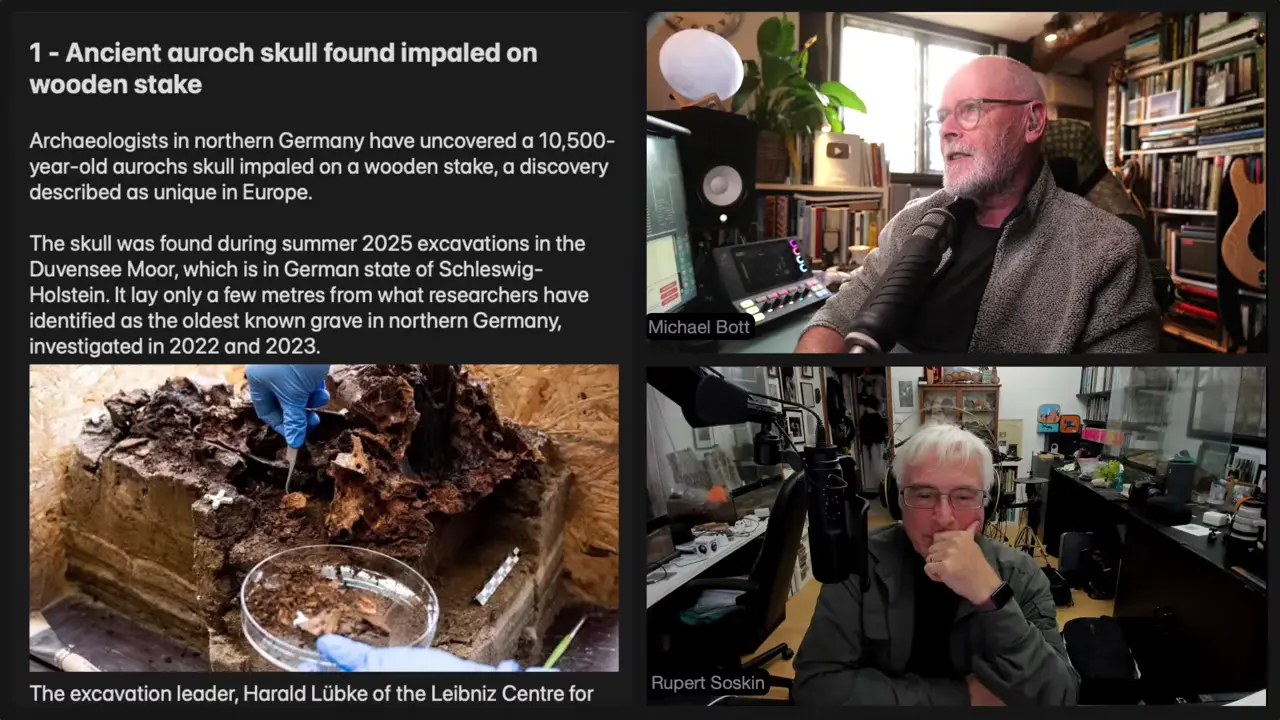
During the summer of 2025, archaeologists in Schleswig-Holstein, northern Germany, recovered an approximately 10,500-year-old auroch, or wild-cattle, skull impaled on a wooden stake at Duvensee moor [V3]. The remarkable discovery was made only a few metres from a grave investigated in 2022 and 2023, which researchers identify as the oldest known grave in northern Germany; one report characterizes it as Germany’s oldest cremation grave. Excavation leader Harald Lüchmann believes that the two discoveries were directly connected and that the staked skull formed part of a burial ritual intended to protect the deceased. This remains an attributed interpretation rather than a demonstrated conclusion in the available reports.
Remote Sensing & Technology
The 2024 study places the beginnings of the Upano Valley’s urban network at approximately 2,500 years ago and characterizes it as the largest known Amazonian network of erected and excavated features at the time of publication. Airborne LiDAR revealed a dense, interconnected urban or settlement landscape concealed beneath the forest [4] [3]. Published accounts put the scale of the network at more than 6,000 earthen platforms linked by roads and settlements across approximately 300 square kilometres [V4].
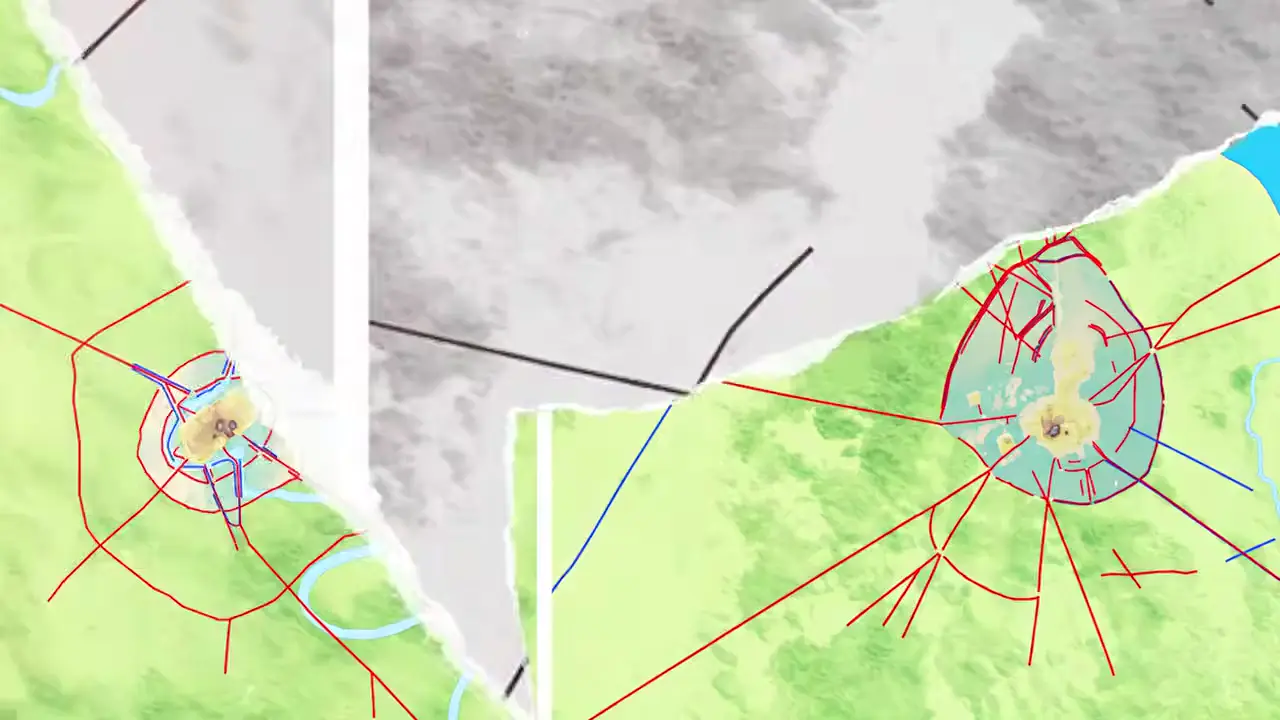
The mapped landscape had a distinctly organized form: rectangular platform complexes stood beside broad excavated streets at Kunguints, while other sections featured platforms around open plazas and straight roads, some reportedly reaching 13 metres in width. According to the CNRS, the settlements are linear [2]. Stéphane Rostain combined remote mapping with years of direct excavation of platforms and recovery of pottery and other traces of domestic life. Residential and circulation infrastructure were integrated with reported productive features, including farmland and drainage works associated with cultivation. However, the Upano pattern should not be generalized across the entire Amazon basin without further evidence, because Amazonian communities constructed different landscapes. The paper’s framing of approximately 2,000 years of “garden urbanism” also leaves unresolved whether this represented one continuous phase and how it relates to the network’s earlier beginnings.
Aerial LiDAR surveys in Guatemala’s Petén region were reported to identify more than 60,000 Maya structures, but that headline total belongs neither to Calakmul nor to its surrounding area in Mexico [6]. The aggregate combines heterogeneous settlement and infrastructure features—houses, palaces, pyramids or ceremonial buildings, fortifications, causeways, farms, and terraced fields—not 60,000 houses, standing monuments, or urban centers; one reported breakdown included 73 stone buildings and 4,775 mountain terraced fields. LiDAR imagery removes the tree-canopy signal, making vegetation-obscured remains visible. National Geographic described the detections as previously unknown remains forming a vast network of cities, fortifications, and farms, although the available evidence does not establish that all features were contemporaneous or politically unified.
Calakmul must be considered separately: a 2016 LiDAR survey covering 240 km² in Mexico’s Calakmul Biosphere Reserve revealed numerous residential clusters and widespread water-management and agricultural modifications around Chactún, Tamchén, and Lagunitas; field surveys and test excavations in 2017–2018 supplied additional archaeological information [5]. The presentation’s extrapolation from more than 60,000 structures to hundreds of thousands across a wider area is the presenter’s argument, not a measured result of the Petén survey [V5].
Underwater Archaeology
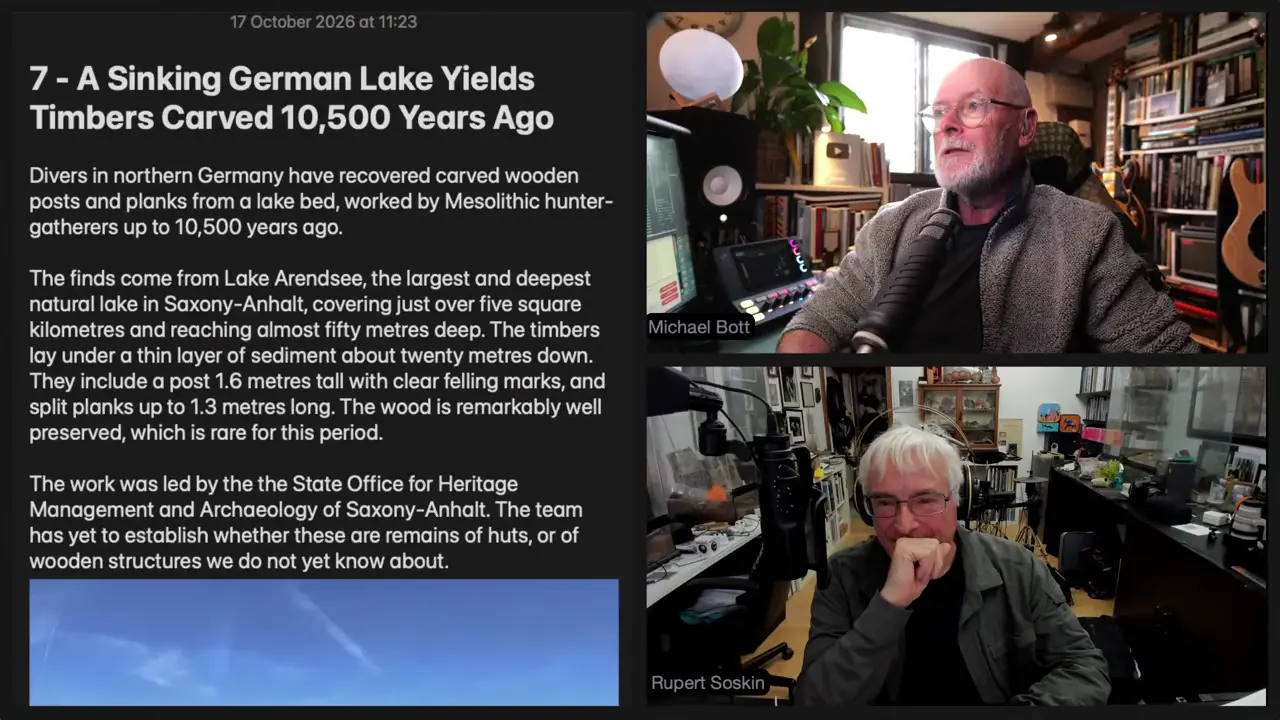
At Lake Arendsee, divers recovered a Mesolithic assemblage of posts and split planks or boards that the supplied reports date to about 10,500 years ago—more than 10,000 years old. A representative post measures about 1.60 m in height or length and bears traces of felling and working, while the split pieces reach approximately 1.30 m. The wood was reported at roughly 20 m below the lake surface, but the depth datum remains unclear, so it should not be described as lying 20 m beneath the lake bed. One account gives the broad calendar framing as around 8500 BCE—an approximate rather than calibrated determination; Lake Arendsee covers about 5.4 km² and reaches approximately 25.6 m at its deepest, rather than nearly 50 m [V6].
Architecture & Monuments
The clearest evidence is architectural rather than chronological: masonry courses continue from the antechamber through the vaulted lower chamber and into the chimney. This supports treating the main chimney masonry as part of the lower structure’s original construction phase, although it establishes only relative contemporaneity, not an independently determined date [V8]. The chimney is a deep axial shaft beginning at ground level and descending more than 15 metres; a short corridor links it to the lower chamber, with a corbelled covering over the corridor and upper shaft. When the lower chamber roof was completed, the chamber stood slightly above ground level, whereas the chimney ended at ground level [V9]. The upper connecting tunnel was cut only after the core masonry had reached at least the horizontal-passage level, so it cannot be treated as evidence that the chimney and tunnel were excavated together as a single original passage.
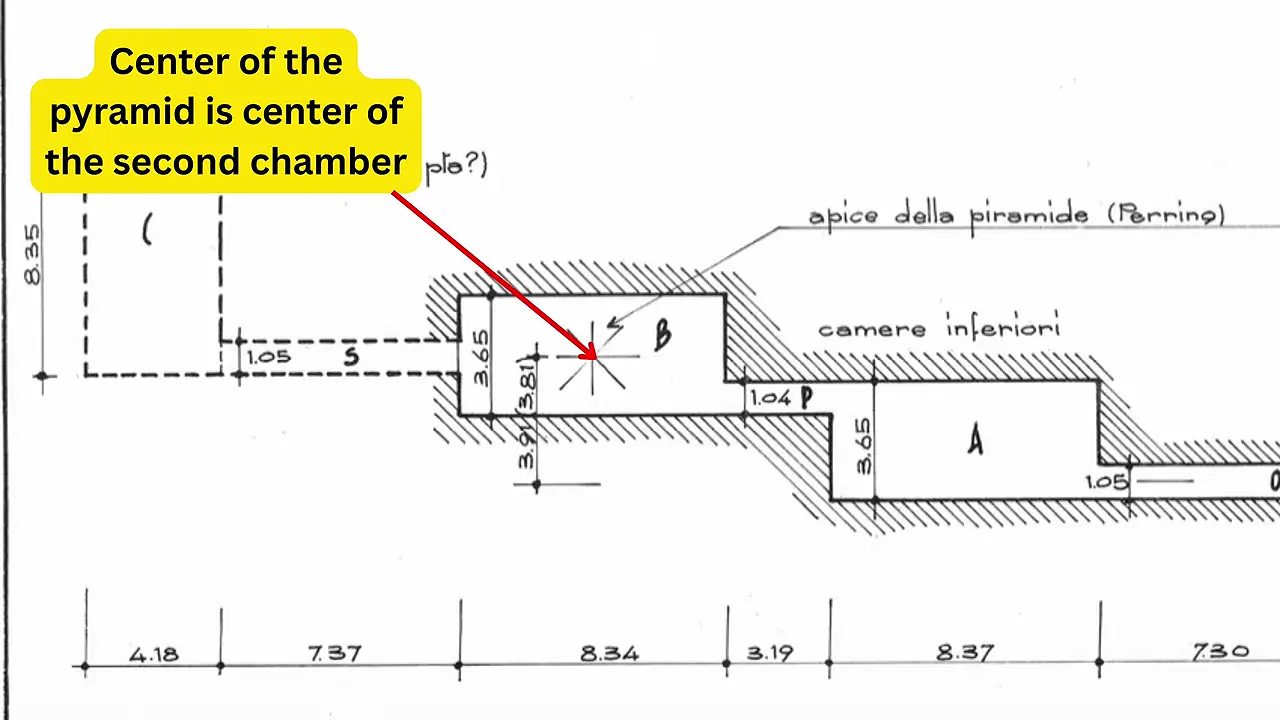
The chimney’s purpose remains uncertain. Proposed explanations include access for workers or construction materials and a temporary work platform or debris shield, but neither has been demonstrated [V7]. Likewise, sockets in the lower chamber’s corbels are interpreted as anchors for temporary timber braces, although their complete form and structural sequence remain inferred. One interpretive account rejects an entrance to an undiscovered upper system, an abandoned planned link later replaced by the tunnel, and a centering device; this rejection is not independently demonstrated.
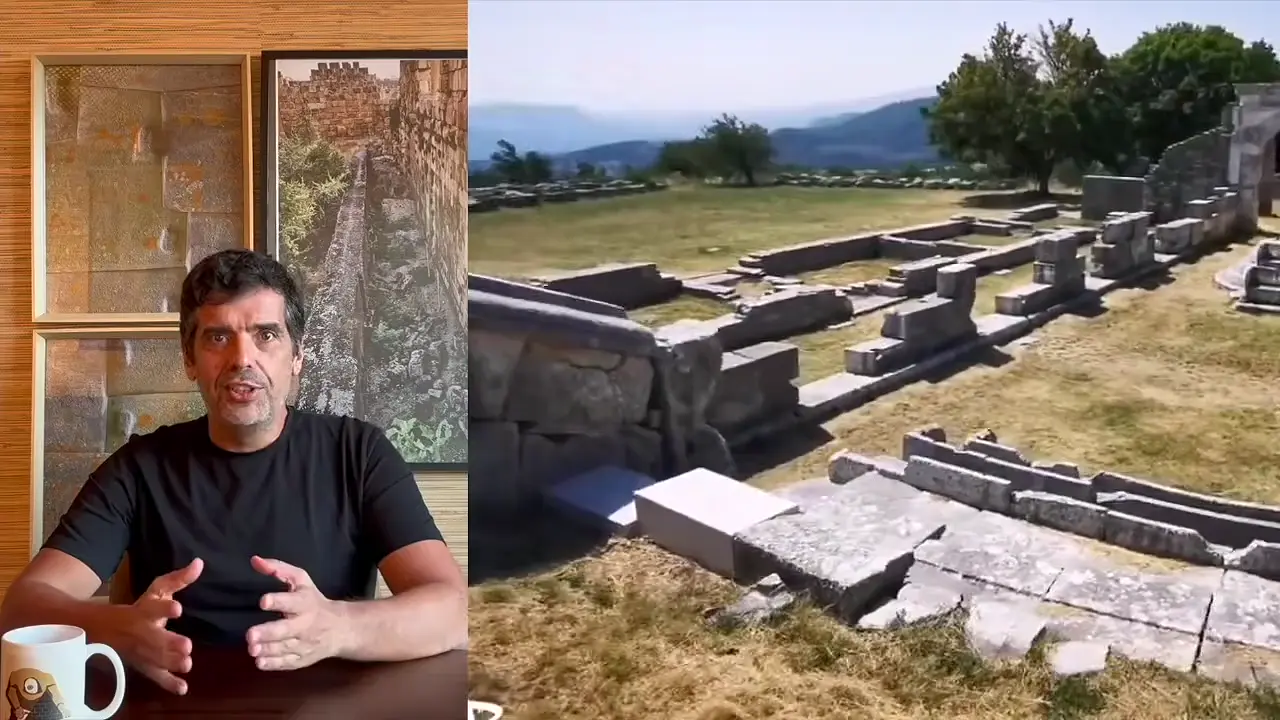
Pietrabbondante is repeatedly identified as a Samnite sanctuary [7], but its Samnite phase belongs to a longer, multi-period history [V11]. Monumental remains include a three-cella temple and a performance building described as a theater in some accounts and an amphitheatre in others. One architectural synthesis assigns most of the principal construction to the late second and early first centuries BCE, with earlier fabric reused and polygonal masonry assigned to an earlier structural layer; this chronology lacks independent corroboration in the supplied material. Although one video calls Pietrabbondante the Samnites’ most important religious site, the evidence offers no comparative inventory of sanctuaries, dedications, cult records, or attendance capable of supporting that superlative [V10].

In Brief
Factum Arte’s reconstructed 3D and colour record of KV62’s north wall is presented as revealing an earlier painted phase: the scan account reports royal cartouches beneath repainted names, which Nicholas Reeves reads as Tutankhaten, Tutankhamun’s pre-accession name. He further proposes that the surviving scene of Ay burying Tutankhamun overlays an earlier scene of Tutankhamun burying an unnamed predecessor [V13]. However, the supplied material does not independently verify the concealed readings, paint stratigraphy, or proposed superposition, and it provides neither paleographic analysis nor the figures, inscriptions, and spatial relationships needed to test the reconstruction. Comparisons of 1931/32 and 1936 photographs do show later reworking of the north-wall figure’s knees, kilt pleats, and hand, plus false moulding over water damage; this is separate from, and does not establish, ancient overpainting.
Architecture provides a second, less direct line of enquiry. Reeves interprets shallow scan anomalies—four on the west wall and six on the north wall—as remnants of altered access, including two doorway sides and four features assigned to an earlier entrance-corridor phase [V12]. These are surface traces rather than exposed doorways. He argues that two sealed doorways remained undisturbed for roughly 3,100 years and that the right-turn layout resembles queens’ tombs [V14], but the excerpts do not supply the dating method, construction phasing, or full architectural comparison. Factum Arte’s documentation supports the scan record and wall-specific inspection, yet it does not independently demonstrate that imagery beneath overpaint was directly recovered.
The central claim is provisional: all three specialists relay the same secondary-source attribution, ultimately drawn from one video summary. Hallowell reconstructed bear veneration as characteristic of an ancient Old World boreal culture associated with reindeer hunting; this is a diffusionist reconstruction, not independently established archaeological fact [V15]. On this account, bear rites were not animal worship in a narrow sense, but attempts to propitiate a supernatural controller and release more bears. Hallowell treated recurring ceremonial elements—not overlap with bear territory—as the significant pattern, while Pueblo bear ceremonies in the North American Southwest did not fit it. He considered psychological and economic explanations inadequate because elaborate periodic Ainu festivals contrasted with simpler Chukchi ceremonies, yet peoples contiguous with the Ainu also held periodic festivals. Some Eurasian peoples associated with domesticated reindeer, he argued, venerated bears rather than reindeer, though they remain unnamed.
Historical Ainu evidence gives the contrast material form: a specially reared bear was reverently killed, had its flesh and blood consumed, and was then sent home as an honored house guest amid songs and celebrations lasting one or more days. Institutional accounts call the full historical festival discontinued, without proving that all later or modified bear-sending practices ended. Munro’s 1930s recordings preserve it as The Ainu Bear Ceremony (1931) [9]. A 2018 formulation interprets the rite as hunting a “deified bear,” but duplicate journal and repository records do not independently corroborate that interpretation [8].
The strongest defensible conclusion is that Wonderkrater provides geographically separate African corroboration of a Younger Dryas–associated platinum anomaly, but not a demonstrated independent replication at Wonderkrater itself. This locality is a high-resolution South African peatland, distinct from Wonderwerk Cave; calling it “Wonderwerk Crater” or describing its research as palaeoanthropological conflates the two sites [10] [V17]. The anomaly lies in peat assigned by the stated age model to about 12,800 cal BP, broadly 13,000 years ago, but this is model-dependent stratigraphic placement rather than direct dating demonstrating that the platinum layer and the climate boundary were synchronous. Its African location nevertheless makes it a separate occurrence from the eleven North American archaeological sequences reported in 2017 [12].
A later single-particle ICP-TOF-MS investigation found the anomaly at a depth of 357.5–362.5 cm, with nanoparticle numbers 4.6 times those of surrounding sediments, a lower average particle mass, and distinct platinum-group and lithophile populations. Crucially, the 4.6-fold figure concerns nanoparticle abundance, not bulk platinum, and this was a same-locality, within-sequence follow-up; the available record does not establish whether it used a new core or separate material, or whether independent collectors, laboratories, preparation procedures, and instruments were used [11]. Richards presented the initial observation and repeat sampling as independent support, but the supplied evidence lacks the sampling and blinding details needed to verify that independence, and no completed global double-blind test is reported [V16]. The geochemistry also permits enhanced terrestrial dust alongside a heterogeneous extraterrestrial component, so it does not uniquely establish impact or airburst causation.
Phlegon’s second-century CE collection preserves the episode as an embedded letter: Haparcus writes to Phaedimus, asking whether it should be brought before a king. Phlegon compiled or preserved the account rather than demonstrating authorship, and Haparcus’s official status is unspecified. In the Phlegon-derived version, Philinnion is the unwed daughter of Deostratos and Cito, dead before marriage—not the wife of a general serving Alexander or a bride who died six months into marriage. Machates, a young man connected to her family, encounters her at night for intimate or sexual contact. The detailed summary says she gives him her ring and a piece of burial cloth, but separately mentions a ring he gave her in connection with a cup; the two references cannot be securely related. Her parents see her, and she dies again; her body then vanishes from the tomb and is found in Machates’s room [V18].

An alternate account attributed to Proclus makes her a new bride who may have died before intercourse, so the unwed-maiden biography is specific to the Phlegon-derived version, not all ancient tellings. “Premature death” is also disputed: Theoi uses that characterization for the unwed Philinnion, while Julia Doroszewska argues that dying a virgin would not count as premature in the terminology discussed [13]. Finally, royal referral does not establish Haparcus as a local official, and the letter’s authenticity remains unproven; calling it an embellishment-free administrative record is a modern interpretation, not an established conclusion.
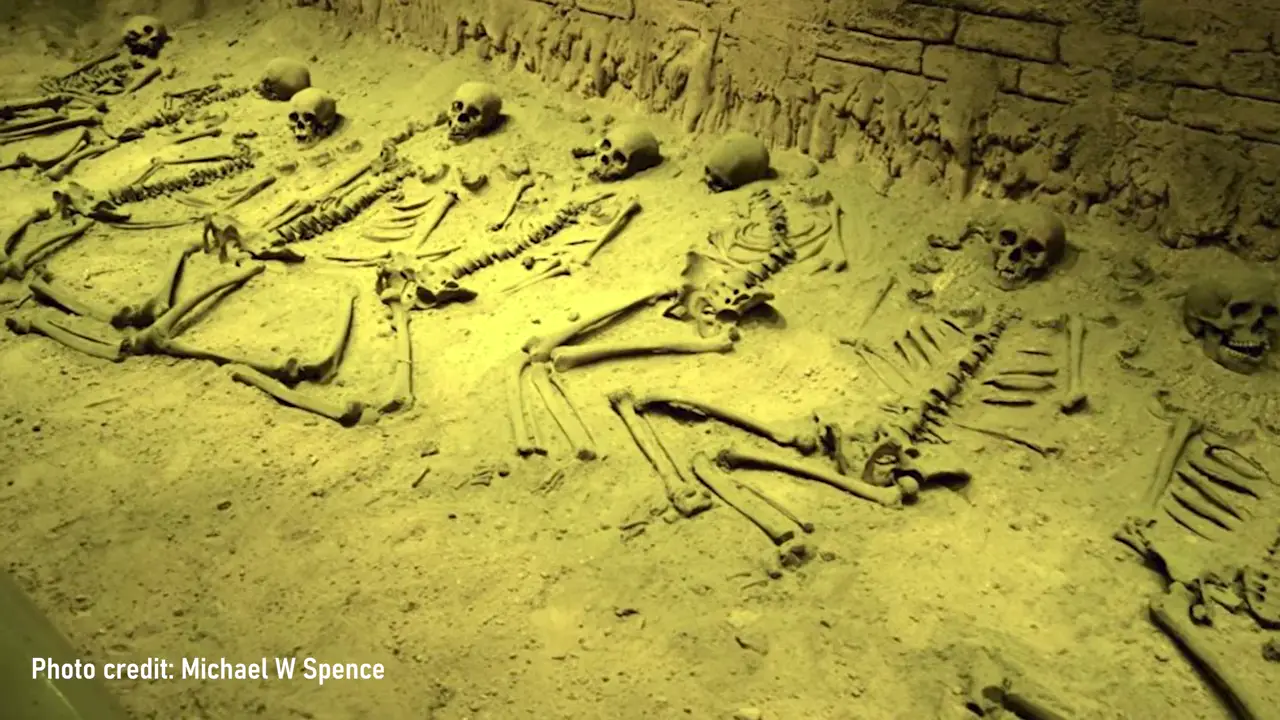
The Temple of the Feathered Serpent’s dedicatory program at Teotihuacan may have included an estimated 200–260 sacrificed individuals. Only 137 are archaeologically documented, and the deposits were made before construction of the pyramid began; the larger figure remains an estimate rather than a documentation count [V19]. Oxygen-isotope analysis suggests that the victims who were analyzed came from several distinct regions of Mesoamerica, although the available evidence does not establish that all 137 were sampled. Most had apparently spent substantial time in Teotihuacan, as indicated by bone composition interpreted as reflecting a local diet. This combination of varied origins and prior residence was proposed as a possible sign that the victims were high-status captives or foreign dignitaries rather than ordinary local residents, but neither captive status, social rank, nor diplomatic identity was directly demonstrated.
Sources
- A Stone Sphere from Costa Rica
- Ancient cities in the Amazon
- Archaeologists Discover Ancient Cities Hidden in the …
- Why the ancient Amazonian cities recently discovered in …
- Archaeological landscape, settlement dynamics, and sociopolitical organization in the Chactún area of the central Maya Lowlands
- Archaeologists use lidar technology to map wealth and …
- Pietrabbondante: the Samnite period is only part of the full …
- The Ainu Bear Ceremony and the Logic behind Hunting …
- The Ainu Bear Ceremony (1931) - Dr Neil Gordon Munro
- (PDF) The Younger Dryas interval at Wonderkrater (South …
- Extraterrestrial Nanoparticle Signatures at the Younger Dryas Boundary (~12,800 years ago) from Wonderkrater, South Africa
- Widespread platinum anomaly documented at the Younger Dryas onset in North American sedimentary sequences
- a Case Study in Phlegon of Tralles s Mirabilia Author: Julia …
Videos
V1. Archaeologist Ed Barnhart — “Pyramids in Canada” V2. Curious Being — “I Investigated the Costa Rica Stone Spheres. The Answer Surprised Me” V3. The Prehistory Guys — “LIVE ~ PREHISTORIC ARCHAEOLOGY NEWS From Around the World | 17/10/2026 02:00PM BST” V4. Michael Button — “Civilization Is Older Than We Were Told” V5. Luke Caverns — “Exploring the Collapse of Ancient Mexico” V6. The Prehistory Guys — “LIVE ~ PREHISTORIC ARCHAEOLOGY NEWS From Around the World | 17/10/2026 02:00PM BST” V7. IntoTheMap — “A New Solution to the Bent Pyramid’s Chimney” V8. IntoTheMap — “A New Solution to the Bent Pyramid’s Chimney” V9. IntoTheMap — “A New Solution to the Bent Pyramid’s Chimney” V10. One-eyed giant building walls — “Is History being Staged? The 2,500-Year-Old Paradox 🎭👁️” V11. One-eyed giant building walls — “Is History being Staged? The 2,500-Year-Old Paradox 🎭👁️” V12. Inside Archaeology — “Is Queen Nefertiti Hiding Inside King Tut’s Tomb? Archaeologist Explains The New Evidence” V13. Inside Archaeology — “Is Queen Nefertiti Hiding Inside King Tut’s Tomb? Archaeologist Explains The New Evidence” V14. Inside Archaeology — “Is Queen Nefertiti Hiding Inside King Tut’s Tomb? Archaeologist Explains The New Evidence” V15. Timeless with Fred Snyder — “The Bear Cult Mystery (Europe, Asia, North America)” V16. The Cosmic Summit — “The Younger Dryas Impact Is About to Face a Global Double-Blind Test” V17. The Cosmic Summit — “The Younger Dryas Impact Is About to Face a Global Double-Blind Test” V18. The Archivist’s Journal — “ANCIENTS Were Recording GHOST Encounters And They Had No Reason To Lie” V19. World of Antiquity — “How We Know Who Built Teotihuacan”
Quality Audit — 9/10
Quality Dimensions
✓ spelling✓ week date✓ proper nouns✓ source quality✓ citation format✓ section balance✓ summary accuracy✗ citation coverage✓ academic citations✓ screenshot placementResearch Clusters
Fixes Applied
Citation: correctedProper noun: Chactán → ChactúnCitation: correctedProper noun: Lagunita → LagunitasCitation: correctedCitation: correctedCitation: correctedKeep exploring
Every site on this page sits on the globe, and the people who research them are on the Discord.
3D Globe · Sites by country · Story Archive · Research Library · Weekly Journal · Search