

Week of July 6: Olmec Heads Were Royal Portraits, Khmer Capital Rediscovered, and More
New analysis of the Olmec colossal heads—ranging from 1.47 to 3.4 meters tall and weighing up to 28 metric tons—reveals distinctive elite markers like artificial cranial deformation and strabismus, reinforcing the case that each monument commemorated a specific individual king rather than a standardized deity. In Cambodia, Phnom Kulen in Siem Reap Province has been identified as Mahendraparvata, the first capital of the Khmer Empire established by King Jayavarman II in 802 CE, featuring an elaborate grid-pattern urban plan with planned temple complexes and water reservoirs. Meanwhile, an oral account documents Indigenous rock arrangements piled on a water-girdled island in the Cusa (Coosa) River, situated near a massive impact crater and accessible only by swimming or shimmying between rocks.
New analysis of the Olmec colossal heads—ranging from 1.47 to 3.4 meters tall and weighing up to 28 metric tons—reveals distinctive elite markers like artificial cranial deformation and strabismus, reinforcing the case that each monument commemorated a specific individual king rather than a standardized deity. In Cambodia, Phnom Kulen in Siem Reap Province has been identified as Mahendraparvata, the first capital of the Khmer Empire established by King Jayavarman II in 802 CE, featuring an elaborate grid-pattern urban plan with planned temple complexes and water reservoirs. Meanwhile, an oral account documents Indigenous rock arrangements piled on a water-girdled island in the Cusa (Coosa) River, situated near a massive impact crater and accessible only by swimming or shimmying between rocks.
In Brief
Distinctive elite markers — including artificial cranial deformation and strabismus — appear on different heads, reinforcing the case that each monument commemorated a specific person rather than a standardized deity type [V1] [1].
Moving these multi-ton blocks required significant labor organization, with scholars proposing two models: either the Olmec dispatched dedicated expeditions to collect the stone, or they paid native peoples to quarry, cut, and transport it [V1]. The heads range from about 1.47 m to 3.4 m tall and weigh between roughly 6 and 28 metric tons, suggesting varied commissions over time.
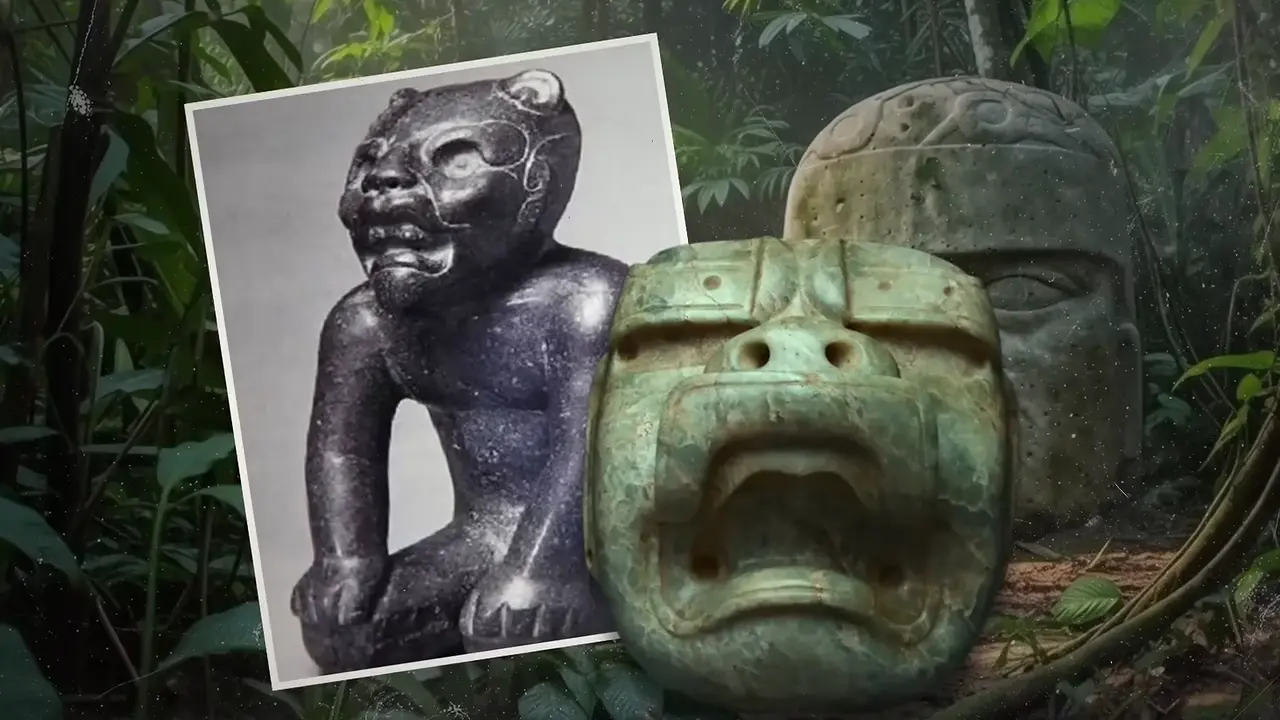
One Spanish-language source claims the colossal heads were “created from thrones,” suggesting reworking of earlier throne monuments, though this interpretation is not corroborated by the English-language sources [1].

An oral account describes visiting an island in the Cusa (Coosa) River where Indigenous people arranged and piled rocks—a site situated near the crater and accessible only by swimming or shimmying between rocks when water levels drop [V2]. The site’s distinctive combination of features—a water-girdled island adjacent to a massive impact structure—makes it a noteworthy locale in the regional archaeological record.

In 802 CE, King Jayavarman II established Mahendraparvata atop Phnom Kulen as the first capital of the Khmer Empire, proclaiming himself chakravartin, or “universal ruler” [2]. “Mahendra” is an epithet of the Vedic deity Indra, giving the mountain a title variously rendered as “Mountain of the Gods” or “great mountain of Lord Indra” [V3]. Situated about 30 km northeast of the Angkor complex in Siem Reap Province, the site has been on Cambodia’s national registry since 1992 [3]. However, no inscriptions authored by Jayavarman II himself survive—knowledge of his reign comes from later royal inscriptions—and the traditional “802 CE” founding date carries interpretive uncertainty, with some scholars favoring a c. 802–850 CE range.
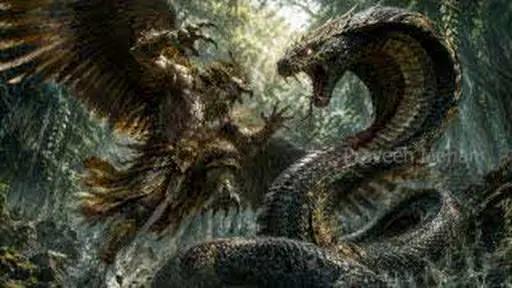
The Phnom Kulen plateau featured an elaborate grid-pattern urban plan with planned temple complexes, extensive water reservoirs, and deliberate landscape modification. Today, Phnom Kulen—literally “Lychee Mountain” in modern Khmer—remains Cambodia’s most sacred mountain and an active weekend and festival pilgrimage site. Folklore also describes a “cosmic egg” said to enclose a Buddha flanked by heavenly maidens—where visitors reportedly feel a perceptible temperature drop—along with curiously adjacent carvings of the eternally warring Garuda and Naga, a tree said to release water, and the site’s enduring reputation among locals as Indra’s “heaven on earth” [V3].
Sources
- Mentes colosales: el universo olmeca a través de su escultura
- A study on the possible construction order of the temples in … - Nature
- Phnom Kulen: Archeological Site/Ancient Site of Mahendraparvata
Videos
V1. Luke Caverns — “The Problem with the Olmec Heads” V2. Institute for Natural Philosophy — “The Shaman and The Philosopher. Ep.26” V3. PraveenMohan — “I Bet You Have Never Seen This Temple | ‘Heaven On Earth’ Found?”
Quality Audit — 9/10
Quality Dimensions
✓ spelling✓ week date✓ proper nouns✓ source quality✓ citation format✗ section balance✓ summary accuracy✓ citation coverage✓ academic citations✓ screenshot placementResearch Clusters
Fixes Applied
Balance: correctedKeep exploring
Every site on this page sits on the globe, and the people who research them are on the Discord.
3D Globe · Sites by country · Story Archive · Research Library · Weekly Journal · Search